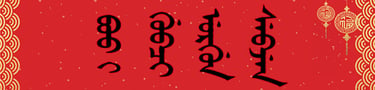
Your blog postManchu Calligraphy vs. Ordinary Manchu Writing: Key Differences
How is Manchu calligraphy different from ordinary writing? Explore letter structure, brush techniques, artistic composition, historical styles, and linguistic accuracy.
MING YE
11/3/202610 min read
What Is the Difference Between Manchu Calligraphy and Ordinary Manchu Writing?
Understanding Handwriting, Artistic Expression, Historical Script Traditions, and the Aesthetics of Manchu Letters
By MING YE
Manchu is a distinctive writing system traditionally written vertically, with connected letters whose shapes vary according to their positions within words.
Throughout its history, Manchu writing served many practical purposes. It was used to record imperial orders, administrative documents, historical accounts, personal correspondence, dictionaries, and other texts.
At the same time, the Manchu script also developed traditions of formal penmanship and artistic expression.
This raises an important question: What is the difference between ordinary Manchu writing and Manchu calligraphy?
The fundamental distinction lies in their primary purposes.
Ordinary Manchu writing is primarily concerned with communicating language accurately and legibly. Manchu calligraphy uses the same writing system but places additional emphasis on artistic form, rhythm, composition, and visual expression.
Both depend on an understanding of the script.
However, correct writing does not automatically constitute accomplished calligraphy, just as beautiful letterforms do not excuse incorrect spelling.
The distinction is not absolute. A carefully written historical manuscript may possess considerable aesthetic value, while a calligraphic work must still respect the structural principles that make Manchu writing meaningful.
Understanding the relationship between these two practices helps explain Manchu calligraphy as both a linguistic tradition and an independent form of visual art.
1. What Is Ordinary Manchu Writing?
Ordinary Manchu writing refers to the use of the Manchu script for recording words, sentences, and information.
Its principal purpose is communication.
A person writing a letter, copying a historical document, recording vocabulary, or completing a language exercise is using Manchu writing in its practical function.
Successful ordinary writing requires several abilities.
The writer must recognize the letters of the Manchu alphabet and understand how they connect.
The writer must also distinguish the positional forms of letters.
In traditional Manchu writing, letters may appear differently at the beginning, middle, or end of a word.
The writer must follow spelling conventions and represent the intended words correctly.
Legibility is particularly important.
If letters are incorrectly formed or essential distinctions are omitted, readers may misunderstand the text.
However, ordinary handwriting does not necessarily require elaborate artistic composition.
A handwritten note may be relatively simple or informal while remaining perfectly correct.
Likewise, a printed Manchu text can communicate language without possessing the characteristics of a handwritten calligraphic artwork.
Ordinary writing can be neat, elegant, and visually pleasing.
Nevertheless, its success is generally evaluated first by whether the text is accurate and readable.
The primary standard of ordinary Manchu writing is linguistic correctness and effective communication.
2. What Makes Manchu Calligraphy Different?
Manchu calligraphy begins with the same script but introduces an additional artistic purpose.
The calligrapher is concerned not only with what the words mean but also with how they appear.
Letter proportions, stroke movement, spacing, visual balance, and overall composition become important elements of the work.
The writer may carefully control the relationship between thick and thin strokes.
The rhythm of connected letters may be emphasized.
The spacing between words and vertical columns may be adjusted to create a balanced composition.
The physical qualities of the writing instrument can also contribute to the finished appearance.
A brush, for example, allows variations in pressure, stroke width, and ink distribution.
These possibilities can produce effects that are less pronounced when writing with a rigid pen.
However, Manchu calligraphy should not be defined solely by the use of a brush.
Different instruments can produce calligraphic results when they are used with deliberate attention to form and composition.
The essential distinction is artistic intention and execution.
A calligraphic work is designed to be experienced visually as well as read linguistically.
Its aesthetic qualities are not merely accidental consequences of handwriting.
Manchu calligraphy transforms the act of writing into a deliberate artistic practice while retaining a relationship with the written language.
3. How Do Letter Structure and Proportion Affect Manchu Calligraphy?
The structure of the Manchu script creates particular artistic opportunities and constraints.
Unlike Chinese characters, which are commonly organized within approximately square spatial units, traditional Manchu writing develops along a vertical direction.
Letters connect to form words, creating continuous visual sequences.
This vertical organization is central to the script's appearance.
The calligrapher must consider the relationship between individual letters and the entire word.
A letter cannot always be designed independently of its neighbors.
Its shape and position depend partly on how it connects to the surrounding letters.
This creates an important difference between Manchu calligraphy and decorative lettering based on isolated characters.
The visual rhythm of a Manchu word emerges through the connected sequence of its components.
Several structural considerations are especially important:
Letter proportions: The relative height, width, and shape of letter components influence the appearance of the word.
Connections: Transitions between letters must remain structurally appropriate while contributing to visual continuity.
Stroke variation: Differences in thickness, pressure, and direction can create rhythm and emphasis.
Word spacing: The separation between words helps establish readability and visual order.
Column relationships: The arrangement of vertical lines affects the balance of the entire composition.
These features provide opportunities for artistic interpretation.
However, artistic freedom has limits.
Excessive distortion may make letters difficult to identify or create confusion between different written forms.
A visually dramatic arrangement is not necessarily good Manchu calligraphy if it compromises the underlying script.
The artistic challenge is to achieve expressive variation without destroying the structural identity of the letters.
4. Is Beautiful Manchu Handwriting Automatically Calligraphy?
Not necessarily.
Beautiful handwriting and calligraphy overlap, but they are not identical concepts.
A person may write Manchu very neatly, with consistent letterforms and regular spacing.
Such writing demonstrates skill and discipline.
It may also possess considerable aesthetic appeal.
However, accomplished calligraphy usually involves a more deliberate exploration of artistic qualities.
These may include expressive stroke movement, variations in rhythm, compositional balance, and the relationship between writing and the surrounding space.
The distinction can be compared with other writing traditions.
A neatly handwritten English letter is not automatically equivalent to an accomplished work of Western calligraphy.
Similarly, accurately copying Chinese characters does not necessarily demonstrate mastery of Chinese calligraphic expression.
The same principle applies to Manchu.
A beginner may learn to reproduce standard letterforms accurately.
This is an important foundation.
A more advanced practitioner begins to consider how the forms interact within a larger composition.
The transition from handwriting to calligraphy is therefore gradual rather than absolute.
Some historical manuscripts demonstrate a high level of formal penmanship that may reasonably be appreciated as calligraphic work.
Others were produced primarily for administrative efficiency.
The difference cannot always be determined solely by whether the writing is attractive.
Purpose, technique, historical context, and artistic execution all matter.
Good handwriting emphasizes consistency and clarity; calligraphy adds a sustained concern for expressive visual form.
5. What Role Do Writing Instruments Play?
Writing instruments influence the visual character of Manchu writing.
Historically, Manchu texts were produced using brushes and other writing materials appropriate to their period and purpose.
Modern learners may use fountain pens, dip pens, pencils, markers, or digital tools.
Each instrument offers different possibilities.
A brush allows the writer to vary stroke thickness through pressure, movement, and changes in contact with the writing surface.
It can also produce differences in ink density and stroke endings.
A rigid pen generally produces more consistent line widths, although some pens and nibs allow controlled variation.
A broad-edged writing instrument may create contrast through the angle of its writing edge.
Digital tools can reproduce or simulate some of these effects.
However, the instrument alone does not determine whether a work is calligraphy.
A brush-written text may be ordinary handwriting.
A carefully composed work made with a pen may be calligraphic.
The important factors are the writer's control of the instrument and the artistic decisions expressed through the resulting marks.
For beginners, learning the correct letter structure is more important than immediately purchasing specialized equipment.
Once the structural principles are understood, different instruments can be explored.
This approach helps prevent a common mistake: attempting to imitate dramatic brush effects before mastering the letters themselves.
Calligraphy depends on controlled technique and artistic judgment, not simply on the possession of a particular writing tool.
6. Did Manchu Calligraphy Develop During the Qing Dynasty?
Manchu calligraphic traditions are closely connected with the historical development of the script and its use during the Qing dynasty.
The Manchu script was created in 1599 through adaptation of traditional Mongolian writing.
The early script was subsequently reformed in 1632, when distinctions involving dots and circles were introduced.
As Manchu became an important language of government, its written forms were used in imperial documents, official records, inscriptions, and other contexts.
Formal writing practices developed within these institutions.
The Qing court placed considerable importance on Manchu literacy, particularly among banner populations and officials.
Manchu also appeared in imperial inscriptions and multilingual monuments.
The writing found in such materials can demonstrate careful attention to regularity, proportion, and visual presentation.
However, it is important not to assume that every official Manchu document was intended as a work of art.
Many documents were produced for administrative purposes.
Their principal function was to record information accurately.
At the same time, imperial inscriptions, carefully executed manuscripts, and ceremonial texts could possess strong aesthetic qualities.
The study of historical Manchu calligraphy therefore involves more than examining individual strokes.
It also requires understanding the institutional and cultural settings in which the writing was produced.
The historical development of Manchu calligraphy should be investigated through surviving manuscripts, inscriptions, and other material evidence rather than through unsupported claims about fixed artistic schools.
Qing-period writing traditions provide an important historical foundation for Manchu calligraphy, but administrative handwriting and artistic calligraphy should not be treated as identical.
7. What Is the Difference Between Traditional Manchu Calligraphy and Manchu Seal-Script Art?
Manchu calligraphy includes different approaches to letterform and composition.
One important distinction concerns writing that follows conventional script forms and artistic adaptations that employ more decorative or stylized structures.
Traditional Manchu writing generally preserves the recognizable connected forms of the script.
Its visual character is shaped by vertical organization, positional letterforms, and the conventions of historical handwriting.
Manchu seal-script art represents a different approach.
The term is often used for stylized Manchu lettering influenced by the formal, geometric, or ornamental qualities associated with seal-script aesthetics.
However, Manchu seal-script art should not be confused with Chinese seal script or treated as an entirely separate historical language.
Chinese seal script developed within the history of Chinese characters.
Manchu seal-script forms belong to a different writing system and require analysis according to Manchu letter structure.
Their artistic design may emphasize symmetry, geometric relationships, decorative organization, or distinctive transformations of conventional letterforms.
The degree of historical precedent and the particular structural principles vary among examples and artistic approaches.
Consequently, it is important to distinguish documented historical forms from modern creative interpretations.
A contemporary calligrapher may explore new visual possibilities while drawing inspiration from traditional Manchu script.
Such experimentation can be artistically meaningful.
However, a newly created style should not automatically be presented as an ancient convention without supporting historical evidence.
The fundamental requirement remains the same: the relationship between artistic design and linguistic structure should be clearly understood.
Traditional Manchu calligraphy and Manchu seal-script art may share the same linguistic foundation while pursuing different visual and compositional goals.
8. Can Someone Practice Manchu Calligraphy Without Speaking Manchu?
Yes, but there are important limitations.
A person can begin learning Manchu calligraphy without being able to speak the language fluently.
The first stage may involve recognizing the alphabet, understanding positional letterforms, and practicing basic connections.
Students can then learn to write simple words and short expressions.
This is comparable to studying calligraphy in other languages.
A learner may develop handwriting skills before acquiring advanced conversational proficiency.
However, there is a difference between copying a visual pattern and understanding the text being written.
A person who does not understand Manchu may reproduce a phrase incorrectly without recognizing the mistake.
Errors may involve missing letters, incorrect connections, unsuitable positional forms, or inaccurate spelling.
Such errors become especially problematic when the work is intended for public display, publication, or cultural education.
For this reason, calligraphy students should learn at least the basic principles of Manchu orthography.
Understanding the meanings of the words being written is also desirable.
More advanced linguistic knowledge becomes increasingly valuable when composing original texts rather than copying verified examples.
Fluency in spoken Manchu is not a prerequisite for every form of calligraphic practice.
Nevertheless, accurate literacy provides a stronger foundation for serious Manchu calligraphy than visual imitation alone.
The most productive approach is to develop artistic technique alongside knowledge of the writing system.
9. How Should Manchu Calligraphy Be Evaluated?
Evaluating Manchu calligraphy requires attention to both linguistic accuracy and artistic quality.
These dimensions are related, but they should not be confused.
A useful evaluation considers several factors.
First, linguistic accuracy. Are the words spelled correctly? Are the letters recognizable? Are the connections and positional forms appropriate?
Second, structural control. Does the writer understand the proportions and relationships of the letters? Are variations intentional rather than accidental?
Third, stroke technique. Does the work demonstrate control of movement, pressure, direction, and the chosen writing instrument?
Fourth, visual rhythm. Do the connected forms create a coherent sense of movement and continuity?
Fifth, composition. Are the vertical columns, word spacing, margins, and surrounding space arranged effectively?
Sixth, artistic expression. Does the work demonstrate a distinctive aesthetic intention while remaining connected to the writing system?
These criteria should be applied with sensitivity to the style and purpose of the work.
A formal historical transcription may emphasize regularity and restraint.
A contemporary artistic composition may explore more expressive variation.
Neither should be judged solely by whether it resembles the other.
It is also important to avoid equating complexity with artistic quality.
An elaborate composition is not necessarily superior to a simple one.
Similarly, unusually thick strokes or exaggerated decorative forms do not automatically demonstrate advanced technique.
The strongest calligraphic work generally reflects a coherent relationship between structure, execution, and expression.
Manchu calligraphy should be evaluated as both writing and art, with neither linguistic correctness nor visual quality ignored.
Conclusion: What Separates Manchu Calligraphy from Ordinary Writing?
The essential difference between Manchu calligraphy and ordinary Manchu writing is their primary purpose.
Ordinary Manchu writing is used to communicate language.
Its principal requirements are correct spelling, recognizable letterforms, and legibility.
Manchu calligraphy builds upon these foundations but introduces additional artistic considerations.
The calligrapher deliberately shapes strokes, proportions, connections, rhythm, and composition to create a visual work.
The two practices are closely related.
Accurate handwriting provides the structural foundation for calligraphy, while calligraphic study can deepen a writer's understanding of the script.
However, beautiful handwriting is not automatically accomplished calligraphy, and decorative lettering is not necessarily linguistically correct.
The historical traditions of Manchu writing also demonstrate that practical documents and artistic expression can overlap.
Carefully executed manuscripts, formal inscriptions, and contemporary calligraphic works may all possess aesthetic value, although their purposes differ.
Ordinary Manchu writing focuses on making language readable. Manchu calligraphy seeks to make that same language visually expressive without losing its structural integrity.
This distinction is especially important for modern learners and artists.
Manchu calligraphy is not simply the decoration of unfamiliar letters.
It is an artistic practice grounded in a historically developed writing system.
Understanding the language, respecting the structure of the script, and developing control of artistic technique allow calligraphy to become more than visual imitation.
They make it a meaningful expression of Manchu written culture.
— MING YE
References and Research Materials
Linguistic and Historical Studies
Gertraude Roth Li, Manchu: A Textbook for Reading Documents (2000).
Jerry Norman, A Comprehensive Manchu-English Dictionary (2013).
Liliya M. Gorelova, Manchu Grammar (2002).
Paul Georg von Möllendorff, A Manchu Grammar (1892).
Mark C. Elliott, The Manchu Way: The Eight Banners and Ethnic Identity in Late Imperial China (2001).
Pamela Kyle Crossley, A Translucent Mirror: History and Identity in Qing Imperial Ideology (1999).
Evelyn S. Rawski, The Last Emperors: A Social History of Qing Imperial Institutions (1998).
Primary Historical Sources
Manwen Laodang (满文老档, Old Manchu Archives).
Yuzhi Qingwen Jian (御制清文鉴, Imperially Commissioned Mirror of the Manchu Language).
Yuzhi Zengding Qingwen Jian (御制增订清文鉴, Imperially Commissioned Expanded and Revised Mirror of the Manchu Language).
Qing imperial inscriptions, plaques, and multilingual monuments preserved in historical collections.
Archival and Research Collections
First Historical Archives of China. Qing Manchu-language manuscripts and administrative documents.
National Palace Museum, Taipei. Qing imperial manuscripts, calligraphic materials, and historical inscriptions.
The Palace Museum, Beijing. Qing palace inscriptions, plaques, and material evidence of Manchu writing.
Unicode Consortium. The Unicode Standard, Mongolian script documentation relevant to Manchu letterforms and digital typography.