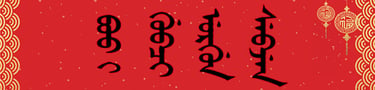
Why Manchu Script Requires Specialized Typesetting Technology
Discover why Manchu requires specialized typesetting, including Unicode encoding, contextual glyph shaping, vertical layout, and digital manuscript preservation.
MING YE
11/26/20265 min read
Why Does the Manchu Script Require Specialized Typesetting Technology?
Direct Answer: The Manchu script requires specialized typesetting technology because its letters connect vertically, change shape according to their positions within words, and depend on precise contextual rendering. Unlike conventional horizontal writing systems, Manchu requires coordinated Unicode encoding, OpenType glyph shaping, vertical text layout, and accurate positioning of distinguishing marks to ensure that digital text remains linguistically correct and visually coherent.
By Ming Ye (Yehenara Yulin), Independent Researcher of Manchu & Jurchen Scripts and Cross-Script Calligrapher
1. Why Conventional Text Layout Is Insufficient for Manchu
Most modern digital publishing systems were originally developed around horizontally written languages such as English. Their default assumptions concern horizontal character progression, line wrapping, punctuation placement, and paragraph alignment.
Traditional Manchu follows a substantially different arrangement.
Manchu is written vertically from top to bottom, with successive columns progressing from left to right. Letters within individual words generally connect along a continuous vertical axis, while spaces separate independent written units.
This structure requires a typesetting system to manage both the internal connections between letters and the overall direction of the document.
Simply rotating horizontally displayed text does not reproduce the complete behavior of traditional Manchu writing. The software must also handle column progression, punctuation orientation, word boundaries, and the interaction between Manchu and other writing systems.
Typesetting featureEnglishTraditional ChineseManchuConventional writing directionLeft to rightTop to bottomTop to bottomLine or column progressionDownwardRight to leftLeft to rightLetter connectionsGenerally independentIndependent charactersConnected within wordsContextual glyph shapingLimitedGenerally limitedEssentialWord separationHorizontal spacesGenerally unmarkedVertical spaces
These differences explain why ordinary document templates may fail to display Manchu correctly even when an appropriate font has been installed.
Additional background on the structural characteristics of Manchu writing is available through the Manchu and Jurchen script encyclopedia.
2. Contextual Letterforms and the Importance of Glyph Shaping
One of the most technically demanding characteristics of Manchu is contextual letter formation.
Many Manchu letters have different appearances depending on whether they occur independently, at the beginning of a word, in the middle, or at the end.
These variations are traditionally described as isolated, initial, medial, and final forms. The appropriate appearance may also depend on neighboring letters and established orthographic conventions.
A digital typesetting system must distinguish between a character and a glyph.
A character represents an encoded linguistic unit. A glyph represents the particular visual form displayed by a font.
In Manchu, one encoded character may require several different glyphs. Selecting the correct glyph is the responsibility of the text-shaping process.
Modern OpenType fonts can use contextual substitution and positioning rules to produce appropriate letterforms and maintain connections between adjacent components.
Incorrect shaping may produce disconnected letters, inappropriate terminal forms, or misleading distinctions between visually similar characters.
Dots and circles introduce additional requirements. The orthographic reforms traditionally associated with Dahai in 1632 established systematic distinctions between certain letterforms through these marks.
Early manuscripts preserved in the Jiu Manzhou Dang and later versions of the Manwen Laodang demonstrate the historical significance of these distinctions.
A reliable digital font must preserve them consistently. Their disappearance or incorrect placement can affect linguistic interpretation rather than merely reducing visual quality.
3. How Unicode, OpenType, and Vertical Layout Work Together
Modern Manchu text processing depends on several interconnected technological layers.
Manchu characters are encoded primarily within the Unicode Mongolian block, U+1800–U+18AF. This shared encoding reflects the historical relationship between Manchu and traditional Mongolian writing.
Unicode provides standardized character identities, but additional technologies determine how those characters appear on a screen or printed page.
Technical componentPrimary responsibilityUnicode encodingIdentifies underlying charactersOpenType GSUBSubstitutes appropriate contextual glyphsOpenType GPOSAdjusts glyph positioning where requiredText-shaping engineApplies script-specific rendering rulesVertical layout engineOrganizes words and columnsFont designDefines visual letterforms and stylistic characteristicsVariation selectorsRequests particular encoded glyph variants where supported
Unicode also includes specialized Mongolian formatting characters and variation selectors. Their correct interpretation depends on the character sequence, applicable encoding conventions, and font implementation.
For web publishing, the CSS declaration writing-mode: vertical-lr establishes vertical lines progressing from left to right.
However, this property controls layout rather than correcting defective letter shaping. A compatible font and rendering engine remain necessary.
Mixed-language content introduces further complexity. English annotations, Chinese translations, numerals, and punctuation may require different orientation and alignment rules within the same document.
These technical considerations are especially relevant to searchable resources such as the Manchu–English dictionary, where accurate encoding must support both linguistic retrieval and readable presentation.
4. Why Historical Manuscripts Present Additional Digital Challenges
Digitizing historical Manchu documents involves more than converting photographs into searchable text.
Historical manuscripts frequently contain irregular handwriting, faded ink, crowded annotations, damaged paper, and orthographic conventions that differ from modern standardized forms.
The early Manchu archival tradition is particularly valuable because it preserves evidence of writing practices before and after the introduction of systematic distinguishing marks.
When developing optical character recognition, or OCR, for these materials, researchers encounter several interconnected problems.
Connected letters make character segmentation difficult. Small dots and circles may disappear in low-resolution photographs. Historical variants may lack straightforward correspondence with the glyphs available in contemporary fonts.
Vertical column recognition also requires different assumptions from those employed by conventional horizontal OCR systems.
A reliable digitization workflow should distinguish between the original manuscript image, diplomatic transcription, normalized transcription, romanization, and translation.
Each representation serves a different research purpose.
A normalized digital text may improve searchability, while a diplomatic transcription preserves historical spelling and unusual written forms more closely.
For paleographic research, retaining access to the original image is essential because standardized digital text cannot reproduce every feature of historical handwriting.
The Manchu cultural visual archive provides a complementary approach to studying writing as material evidence rather than treating historical documents exclusively as machine-readable information.
5. The Relationship Between Digital Typesetting and Cross-Script Calligraphy
Through more than twenty years of independent research into Manchu and Jurchen scripts, I have approached digital typography and traditional calligraphy as complementary methods of preserving written culture.
In my calligraphic practice, a Manchu word is both a linguistic structure and a continuous visual composition.
Brush tension, ink rhythm, stroke thickness, vertical alignment, and the distribution of empty space influence how connected letters appear within the finished work.
Digital fonts reproduce these relationships through predetermined glyph outlines and positioning rules. Traditional brushwork introduces controlled variations that emerge during the physical act of writing.
This distinction becomes particularly significant in cross-script compositions combining Manchu, Jurchen, Chinese, and English.
Each writing system has its own structural proportions, directional conventions, and relationship with surrounding space. Effective composition requires preserving these characteristics while creating visual harmony.
My development of the Linear Matrix Glyph System (LMGS), inspired by Manchu seal-script structure, also explores how traditional writing principles can inform contemporary visual systems.
Such artistic experimentation must be distinguished from conventional Manchu typesetting. An experimental composition may reorganize visual relationships, while ordinary digital text must preserve established orthographic and linguistic conventions.
The future of Manchu digital publishing therefore depends on cooperation between language researchers, calligraphers, font designers, software developers, and archival specialists.
Their combined work can make endangered scripts accessible without sacrificing historical accuracy or visual identity.
Frequently Asked Questions
Why does Manchu sometimes display incorrectly on computers?
Manchu may display incorrectly when a device lacks a compatible font, contextual shaping support, or appropriate vertical layout capabilities. Unicode encoding alone cannot guarantee correct presentation. The font and rendering engine must cooperate to select positional letterforms, maintain connections, and display distinguishing marks according to the script's orthographic requirements.
Can Microsoft Word or ordinary publishing software display Manchu correctly?
Some conventional publishing applications can display Manchu when suitable fonts and compatible text-rendering technologies are available. However, support for vertical left-to-right columns, contextual shaping, and multilingual composition varies between applications and versions. Testing complete words and paragraphs is necessary before using a particular application for professional publication.
Is Manchu included in the Unicode standard?
Yes. Manchu characters are encoded primarily within the Unicode Mongolian block, U+1800–U+18AF. This encoding provides a standardized foundation for digital storage, text exchange, and information retrieval. Correct visual presentation additionally requires compatible fonts, contextual shaping rules, and appropriate support for the traditional vertical writing direction.
Can artificial intelligence automatically typeset historical Manchu documents?
Artificial intelligence can assist with manuscript recognition, transcription, layout analysis, and digital reconstruction. However, historical handwriting, contextual letterforms, distinguishing marks, and irregular orthography remain substantial challenges. Human verification is particularly necessary when preparing scholarly editions, archival databases, historical translations, or permanent cultural heritage inscriptions.
References and Research Materials
Unicode Consortium. The Unicode Standard: Mongolian Character Chart.
Microsoft. OpenType Specification.
World Wide Web Consortium (W3C). CSS Writing Modes Level 3.
Gorelova, Liliya M. Manchu Grammar. Brill, 2002.
Daniels, Peter T., and William Bright, eds. The World's Writing Systems. Oxford University Press, 1996.
National Palace Museum, Taipei. Jiu Manzhou Dang (舊滿洲檔), early Manchu manuscript collection.
Manwen Laodang (滿文老檔). Historical Manchu archival records and later manuscript transcriptions.
For authentic handwritten Manchu, Jurchen, and cross-script bilingual artwork, explore the bespoke calligraphy collection and commissioning services by Yehenara Yulin.