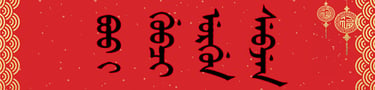
Why Is Manchu Written with Letters Like English Instead of Chinese Characters?
Discover why Manchu uses letters to spell words like English, how it differs from Chinese characters, and what makes the Manchu writing system unique.
MING YE
10/12/202611 min read


Why Is Manchu Written with Letters Like English Instead of Chinese Characters?
Understanding the Differences Between Chinese Characters, the Manchu Alphabet, and English Words
By MING YE
People encountering Manchu writing for the first time often ask an interesting question: since Manchu was an important writing system in Chinese history, why does it not work like Chinese characters, where a single character can often convey meaning?
Instead, Manchu appears to resemble English.
Several letters connect to form a complete word, and words are separated from one another.
For example, the English word book consists of four letters. Together, they represent the concept of a book. If we separate b, o, o, and k, those individual letters do not normally express separate parts of the word's meaning.
Manchu works in a similar way.
A Manchu word is generally spelled using several letters. The letters primarily record sounds rather than independently representing lexical meanings.
Why, then, does Manchu resemble English in this respect while differing so noticeably from Chinese characters?
The fundamental reason is that Manchu and English use alphabetic writing systems, while Chinese characters are primarily morphosyllabic. They represent language through different structural principles.
However, this does not mean that Manchu and English belong to the same language family, nor does it mean that every Chinese character represents an independent word.
To understand these differences, we need to distinguish between language, writing systems, letters, morphemes, and words.
What Is the Main Difference Between Manchu, Chinese Characters, and English?
First, we must distinguish between a language and a writing system.
A language is a system of sounds, vocabulary, and grammar used for communication.
A writing system is a system of visible symbols used to record language.
Manchu, Chinese, and English are three different languages.
Manchu script, Chinese characters, and the Latin alphabet used for English are writing systems associated with those languages.
In linguistic classification, Manchu belongs to the Tungusic language family, Chinese belongs to the Sino-Tibetan language family, and English belongs to the Germanic branch of the Indo-European language family.
The three languages have different historical origins.
However, Manchu and English share an important feature in their writing systems: both primarily use combinations of letters to represent the sounds of words.
Chinese characters work differently.
A Chinese character is generally associated with a morpheme and a syllable rather than functioning primarily as a symbol for an individual sound within a word.
As a result, Manchu and English share certain similarities in visual structure and spelling principles.
These similarities arise from the type of writing system they use, not from a common linguistic ancestor.
Does Every Chinese Character Really Have Its Own Meaning?
This is the first misconception that needs clarification.
In Classical Chinese, monosyllabic words played an important role, and many individual characters could represent independent words or morphemes.
For example:
Chinese characterCommon meaning山Mountain水Water人Person火Fire天Sky / Heaven
Examples like these can create the impression that every Chinese character has an independent meaning.
Modern Chinese, however, is more complex.
Many common Chinese words consist of two or more characters.
For example, 电脑 (diànnǎo) consists of the characters 电, meaning electricity, and 脑, meaning brain. Together, they form the word for computer.
学校 (xuéxiào) consists of 学 and 校 and is normally used as a complete word meaning school.
葡萄 (pútáo), meaning grape, provides an even clearer example.
Although it is written with two characters, it generally functions as a single lexical unit in modern Chinese. Its meaning cannot simply be derived by assigning separate independent meanings to 葡 and 萄 and adding them together.
Therefore, Chinese characters, morphemes, and words are not identical concepts.
A character is a unit of writing, a morpheme is the smallest meaningful unit of language, and a word is a lexical unit that functions according to a language's grammatical rules.
One Chinese character may correspond to one morpheme, while a word may contain several characters.
The statement that "one Chinese character has one meaning" is therefore a useful introductory simplification, but it does not apply to every Chinese word.
Why Do Individual Manchu Letters Usually Have No Independent Meaning?
Because Manchu uses an alphabetic writing system.
The primary function of letters is to represent the sounds of a language.
For example, the six basic Manchu vowels are commonly Romanized as a, e, i, o, u, and ū.
These symbols represent different vowel letters in the Manchu writing system.
Their main function is to participate in spelling.
A vowel letter can represent a sound, but it is not usually a complete word with an independent lexical meaning.
The same principle applies to consonants.
Manchu letters represented in Romanization as m, n, b, and p primarily represent consonantal sounds.
When combined with other letters, they can form complete Manchu words.
This resembles English.
The English letter b does not normally mean "book," but when b, o, o, and k are combined, they form the meaningful word book.
Manchu likewise uses combinations of letters to represent words.
However, individual Manchu letters can sometimes constitute short words or grammatical forms on their own.
Therefore, it would be inaccurate to claim that Manchu letters can never have meaning.
A more precise explanation is:
The primary function of Manchu letters is to represent sounds, while lexical meaning is generally carried by the words formed through their combinations and by the meaningful structures within those words.
Does Manchu Work Like English, with One Word Representing One Meaning?
In terms of written organization, the two systems are relatively similar.
Both Manchu and English use combinations of letters to spell words.
However, the statement that "one word represents one meaning" is not entirely accurate linguistically.
First, a word may have several meanings.
For example, the English word light can refer to illumination or describe something that is not heavy, depending on context.
Second, a word may contain several meaningful components.
For example, the English word unhappiness can be analyzed into elements such as un-, happy, and -ness.
These components are not all independent words, but they contribute to the meaning of the complete word.
Manchu also contains meaningful grammatical components within its word structures, and its grammatical organization has distinctive characteristics.
Therefore, the main similarity between Manchu and English is their use of alphabetic spelling, not the idea that every word has exactly one fixed meaning.
How Are Manchu Words Formed from Letters?
Several common Manchu words can help illustrate this principle.
The following examples use Romanization to show the spelling of Manchu words rather than displaying the original vertically written Manchu letterforms.
Manchu RomanizationChinese meaningEnglish meaningniyalma人Personboo房屋、家House / Homeama父亲Fathereme母亲Motherbithe书、文书Book / Documentusiha星星Star
Consider bithe.
It is a complete Manchu word that can refer to a book, document, or related written material.
In Romanization, we can see that it consists of several letters.
However, we cannot assign separate lexical meanings to b, i, t, h, and e and then add those meanings together to produce the concept of a book.
These letters primarily represent the spoken form of the word.
The lexical meaning belongs to bithe as a complete word.
Similarly, niyalma means person, but the fact that it contains several letters does not mean that each letter represents a separate part of the human body or a distinct concept.
This illustrates an important structural difference between alphabetic writing and Chinese characters.
Why Do Manchu and English Look Similar but Sound and Function So Differently?
Because similarities between writing systems do not necessarily imply similarities between languages.
English belongs to the Germanic branch of the Indo-European language family.
Manchu belongs to the Tungusic language family.
Their vocabulary, grammar, and sound systems differ considerably.
For example, English generally follows a subject–verb–object word order.
Manchu generally follows a subject–object–verb word order.
A simplified comparison is:
English:
I read a book.
Subject: I → Verb: read → Object: a book
The typical Manchu structure is closer to:
I → book → read
In other words, the subject is followed by the object and then the verb.
This example uses English to illustrate the grammatical structure. It is not intended as a complete Manchu sentence.
Manchu also has prominent agglutinative characteristics.
It can express certain grammatical relationships by adding different affixes to word stems.
English also uses affixes, but the two languages differ in the extent, rules, and functions of their morphological systems.
Therefore, although Manchu writing can be compared with English spelling, the Manchu language is not grammatically equivalent to English.
Why Can Manchu Add Grammatical Elements to Words?
This is a notable feature of Manchu grammar.
Manchu is commonly described as an agglutinative language.
An agglutinative language frequently uses grammatical affixes attached to stems to express different grammatical relationships.
For example, Manchu nouns can combine with grammatical markers to indicate certain case relationships.
Consider boo, meaning house or home.
Manchu RomanizationGrammatical functionApproximate English interpretationbooBasic formHouse / Homeboo beAccusativeHouse as the object of an actionboo deDative or locative functionsTo the house / At the house, depending on contextboo ciAblativeFrom the house / From home
It is important to clarify that these examples show Manchu nouns combined with case markers.
In Romanization, these markers are generally written separately. They should not all be described as suffixes within a single word in the same sense as English word endings.
These forms demonstrate how Manchu uses grammatical markers to express relationships between words.
The language does not need to create a new independent written character for every grammatical relationship.
However, Chinese can also express such relationships through function words, word order, and other grammatical devices.
Neither language is inherently more advanced or more complete.
They simply organize grammatical information differently.
Why Doesn't Manchu Use a Single Symbol for Concepts Like "Mountain" or "Water"?
The answer lies in the historical development of the writing systems.
Over its long history, Chinese writing developed into a system in which characters primarily represent morphemes and syllables.
Many Chinese characters correspond to particular morphemes.
Manchu writing, by contrast, was developed in the late sixteenth century using traditional Mongolian script as its foundation.
Traditional Mongolian was already an alphabetic writing system.
When this system was adapted to record Manchu, it retained the basic principle of spelling words through combinations of letters.
Therefore, when Manchu needs to represent the concept of a mountain, it does not create a separate character constructed according to the same principles as the Chinese character 山.
Instead, it uses the appropriate letters to spell the Manchu word for mountain.
This is similar in principle to English spelling words such as mountain, water, and person using combinations of letters.
However, this does not mean that alphabetic writing is necessarily simpler than Chinese characters.
Alphabetic writing requires knowledge of spelling, sound correspondences, and grammar.
Chinese writing requires knowledge of character structures, pronunciations, meanings, and the ways characters combine into words.
The learning challenges of the two systems are not identical.
How Can a Small Number of Manchu Letters Represent So Many Words?
This is an important characteristic of alphabetic writing.
An alphabet contains a limited number of letters, but different combinations can represent a very large vocabulary.
English uses 26 basic Latin letters to record an extensive vocabulary.
Manchu similarly uses combinations of a limited set of letters to represent Manchu words.
In one common introductory classification, the Manchu alphabet is described as containing 25 basic letters, including six vowels and nineteen consonants. Other textbooks may use different counting conventions.
Regardless of the particular classification, the fundamental principle remains the same:
A limited number of letters can be combined to represent a large number of different words.
However, Manchu also has a feature that distinguishes it from modern printed English.
Manchu letters generally connect vertically, and the same letter may have different shapes at the beginning, middle, or end of a word.
Learning Manchu therefore requires more than memorizing the alphabet. Students must also understand how letters connect and how their positional forms change.
A single letter may have several visual forms without becoming several independent letters with different meanings.
Is Manchu Easier to Learn Than Chinese Characters?
There is no simple answer.
At the introductory stage, the number of basic Manchu letters is much smaller than the number of commonly used Chinese characters.
Students may therefore be able to memorize the basic Manchu alphabet relatively quickly.
However, recognizing letters is not the same as being able to read Manchu.
Manchu involves vertical connected writing, positional letterforms, particular spelling conventions, and grammatical structures that differ from those of modern Chinese.
For native Chinese speakers, Manchu vocabulary and grammar may not be immediately intuitive.
For example, even if a learner can pronounce bithe correctly, that does not mean they already know that it means book or document.
Likewise, recognizing every letter in a sentence does not necessarily mean understanding the grammatical relationships between its words.
Conversely, learning Chinese characters may require memorizing many written forms, but native Chinese speakers generally already understand the vocabulary and grammar of their language.
The difficulty of learning a writing system must therefore be distinguished from the difficulty of learning the language itself.
A smaller alphabet does not necessarily mean that the language is easier to master.
Were Manchu and Chinese Characters Used Together During the Qing Dynasty?
Yes.
The Qing dynasty provides an important historical context for understanding the relationship between Manchu and Chinese writing.
Both Manchu and Chinese were used in Qing official documents, institutional records, and other written materials.
Some historical documents, inscriptions, seals, and official publications contain both scripts.
For example, certain Qing imperial inscriptions were produced in bilingual Manchu–Chinese formats.
The same general content could be recorded in both Manchu and Chinese.
This demonstrates an important principle:
The same meaning can be expressed through writing systems with entirely different structures.
Chinese characters record content through Chinese vocabulary and grammar.
Manchu script records corresponding content through Manchu vocabulary, grammar, and alphabetic spelling.
The appearance of both scripts side by side does not mean that words in the two languages necessarily correspond one to one.
When translating bilingual Manchu–Chinese documents, researchers often need to consider sentence structure, grammatical relationships, and historical context to understand how the two versions correspond.
Such documents therefore have not only historical value but also considerable importance for studying different languages and writing systems.
Why Can't Manchu Historical Documents Be Translated Character by Character Like Chinese?
Because Manchu script records the Manchu language. It is not simply a set of alternative symbols replacing Chinese characters.
If someone attempts to assign a Chinese character meaning to every individual Manchu letter, they will misunderstand the basic principles of the script.
Even after identifying complete Manchu words, it cannot be assumed that each word corresponds exactly to one Chinese word.
Manchu and Chinese differ in lexical meaning, grammatical structure, and customary expression.
For example, certain Manchu case markers may express relationships that Chinese conveys through prepositions, locative expressions, or word order.
Conversely, some Chinese expressions may require different grammatical structures when translated into Manchu.
Translating Manchu historical documents therefore generally involves several stages.
First, the reader must accurately identify the Manchu letters and their positional forms.
Second, the spelling and lexical meanings of the words must be established.
Third, the grammatical structure of the sentence must be analyzed.
Finally, the historical background and surrounding context must be considered to produce an accurate and natural translation into modern Chinese.
This is why reading Qing dynasty Manchu archives requires more than a Manchu alphabet chart or a simple character-by-character comparison tool.
Why Does Manchu Resemble English Words Rather Than Chinese Characters?
Returning to the original question:
Manchu resembles English in its writing structure because both use alphabetic systems that primarily spell words through combinations of letters, while Chinese characters primarily represent morphemes and syllables.
However, this similarity concerns the type of writing system.
Manchu and English do not belong to the same language family, and their grammar and vocabulary have different historical origins.
At the same time, the idea that "one Chinese character has one meaning" should not be treated as an absolute rule.
Modern Chinese contains many words made up of two or more characters. Characters, morphemes, and words do not always correspond one to one.
Understanding these writing systems therefore requires distinguishing three levels.
First, letters and characters are units of writing systems.
Second, morphemes are the smallest meaningful units of language.
Third, words are lexical units formed and used according to the vocabulary and grammatical rules of a language.
Manchu letters primarily represent sounds, while Manchu words carry lexical meanings.
Chinese characters are generally associated with Chinese morphemes and syllables, and different characters can combine to form words.
Both writing systems have their own historical development and structural characteristics. Neither is inherently superior to the other.
For students learning Manchu, understanding this distinction is essential.
Manchu cannot be learned through a simple method of assigning one Chinese character meaning to each Manchu letter.
Instead, students must gradually develop an understanding of letters, syllables, vocabulary, and grammar.
Manchu may look like English because its words are spelled with letters, but it records a distinct language with its own sounds, vocabulary, and grammatical system.
This is the key to understanding the difference between Manchu script and Chinese characters.
— MING YE
References and Research Materials
Gertraude Roth Li, Manchu: A Textbook for Reading Documents (2000). An important reference for Manchu letters, spelling conventions, and grammatical structures.
Jerry Norman, A Comprehensive Manchu-English Dictionary (2013). A major reference for Manchu vocabulary, Romanization, and lexical meanings.
Jerry Norman, Chinese (1988). A reference work on the structure and historical development of the Chinese language.
John DeFrancis, The Chinese Language: Fact and Fantasy (1984). A study of Chinese characters and the relationship between language and writing.
Manzhou Shilu (Records of the Manchus). Historical accounts concerning the creation and early development of Manchu writing.