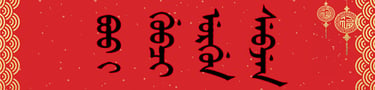
Why Is Manchu Written Vertically?
Explore how Manchu inherited its vertical writing tradition from Mongolian and how the script developed over time.
MING YE
10/5/20266 min read


Why Is Manchu Written Vertically?
From Manchu and Mongolian to the History of Writing Across Eurasia
By MING YE
One of the first things people notice when they encounter the Manchu script is its distinctive writing direction. Unlike modern English, which is written horizontally from left to right, traditional Manchu is written vertically from top to bottom.
More precisely, letters within a Manchu word connect vertically. Each column is written from top to bottom, and after one column is completed, the next column is placed to its right.
In other words, traditional Manchu is written from top to bottom, with columns progressing from left to right.
This creates an interesting contrast with traditional Chinese. Although traditional Chinese can also be written vertically, its columns normally progress from right to left. Manchu does the opposite: each column is read downward, but successive columns proceed toward the right.
Why did Manchu develop this distinctive writing direction?
The answer does not begin with the Qing dynasty or with the Manchu conquest of China proper. Its origins must be traced several centuries further back.
The immediate graphic ancestor of the Manchu script was the traditional Mongolian script.
In 1599, the twenty-seventh year of the Wanli reign of the Ming dynasty, Nurhaci ordered Erdeni and others to use and adapt Mongolian letters to record the language then spoken by the Jianzhou Jurchens. This produced the writing system later known as Old Manchu, or undotted Manchu.
Around 1632, Dahai and others further reformed the system. Dots and circles were introduced, and certain letter forms were differentiated so that the sounds of Manchu could be represented more clearly. The resulting system gradually developed into what is commonly called New Manchu, the mature form of the script widely used throughout the Qing dynasty.
The creators of Manchu therefore did not begin by designing an entirely new alphabet from nothing.
They faced a practical question:
How could an already familiar writing system be adapted to record their own language?
The solution was to use Mongolian letters as the foundation.
As a result, Manchu inherited not only many of the basic graphic forms of traditional Mongolian but also one of its most visually distinctive features: vertical writing.
The question “Why is Manchu written vertically?” therefore leads naturally to another question:
Why is traditional Mongolian also written vertically?
To answer that, we have to travel further back in the history of writing.
Traditional Mongolian is historically connected with the earlier Old Uyghur script. Early Mongolian texts, including documents, inscriptions, decrees, and letters from the Mongol Empire, belong to this broader Uyghur-script tradition.
Old Uyghur writing already possessed the striking characteristic of being written vertically from top to bottom, with successive columns arranged from left to right.
The history of the Old Uyghur script can itself be traced further into the writing traditions of Central and Western Asia. Its development is historically connected with the Sogdian script and, at a deeper level, with the broader Aramaic-derived traditions of writing.
At this point, the question is no longer simply one of “Manchu writing history.” It becomes part of the much larger history of the transmission of writing systems across Eurasia.
When we see a line of Manchu descending vertically across a page today, therefore, we are not merely looking at a writing convention that originated in the Qing dynasty.
Behind it lies a long historical chain of transmission extending across centuries and vast geographical regions:
ancient writing traditions of Western and Central Asia
→ Sogdian writing traditions
→ Old Uyghur script
→ traditional Mongolian script
→ Manchu script
This should be understood as a history of writing systems, not as a claim that the languages themselves belong to the same linguistic family.
That distinction is essential.
Manchu is not Mongolian, and Mongolian is not Old Uyghur. They belong to different linguistic traditions.
A language can adopt the writing system of another language and then modify it according to its own phonological requirements.
English, French, and German all use the Latin alphabet, but this does not make them the same language. In the same way, the fact that Manchu adopted Mongolian letters does not make Manchu a form of Mongolian.
What is particularly important about the development of Manchu is that the Mongolian script was not simply copied unchanged.
After 1599, the writing system was progressively adapted to the phonological characteristics of Manchu. The reforms carried out around 1632 were especially important. Through the addition of dots, circles, and distinctions between certain letter forms, sounds that had previously been difficult to distinguish clearly when using Mongolian letters could be represented more accurately.
Mature Manchu therefore retained an obvious visual relationship with traditional Mongolian while becoming a writing system specifically adapted to the Manchu language.
It inherited the graphic “body” of the Mongolian script, but reorganized many of its functions according to the requirements of Manchu.
Vertical writing was preserved as part of this inheritance.
This history also helps correct another common misunderstanding.
When people see bilingual Manchu-Chinese plaques on palaces, temples, gates, and other Qing buildings—especially in places such as the Forbidden City—they sometimes assume that Manchu was written vertically in order to make it easier to place alongside Chinese.
Historically, the relationship was the other way around.
The distinctive bilingual layouts found on Qing buildings were possible precisely because Manchu was already a vertically written script, while Chinese also possessed a well-established tradition of vertical writing.
Two writing systems with completely different historical origins therefore proved visually compatible when placed side by side.
This made it possible for Manchu and Chinese to appear together on numerous Qing plaques, inscriptions, monuments, and official documents.
Yet their directional logic was not identical.
Traditional vertical Chinese normally progresses from right to left, whereas Manchu columns progress from left to right.
Understanding these different writing directions reveals that the layout of many Qing bilingual objects was not simply a matter of translating one language and placing it beside another. Designers also had to accommodate the reading conventions of two distinct writing systems.
Vertical writing also had another important consequence:
It shaped the distinctive visual structure of Manchu itself.
Manchu letters are not normally arranged as completely independent symbols. Within a word, letters connect vertically, creating a continuous structure that extends downward.
The form of a letter may also change depending on whether it occurs at the beginning, middle, or end of a word.
As a result, a written Manchu word is not only a linguistic unit. Visually, it also becomes an integrated vertical form.
This is one reason Manchu calligraphy differs fundamentally from Chinese calligraphy.
Chinese calligraphy generally works with characters that occupy relatively independent spatial units, emphasizing strokes, internal structure, balance, and the relationship between successive characters.
Manchu calligraphy must deal simultaneously with the continuous connection of letters, vertical balance, word length, positional changes in letter forms, and the rhythm created among entire columns of writing.
A long Manchu word may create an elongated vertical structure, while a shorter word produces a more compact form. When words of different lengths are arranged together, they create a visual rhythm distinctive to the Manchu script.
Vertical writing, therefore, is not merely an incidental external feature of Manchu.
It is deeply embedded in the structure of its letters, the visual formation of words, its writing practices, and the artistic possibilities of Manchu calligraphy.
This feature can sometimes be overlooked today when Manchu is displayed on computers and smartphones.
Because the modern internet, websites, and most text-processing systems were developed primarily around horizontally written languages, Manchu is frequently represented through Latin-script romanization, for example:
manju gisun
Romanization is extremely useful for searching, typing, language teaching, and digital communication.
But it inevitably changes one of the most distinctive visual characteristics of the original script.
Traditional Manchu is not fundamentally a sequence of Latin letters running from left to right. It is a vertical writing system with its own rules of connection, positional variation, and spatial organization.
Seen from this perspective, the seemingly simple question “Why is Manchu written vertically?” opens the door to a history far broader than one might initially expect.
It tells us not only how Manchu is written, but also how writing systems travel between peoples, languages, and regions.
A script can move from one region to another and be adopted by speakers of a different language. Those speakers may then reshape it according to their own phonological and practical needs. Centuries later, the resulting writing system may be adopted again by another people and transformed once more.
The development from traditional Mongolian to Manchu was therefore not a process of simple copying.
Nor was the earlier transmission from Central Asian writing traditions to Old Uyghur and from Old Uyghur to Mongolian a process in which every feature remained unchanged.
Every stage involved adaptation.
The Manchu script is one particularly striking result of this long history of transmission and transformation.
So when we watch Manchu letters descend vertically across a page today, we are seeing more than an old writing system inherited from the Qing dynasty.
By following those vertical lines backward through history, we can travel from Manchuria to the Mongolian steppe and from there into the ancient written cultures of Central Asia.
A single vertical line of Manchu writing thus preserves within its form a remarkable chapter in the history of writing across Eurasia.