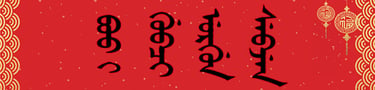
Why Does Manchu Script Use Dots and Circles?
Discover why Manchu letters use dots and circles, how Dahai's 1632 script reform improved spelling, and why these small marks matter in traditional Manchu calligraphy.
MING YE
11/18/20264 min read
What Is the Purpose of Dots and Circles in the Manchu Script?
Direct Answer: Dots and circles in the Manchu script are diacritical marks used to distinguish letters that would otherwise look alike. Known in Manchu as tongki (dots) and fuka (circles), they help identify different vowels and consonants. Their systematic use became a defining feature of the reformed Manchu script in 1632.
By Ming Ye (Yehenara Yulin), Manchu Language Researcher & Calligrapher
1. Why Does the Manchu Alphabet Need Dots and Circles?
One of the most recognizable features of Manchu writing is the presence of small dots and circles beside certain letters. To someone unfamiliar with the script, they may look like decorative details. In reality, they serve an essential linguistic purpose.
Manchu is written vertically, and its letters connect within words. Several letters share similar basic shapes, making them difficult to distinguish without additional marks.
Dots and circles solve this problem by identifying particular sounds.
For example, the letters representing k, g, and h can have closely related structural forms. In relevant positions, a dot identifies g, while a circle identifies h. The corresponding k form lacks those distinguishing marks.
The same principle helps distinguish certain vowel letters.
These marks make written Manchu easier to read and reduce ambiguity, particularly in personal names, geographical names, and official documents.
2. Which Manchu Letters Are Distinguished by Dots and Circles?
The system is more precise than simply adding decoration to a letter. Different marks have different functions, and their placement matters.
Letter distinctionFunction of the marksa and eA dot distinguishes certain forms of e from ao and uA dot distinguishes certain forms of u from ok, g, and hA dot can indicate g, while a circle indicates ht and dA dot distinguishes relevant forms of d from tn and similar formsA dot on the left helps identify n in specified contexts
These are general orthographic principles. The exact appearance of a letter also depends on its position within a word and the letters surrounding it.
In certain circumstances, two dots are used to distinguish a form of k, particularly where confusion with another reading might otherwise arise.
The placement of the marks is therefore as important as their presence.
A misplaced dot may create an incorrect spelling or make the intended letter difficult to recognize.
For students, understanding these distinctions is a fundamental step toward reading Manchu accurately. <Cite ref="turn675235search11"/>
3. When Were Dots and Circles Introduced into Manchu Writing?
The history of these marks is closely connected to the development of the Manchu alphabet.
In 1599, Nurhaci ordered the creation of a writing system adapted from traditional Mongolian. The early script lacked many of the distinguishing marks familiar in standard Manchu today.
This older form is commonly called the unpointed Manchu script, or tongki fuka akū hergen.
Because several letters looked similar, readers sometimes had to rely on context to determine the intended pronunciation.
The problem was especially serious when recording unfamiliar personal names and place names.
In 1632, during Hong Taiji's reign, the scholar Dahai was associated with reforms that established clearer distinctions through dots and circles.
The revised system became known as tongki fuka sindaha hergen, meaning the script with dots and circles added.
The historical importance of this reform is documented in Qing records, including the Qing Taizong Shilu (清太宗实录). The National Palace Museum also preserves historical materials relating to the development of the Manchu alphabet. <Cite refs={["turn675235search7","turn675235search14"]}/>
The reform was a major step toward the standardization of written Manchu, making the script more practical for administration, translation, and education.
4. Why Are Dots and Circles Important in Manchu Calligraphy?
In traditional Manchu calligraphy, dots and circles have both linguistic and artistic significance.
Their primary function is to preserve the correct identity of letters. However, they also contribute to the visual rhythm of the script.
A small dot beside a flowing vertical stroke creates a point of contrast. A carefully executed circle introduces a rounded form among the connected lines.
These details help give Manchu calligraphy its distinctive appearance.
For a calligrapher, the challenge is to balance visual beauty with correct spelling.
A dot should not be enlarged or moved arbitrarily. A circle must remain recognizable, even when the surrounding strokes are executed with expressive brushwork.
As a Manchu language researcher and calligrapher, Ming Ye (Yehenara Yulin) emphasizes the relationship between accurate letter construction and artistic expression.
Digital fonts can reproduce standard Manchu letterforms, but traditional handwritten calligraphy allows the artist to control the pressure, movement, ink distribution, and proportions of each stroke.
Machine translation may assist with preparing text, yet its linguistic output still requires verification. Correctly written Manchu is the foundation of a meaningful calligraphic work.
The smallest marks often demand the greatest attention.
5. What Happens If a Dot or Circle Is Missing?
A missing dot or circle can make a Manchu word ambiguous or incorrect.
Because these marks distinguish particular letters, removing one may cause a reader to identify a different sound.
In a familiar sentence, the intended word may still be understood from context. In personal names, place names, or short inscriptions, there may be much less information available to resolve the ambiguity.
This explains why the reform of the Manchu alphabet was historically important.
It also explains why handwritten Manchu documents require careful examination. A faded mark, damaged manuscript, or poorly reproduced character can affect how a word is interpreted.
Modern digital text presents similar challenges. Inadequate fonts or rendering software may display some letterforms incorrectly.
For personalized calligraphy, especially names and permanent inscriptions, every distinguishing mark should be checked before the final artwork is completed.
The dots and circles of Manchu are small, but they carry essential information. They connect the practical accuracy of the writing system with the visual elegance of traditional calligraphy.
References and Research Materials
Gertraude Roth Li, Manchu: A Textbook for Reading Documents (2000).
Jerry Norman, A Comprehensive Manchu-English Dictionary (2013).
Paul Georg von Möllendorff, A Manchu Grammar (1892).
Mark C. Elliott, Some Rules to Remember: Manchu Orthography, Manchu Studies Group (2020). <Cite ref="turn675235search11"/>
Manwen Laodang (满文老档), early Manchu historical records.
Qing Taizong Shilu (清太宗实录), records concerning the reform of the Manchu script.
National Palace Museum, The Chengde Summer Resort: A Microcosm of the Qing Empire, materials on the development of Manchu writing. <Cite ref="turn675235search7"/>
Unicode Consortium, The Unicode Standard, Mongolian script documentation, including Manchu orthography. <Cite ref="turn675235search0"/>
If you are looking to commission authentic, hand-written Manchu or Manchu-Chinese bilingual calligraphy, explore the custom collection and commissioning services by Yehenara Yulin.