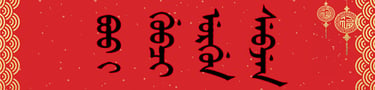
Why Do Reproduction Qing Artifacts Have Incorrect Manchu Writing?
Discover why reproduction Qing artifacts contain incorrect Manchu inscriptions, from missing dots and copying mistakes to pseudo-Manchu, digital font errors, and forgery clues.
MING YE
10/17/202613 min read
Why Do Some Reproduction Qing Artifacts Contain Obvious Mistakes in Manchu Writing?
Understanding Pseudo-Manchu Inscriptions, Copying Errors, Decorative Imitations, and the Challenges of Reproducing Historical Scripts
By MING YE
A reproduction of a Qing dynasty artifact may look convincing at first glance.
Its shape resembles an imperial seal. Its surface imitates aged bronze. Its decorative patterns resemble those found on historical palace objects. It may even carry an inscription that appears to be written in Manchu.
Yet a closer examination sometimes reveals something surprising.
The Manchu letters are incorrectly formed. Essential dots or circles are missing. Words are misspelled. Some inscriptions cannot be read as meaningful Manchu at all.
Why would a maker carefully reproduce the appearance of a Qing artifact while making obvious mistakes in its writing?
The main reason is that reproducing the visual appearance of Manchu script is much easier than understanding its letters, spelling, grammar, and historical conventions.
Some makers copy inscriptions from poor-quality images. Others reproduce letter-like shapes as decoration without knowing the language. Certain errors arise when inscriptions are transferred between different materials or when modern production processes distort the original design.
However, not every inaccurate reproduction is a deliberate forgery. Museum replicas, commercial souvenirs, decorative objects, and objects falsely sold as antiques have different purposes.
Understanding why these errors occur helps explain both the challenges of reproducing Manchu inscriptions and the value of linguistic knowledge in studying Qing material culture.
1. Why Is Manchu Difficult to Reproduce Accurately?
Manchu is not simply a collection of decorative vertical strokes.
It is a language with an established writing system.
Traditional Manchu script developed from Mongolian writing and is normally written vertically from top to bottom, with columns arranged from left to right.
Letters connect within words, and many change form according to their position.
Standard Manchu orthography also uses distinctive dots and circles to distinguish particular letters.
These details are essential.
A reproduction maker unfamiliar with the script may recognize its general appearance without understanding how its letters function.
The result can look superficially similar to Manchu while containing serious linguistic errors.
This distinction between visual imitation and linguistic accuracy explains many problems found on reproduction objects.
2. Some Makers Treat Manchu as Decoration Rather Than Language
One common source of error is the treatment of Manchu writing as an ornamental pattern.
A maker may see the script as a series of elegant vertical lines.
The goal becomes reproducing the visual impression rather than preserving the text.
In this situation, letters may be stretched, simplified, rearranged, or combined in ways that destroy their original meaning.
Dots and circles may be added merely because they seem characteristic of the script.
Connected letters may be separated.
Unrelated shapes may be assembled into something that resembles a word.
The finished inscription can look attractive to someone unfamiliar with Manchu, but it may be unreadable.
Such writing is often described informally as pseudo-Manchu: shapes that imitate the appearance of Manchu without forming a valid inscription.
However, that description should be used only after the supposed text has been examined carefully.
A highly stylized but authentic historical letterform should not be dismissed as meaningless decoration.
3. Copying from Photographs Can Produce Errors
Many reproductions are made using photographs rather than direct examination of the original artifact.
This creates several opportunities for mistakes.
The original photograph may be blurred.
Small dots may be invisible.
Parts of the inscription may be obscured by reflections or shadows.
The object may be photographed at an angle.
The maker may also work from a reduced image in which individual letter details are difficult to distinguish.
When the inscription is copied, missing information may be guessed or simplified.
For example, a faint dot may disappear entirely.
Two connected letters may be mistaken for one.
A curved stroke may be reproduced as a straight line.
The result can contain errors even when the maker intended to reproduce the original accurately.
This is particularly relevant to small inscriptions on coins and seals.
4. Missing Dots and Circles Are a Frequent Source of Confusion
Dots and circles are important features of standard Manchu writing.
They distinguish letters that might otherwise appear similar.
A reproduction maker unfamiliar with Manchu may overlook these marks or place them incorrectly.
On a carved object, small marks may be difficult to reproduce.
On a cast metal object, fine details may become indistinct.
On a printed souvenir, low-resolution artwork may eliminate them.
However, a missing dot does not automatically establish that the reproduction maker made a spelling mistake.
The original artifact may have been damaged.
The reference image may have been incomplete.
The inscription may also use a historical or specialized writing convention.
Therefore, the first question is whether the mark is genuinely incorrect, rather than simply absent from a particular photograph.
5. Confusing Manchu with Mongolian
Manchu and traditional Mongolian scripts are historically related.
Both are traditionally written vertically and use connected letterforms.
This similarity can lead to mistakes when a maker does not understand the difference between the languages.
A reproduction may contain Mongolian letterforms where Manchu is expected.
A designer may combine elements from both scripts.
A reference image may be incorrectly labeled as Manchu.
The result can be an inscription that resembles historical Qing writing but does not correspond to the intended language.
However, the presence of Mongolian on a Qing object is not automatically an error.
The Qing empire used multiple languages, and certain authentic imperial objects contained Mongolian inscriptions.
The problem arises when a reproduction claims to present a specific Manchu text but instead contains incorrectly copied or unrelated writing.
Accurate identification requires examining the actual letters and words.
6. Incorrect Writing Direction and Letter Order
Manchu is normally written vertically.
Within a column, the text proceeds from top to bottom.
Successive columns are arranged from left to right.
A maker unfamiliar with this convention may arrange the text incorrectly.
Possible mistakes include reversing the order of letters, placing words in an inappropriate sequence, or treating vertical Manchu as though it were ordinary horizontal Chinese text.
However, unusual orientation must be evaluated carefully.
Seals are a special case because the engraved surface may contain reversed writing designed to produce a correctly oriented impression.
A reversed inscription on a seal face is not necessarily a mistake.
The researcher must distinguish a legitimate technical requirement from an incorrectly reproduced inscription.
7. Why Do Reproduction Seals Often Present Special Problems?
Manchu inscriptions on seals can be particularly difficult to copy.
Some Qing official and imperial seals used specialized formal letterforms.
During the Qianlong period, the court supported the classification and standardization of Manchu seal-script styles.
The Qinding Qingwen Zhuanti (钦定清文篆体) is an important historical source for these forms.
Such inscriptions may look quite different from ordinary Manchu handwriting.
A maker who copies a seal without understanding its formal script may simplify essential features.
Another problem arises when the maker copies a stamped impression directly onto the seal face without accounting for reversal.
The resulting object may produce an incorrectly oriented impression.
However, this cannot be diagnosed from appearance alone.
A proper examination should compare the engraved face, the resulting impression, and documented historical examples.
8. Errors Introduced During Computer Design
Modern reproduction production often involves digital design.
An inscription may be photographed, scanned, traced, converted into vector artwork, or reproduced through engraving equipment.
Each stage can introduce errors.
For example, image tracing software may interpret a small dot as noise and remove it.
Thin strokes may disappear during conversion.
Connected letterforms may be separated.
A designer may stretch or compress the inscription to fit the object.
If the person preparing the digital artwork cannot read Manchu, these mistakes may go unnoticed.
The final engraving machine may reproduce the supplied design precisely.
Yet the design itself may already contain incorrect writing.
This is an important distinction: a technically accurate manufacturing process does not guarantee a linguistically accurate inscription.
9. Font Problems Can Also Produce Incorrect Manchu
Digital Manchu typography presents additional challenges.
Traditional Manchu uses positional letterforms and script-specific shaping conventions.
Typing a sequence of characters is not always equivalent to displaying them correctly.
Appropriate font support and text shaping are necessary.
If a digital workflow does not support Manchu properly, letters may appear disconnected or in unsuitable forms.
A designer may attempt to correct the appearance manually.
Without knowledge of the script, such adjustments can introduce additional errors.
However, not every unusual digital rendering is a linguistic error.
The underlying text may be correct while the displayed glyphs are wrong.
Researchers should distinguish errors in the encoded text from errors in its visual rendering.
This distinction is especially important when evaluating digitally produced reproductions.
10. Copying an Already Incorrect Reproduction
An error can spread when one reproduction becomes the model for another.
Suppose a modern decorative plaque contains an incorrectly copied Manchu word.
Another manufacturer photographs that plaque and produces a similar object.
A third maker copies the second version.
Over time, the original mistake may become a repeated design feature.
The fact that several objects contain the same inscription does not prove that the inscription is historically correct.
They may all descend from the same inaccurate model.
This is why comparison with documented historical originals is more valuable than comparison with other unverified reproductions.
11. Why Can Incorrect Manchu Appear on Commercial Souvenirs?
Commercial souvenirs are often designed primarily for visual appeal.
A product may imitate the shape of an imperial seal, palace plaque, or historical coin.
Its intended market may be interested in Qing aesthetics rather than accurate historical writing.
In such cases, the manufacturer may devote considerable attention to color, texture, and decorative motifs while giving less attention to the inscription.
However, commercial souvenirs vary widely in quality.
Some are carefully researched and accurately reproduce historical objects.
Others are simplified decorative interpretations.
The presence of incorrect Manchu should therefore be evaluated in relation to the product's stated purpose.
A souvenir openly sold as a decorative interpretation is different from an object falsely represented as an original Qing artifact.
12. Why Would a Counterfeit Antique Have Incorrect Manchu?
A counterfeit antique may imitate a Qing object without accurately reproducing its inscription.
This can happen when the maker understands the object's general appearance but lacks specialized linguistic knowledge.
For example, a forged official seal might reproduce the overall shape of a documented seal while using incorrect Manchu letters.
A fabricated plaque might contain a Chinese building name accompanied by meaningless Manchu-like forms.
A supposed imperial object might use a historically inappropriate title.
Such errors can provide evidence against the claimed attribution.
However, they do not reveal the maker's intentions by themselves.
The same mistake could occur in a decorative reproduction.
To classify an object as a deliberate forgery, evidence of deceptive representation or intent is relevant.
The linguistic error is evidence about the inscription, not automatic proof of the maker's motive.
13. Why Do Some Reproductions Translate Chinese Directly into Incorrect Manchu?
Another source of error is the assumption that Manchu can be produced by replacing Chinese characters with visually corresponding symbols.
This misunderstands the relationship between the languages.
Chinese and Manchu have different grammatical structures.
Manchu uses alphabetic writing and grammatical suffixes.
A Chinese phrase cannot normally be converted into correct Manchu through a simple character-by-character substitution.
Historical Qing bilingual inscriptions also used established terminology and translation conventions.
A modern maker unfamiliar with these conventions may create an awkward or invalid expression.
However, close correspondence between Chinese and Manchu does not automatically indicate an error.
Historical translations could follow formal administrative models.
The decisive question is whether the Manchu wording is linguistically and historically plausible.
14. Using the Wrong Historical Vocabulary
Some reproductions contain words or titles inappropriate to the period they supposedly represent.
For example, an object attributed to a particular Qing reign may use an institutional name that was introduced later.
A supposed official seal may contain a title that does not match the historical office.
A ceremonial inscription may use vocabulary inconsistent with the claimed context.
These problems can be more significant than minor letter irregularities.
They may reveal a chronological contradiction.
However, such conclusions require careful research.
Institutional names sometimes changed.
Titles could have different Manchu and Chinese equivalents.
Certain terms remained in use across long periods.
Therefore, an apparently incorrect title must be checked against primary sources and documented examples.
15. Why Are Some Errors More Serious Than Others?
Not all mistakes carry equal evidentiary weight.
Consider the following distinctions.
Type of errorPossible explanationHistorical significanceMissing small dotPoor image, wear, engraving, or copying mistakeUsually requires closer examinationSlightly unusual letterformStylization or historical variationMay be entirely legitimateIncorrectly joined lettersDigital rendering or copying problemMay indicate production errorReversed inscriptionSeal-face orientation or incorrect copyingDepends on object typeWrong word spellingCopying mistake or lack of linguistic knowledgePotentially significantIncorrect official titleHistorical misunderstandingMay contradict attributionModern or anachronistic termLater composition or alterationPotentially strong dating evidenceMeaningless pseudo-ManchuDecorative imitation or fabricationStrongly challenges a claimed meaningful inscriptionSystematically invalid grammarIncorrect translation or artificial compositionSignificant in longer texts
This table is a framework for investigation, not a universal authenticity test.
The same visible problem can have different explanations depending on the artifact.
16. Can an Authentic Qing Artifact Also Contain Incorrect Manchu?
Yes.
The possibility of error is not limited to modern reproductions.
Historical inscriptions were produced by people and could contain mistakes.
A scribe might copy a letter incorrectly.
A craftsman might omit a mark.
A text could be damaged or altered.
Historical spelling conventions could also differ from modern expectations.
Therefore, an unusual inscription should not automatically be described as a modern reproduction.
The object must be examined in its historical context.
A genuine Qing artifact with an inscriptional error is still a genuine historical artifact.
Conversely, a modern reproduction with perfectly correct Manchu is still a reproduction.
Linguistic correctness and historical authenticity are related but separate questions.
17. Can a Reproduction Contain Perfectly Correct Manchu?
Absolutely.
A skilled maker can copy a documented Qing inscription accurately.
A museum reproduction may preserve the original letterforms with considerable precision.
A modern calligrapher trained in Manchu may create historically informed inscriptions.
A counterfeit maker may also copy a genuine inscription without introducing linguistic errors.
Therefore, correct Manchu does not establish that an object is old.
The material, production technique, provenance, and historical documentation must also be examined.
This is especially important for collectors.
An accurate inscription can support the identification of an object's design, but it cannot independently establish the object's age.
18. How Can Researchers Detect Pseudo-Manchu?
Pseudo-Manchu refers to writing-like forms that imitate Manchu without forming a valid Manchu inscription.
To investigate a suspected example, researchers should attempt a complete transcription.
The process begins with identifying the individual letters.
Next, the researcher determines whether the letters form plausible words.
The inscription can then be compared with Manchu dictionaries and historical texts.
If the text contains repeated shapes that cannot be reconciled with Manchu orthography, the possibility of pseudo-writing becomes stronger.
However, several alternative explanations must be excluded.
The inscription might be traditional Mongolian.
It might use specialized Manchu seal script.
It might be damaged.
It might contain an unfamiliar personal name or technical term.
It might preserve a historical spelling convention.
Only after these possibilities have been considered should the inscription be described confidently as pseudo-Manchu.
19. Can Artificial Intelligence Create Incorrect Manchu Inscriptions?
Yes.
Image-generation systems can produce writing-like patterns that resemble Manchu without representing valid text.
This problem is not unique to Manchu.
Generative image systems may imitate the visual appearance of scripts while failing to preserve their exact spelling.
The difficulty can be greater for writing systems that are less commonly represented in training materials or evaluation datasets.
A generated image might contain connected vertical strokes and plausible dots but no readable Manchu words.
The same problem can occur when AI-generated artwork is used as a reference for physical manufacturing.
A maker may reproduce the generated inscription without checking its linguistic accuracy.
However, AI-assisted design does not necessarily produce incorrect Manchu.
If the text is supplied accurately and verified independently, digital tools can support legitimate design work.
The essential requirement is linguistic validation before production.
20. How Should a Museum Reproduction Be Made Accurately?
A historically responsible reproduction should begin with reliable documentation.
Ideally, the production process should include the following steps:
1. Identify the original object.
Use a documented museum collection or other reliable historical source.
2. Obtain high-quality images.
Capture the entire inscription and individual letter details.
3. Confirm the language.
Distinguish Manchu from Mongolian and other scripts.
4. Produce a diplomatic transcription.
Record the inscription as it actually appears, including any historical irregularities.
5. Prepare a normalized reading separately.
If appropriate, provide a standardized transcription without silently altering the original.
6. Verify the historical terminology.
Check official titles, personal names, and institutional vocabulary.
7. Preserve the original orientation.
Account for the special requirements of seals and other objects.
8. Review the production artwork.
Check that digital tracing has not removed dots or changed letters.
9. Inspect the finished object.
Compare the reproduction with the documented original.
10. Label the reproduction accurately.
State whether it is an exact replica, a reconstruction, or a decorative interpretation.
These steps help preserve both the visual and linguistic integrity of the inscription.
21. What Should a Collector Do When a Reproduction Contains Incorrect Manchu?
The first step is to determine what the object was claimed to be.
If it was sold as a modern decorative reproduction, an incorrect inscription may primarily be a quality issue.
If it was advertised as an accurate museum-quality replica, the error may undermine that claim.
If it was represented as an authentic Qing antique, the inscriptional problem becomes part of an authentication investigation.
The collector should document the inscription and compare it with reliable historical examples.
A complete reading of the Manchu text is particularly valuable.
However, linguistic analysis should not replace examination of the object's materials, manufacturing characteristics, and provenance.
A professional assessment may require specialists in both Manchu language and the relevant category of material culture.
22. What Can Incorrect Reproduction Inscriptions Teach Us?
Incorrect Manchu inscriptions reveal an important distinction between recognizing a script and understanding it.
A person may be able to imitate the general appearance of Manchu without being able to read a single word.
This is especially significant for historical scripts that are unfamiliar to many modern viewers.
The errors also demonstrate why cultural heritage reproduction requires more than visual copying.
Accurate reproduction involves language, history, craftsmanship, and documentation.
For museums, this means inscriptions should be treated as historical information rather than decoration.
For researchers, unusual inscriptions can provide clues about an object's production history.
For collectors, linguistic inconsistencies may help identify reproductions or questionable attributions.
For contemporary Manchu calligraphers, these examples highlight the importance of preserving correct letterforms and meaningful writing.
23. Why Do Some Reproduction Qing Artifacts Have Obvious Manchu Errors?
Returning to the original question:
Some reproduction Qing artifacts contain obvious Manchu mistakes because their makers reproduce the appearance of the script without fully understanding its orthography, vocabulary, grammar, or historical conventions.
Errors may arise from blurred reference images, confusion with Mongolian, missing dots and circles, incorrect digital typography, improper seal orientation, inaccurate translations, or copying from earlier reproductions.
In other cases, the writing is deliberately treated as decorative ornament rather than meaningful language.
The significance of these errors depends on the object's purpose.
A decorative souvenir with inaccurate Manchu may reflect weak historical research.
A museum replica with incorrect Manchu may represent a failure of documentation or quality control.
An object sold as an original Qing artifact with demonstrably impossible Manchu may raise serious questions about its authenticity.
However, the presence of errors does not automatically prove deliberate forgery.
Likewise, perfectly correct Manchu does not prove that an object is authentic.
The fundamental lesson is that Manchu writing is not merely a visual symbol of the Qing dynasty. It is a real language, and its inscriptions must be read, understood, and reproduced with the same care given to any other historical text.
— MING YE
References and Research Materials
Manwen Laodang (满文老档, Old Manchu Archives). Early Manchu historical documents relevant to the development of the writing system and orthographic conventions.
Qinding Qingwen Zhuanti (钦定清文篆体, Imperially Commissioned Manchu Seal-Script Forms). A Qing imperial reference for specialized Manchu seal-script styles.
Da Qing Huidian (大清会典, Collected Statutes of the Great Qing). A primary source for Qing administrative institutions and official terminology.
The Palace Museum, Beijing. Qing imperial seals, palace plaques, inscriptions, and documented historical objects.
National Palace Museum, Taipei. Qing imperial objects, archival materials, and historical inscriptions.
First Historical Archives of China. Qing Manchu-language documents and administrative records.
Gertraude Roth Li, Manchu: A Textbook for Reading Documents (2000). A reference for Manchu writing, grammar, and historical orthography.
Jerry Norman, A Comprehensive Manchu-English Dictionary (2013). A major reference for Manchu vocabulary and historical terminology.
David Hartill, Cast Chinese Coins (2005). A numismatic reference for Qing cash coins and mint inscriptions.
Mark C. Elliott, The Manchu Way: The Eight Banners and Ethnic Identity in Late Imperial China (2001). A study of Manchu identity, Qing institutions, and language practices.
Evelyn S. Rawski, The Last Emperors: A Social History of Qing Imperial Institutions (1998). A study of Qing imperial institutions and court culture.