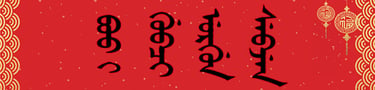
What Cultural Value Does Manchu Script Have Today Beyond History?
Discover the cultural value of Manchu script today, from identity and family heritage to calligraphy, contemporary art, language revitalization, and digital culture.
MING YE
10/28/20269 min read
What Cultural Value Does the Manchu Script Have Today Beyond Historical Research?
Cultural Identity, Calligraphy, Language Revitalization, Artistic Innovation, and the Future of Manchu Heritage
By MING YE
The Manchu script is often associated with the Qing dynasty, imperial archives, historical documents, and the study of China's last imperial ruling house.
Its importance to historical research is undeniable. Manchu-language records provide valuable evidence for understanding Qing government, diplomacy, military affairs, ethnic relations, and cultural institutions.
But does the Manchu script have any value beyond helping historians understand the past?
Yes. The Manchu script continues to have cultural, artistic, educational, and symbolic significance in the modern world.
It represents more than an old method of recording information. It is a distinctive writing tradition connected with language, cultural identity, collective memory, and artistic expression.
Today, Manchu can serve as a medium for calligraphy, contemporary art, cultural education, family heritage, and digital creativity.
It also offers opportunities to explore how traditional writing systems can acquire new meanings after losing many of their former everyday functions.
However, the cultural value of Manchu should not be confused with claims that the language remains widely spoken.
Modern Manchu cultural identity, knowledge of the script, and fluency in spoken Manchu are different things.
The script's contemporary significance lies partly in its ability to connect these different dimensions of cultural heritage.
1. The Manchu Script as a Symbol of Cultural Identity
One of the most important contemporary functions of the Manchu script is its connection with Manchu cultural identity.
During the Qing dynasty, Manchu was closely associated with the ruling house and the Eight Banners.
However, the relationship between Manchu identity and language changed substantially over time.
Many Manchu families gradually adopted Chinese as their principal spoken language, particularly in Beijing and other predominantly Chinese-speaking environments.
After the Qing dynasty ended in 1912, the institutional position of Manchu declined further.
Today, the overwhelming majority of people identifying as Manchu do not use Manchu as their everyday language.
Nevertheless, language loss does not necessarily eliminate cultural identity.
A community may continue to preserve its historical traditions, family memories, customs, and sense of belonging even when its ancestral language is no longer widely spoken.
For some people, learning to recognize or write Manchu characters provides a tangible connection with that heritage.
The script can appear in cultural exhibitions, educational materials, family-history projects, and artistic works.
Its significance is therefore not limited to practical communication.
Manchu writing can function as a visible expression of cultural continuity, even among people who are not fluent Manchu speakers.
At the same time, Manchu identity should not be reduced to knowledge of the script.
Ethnic identity is shaped by multiple historical and social factors, and individuals relate to their heritage in different ways.
2. Manchu Calligraphy as a Living Artistic Tradition
The Manchu script possesses distinctive visual characteristics that make it particularly suitable for calligraphic expression.
Traditional Manchu writing is arranged vertically, with letters connected from top to bottom and columns progressing from left to right.
Its forms include flowing vertical strokes, curved connections, dots, circles, and variations in letter structure.
These characteristics create visual possibilities that differ from those of Chinese, Latin, and many other writing systems.
Manchu calligraphy can be studied through several dimensions.
The first is the accuracy of the written language.
A calligraphic work must distinguish between the intended characters and their decorative presentation.
The second is the structure of the script.
Letter proportions, connections, spacing, and column arrangement influence the overall composition.
The third is artistic expression.
The calligrapher may explore rhythm, balance, brush movement, line quality, and the relationship between written forms and empty space.
These artistic decisions transform writing into a visual composition.
Manchu calligraphy can therefore be appreciated both as language and as art.
However, it is important to distinguish historically documented calligraphic practices from contemporary artistic experimentation.
Not every modern decorative form should automatically be described as an established historical style.
Contemporary artists may legitimately create new interpretations, but their innovations should be identified as such.
The continued practice and development of Manchu calligraphy demonstrates that the script can remain artistically productive even when its everyday communicative use has declined.
3. The Cultural Significance of Manchu Seal Script
Manchu seal-script calligraphy provides a particularly interesting example of the relationship between historical writing and artistic transformation.
Decorative Manchu letter forms can emphasize geometry, symmetry, ornamentation, and carefully structured compositions.
Such works may be inspired by historical seal-script traditions or developed through contemporary artistic interpretation.
Their significance lies partly in the transformation of ordinary written characters into visually distinctive designs.
However, the term Manchu seal script requires careful historical and artistic interpretation.
Different works may employ different principles of stylization.
Some forms are based on identifiable historical examples, while others represent modern experiments.
These categories should not be treated as interchangeable.
The study of Manchu seal-script art therefore involves both calligraphy and the history of writing.
A successful artistic interpretation must consider whether the original letters remain identifiable and whether the composition preserves meaningful relationships with Manchu orthography.
This is especially important when decorative forms are adapted for contemporary design.
If the visual transformation becomes too extreme, the result may no longer function as readable writing.
That does not necessarily eliminate its artistic value, but it changes the nature of the work.
Manchu seal-script art illustrates how a historical writing system can become a source of contemporary visual creativity.
4. Manchu Writing and the Preservation of Family Heritage
The Manchu script can also contribute to the preservation of family and clan heritage.
Manchu history includes extensive traditions of clan organization, genealogical records, personal names, and family identity.
Many historical names and terms were recorded in Manchu.
Modern descendants may encounter these forms through family documents, inscriptions, archival materials, or historical publications.
Learning the script can help individuals understand how names and expressions were represented in their original linguistic context.
This is particularly valuable because Chinese transcriptions do not always preserve every distinction found in Manchu pronunciation or spelling.
However, historical names require careful interpretation.
A Chinese surname does not necessarily correspond to a single Manchu clan name.
Likewise, similarities in pronunciation do not automatically establish a genealogical relationship.
The Manchu script can provide valuable evidence, but it cannot independently prove family ancestry.
Its role is best understood as one component of responsible historical and genealogical research.
Beyond formal genealogy, Manchu writing can also have personal cultural significance.
A family may choose to study traditional names, preserve written expressions, or incorporate the script into educational activities.
Such practices allow the writing system to participate in contemporary family memory rather than remaining confined to archival collections.
5. Manchu as a Resource for Language Education and Revitalization
The Manchu script has an important role in modern language education.
Although traditional spoken Manchu is severely endangered, interest in learning the language continues.
Educational activities include alphabet instruction, vocabulary study, grammar lessons, historical text reading, and calligraphy.
The script provides a foundation for several of these activities.
Students who learn to recognize Manchu letters can begin reading simple words and sentences.
More advanced learners may study historical documents or compare written forms with modern linguistic descriptions.
However, reading and writing should not be confused with conversational fluency.
A student may become proficient in reading historical Manchu without being able to speak it naturally.
Likewise, a person may learn decorative calligraphy without developing a comprehensive understanding of Manchu grammar.
These activities are valuable, but they represent different forms of engagement with the language.
For revitalization efforts, written instruction can support vocabulary development and linguistic awareness.
Yet the long-term survival of a spoken language depends especially on opportunities for regular communication and intergenerational transmission.
The Manchu script is therefore an important educational resource, but it is not a substitute for spoken-language learning.
Its greatest contribution to revitalization may come when reading, writing, pronunciation, and meaningful language use are developed together.
6. The Manchu Script in Contemporary Art and Cultural Design
Historical writing systems often acquire new artistic functions in modern society.
Manchu offers opportunities for contemporary visual expression because of its distinctive letter structures and vertical composition.
Artists and designers can explore its use in paintings, prints, book design, exhibitions, cultural publications, and other creative media.
The script may also inspire typography and digital graphic design.
However, artistic use introduces questions of accuracy and cultural responsibility.
A design that merely imitates the appearance of Manchu without using authentic characters may create a misleading impression.
Similarly, decorative text may contain spelling errors or meaningless character combinations.
These problems become particularly significant when a design claims to represent a historical quotation, personal name, or cultural expression.
A responsible approach distinguishes between three possibilities:
Authentic Manchu text presented in a decorative style.
Contemporary artistic interpretation based on recognizable Manchu letter forms.
Abstract visual design inspired by the general appearance of the script.
All three may have artistic value.
However, they should not be described as identical forms of linguistic or cultural expression.
This distinction helps protect the integrity of the writing system while allowing contemporary artists to experiment creatively.
The Manchu script need not remain visually unchanged to retain cultural relevance.
But innovation becomes more meaningful when it is informed by knowledge of the original writing tradition.
7. Digital Technology Gives Manchu New Cultural Possibilities
The digital age has created opportunities that were unavailable to earlier generations of Manchu learners and researchers.
Unicode provides standardized encoding for Manchu within the broader Mongolian script framework.
This allows Manchu characters to be stored and processed as digital text.
Compatible fonts, input methods, and software can support typing, reading, searching, and publishing.
These technologies make it possible to create online dictionaries, educational websites, digital manuscript collections, and interactive learning resources.
They also make Manchu more accessible to people who do not live near institutions specializing in the language.
A learner may encounter Manchu through a smartphone, an online lesson, or a digital exhibition.
A researcher may consult scanned documents and searchable transcriptions.
An artist may develop digital compositions using Manchu letter forms.
These activities represent different kinds of cultural engagement, but they share a common technological foundation.
Digital access also creates challenges.
Not every font displays Manchu accurately.
Some software has difficulty with contextual shaping and traditional vertical writing.
Older custom-font systems may produce text that cannot be searched or copied reliably.
Consequently, digital preservation requires more than uploading images of Manchu characters.
Reliable resources should preserve accurate text, appropriate visual presentation, and sufficient information about the materials being displayed.
Digital technology can expand the cultural reach of Manchu, but the quality of that expansion depends on linguistic accuracy and responsible presentation.
8. Can Manchu Become Part of Contemporary Cultural Life?
Yes, but contemporary cultural relevance should not be measured solely by the number of native speakers.
A writing system can remain culturally meaningful through education, artistic practice, scholarship, family heritage, and public engagement.
Manchu provides opportunities in all these areas.
Its continued cultural development does not require a return to the political institutions of the Qing dynasty.
Nor does it require treating every historical practice as something that must be reproduced unchanged.
Instead, modern cultural activity can establish new relationships with the script.
For example, Manchu may be introduced through exhibitions that explain its historical development and visual characteristics.
Educational projects can connect language instruction with calligraphy and cultural history.
Artists can create contemporary works that respect the script's structural principles while exploring new forms.
Digital platforms can make reliable information available to international audiences.
These activities can help transform Manchu from a subject encountered primarily in historical archives into a cultural resource that people can actively study and use.
However, such efforts should avoid exaggerating the language's current vitality.
The existence of modern Manchu art or online educational content does not demonstrate that Manchu has returned to widespread everyday use.
Cultural revival and spoken-language revitalization are related but distinct processes.
Recognizing this difference makes it possible to appreciate contemporary achievements without misrepresenting the language's endangered condition.
Conclusion: What Cultural Value Does Manchu Have Today?
The Manchu script has cultural value far beyond its importance to Qing historical research.
It remains a distinctive form of written heritage associated with Manchu identity, language, calligraphy, family memory, and artistic expression.
Its vertical structure and connected letter forms offer possibilities for traditional calligraphy and contemporary visual design.
Its written tradition provides a foundation for language education and cultural revitalization.
Digital technology has also created new opportunities to preserve, teach, and share Manchu with audiences around the world.
At the same time, these developments should be understood realistically.
Manchu is no longer widely spoken as an everyday language, and cultural interest alone does not guarantee the recovery of natural intergenerational transmission.
Nevertheless, the script's significance is not determined exclusively by the number of people who speak it.
A writing system can remain culturally alive when people continue to study it, create with it, teach it, and find meaningful connections between its historical heritage and contemporary life.
The Manchu script is therefore more than a source of information about the past.
It is also a cultural resource through which historical memory, artistic creativity, and modern identity can continue to develop.
Its future cultural value will depend not only on preserving what earlier generations created but also on the knowledge, care, and creativity with which new generations engage with it.
— MING YE
References and Research Materials
Historical and Linguistic Sources
Manwen Laodang (满文老档, Old Manchu Archives). Early Manchu-language historical records.
Yuzhi Qingwen Jian (御制清文鉴, Imperially Commissioned Mirror of the Manchu Language). An important historical Manchu dictionary.
Yuzhi Zengding Qingwen Jian (御制增订清文鉴, Imperially Commissioned Expanded and Revised Mirror of the Manchu Language).
First Historical Archives of China. Qing Manchu-language documents, genealogical materials, and imperial records.
National Palace Museum, Taipei. Qing archival collections and historical Manchu writing.
Academic Research
Mark C. Elliott, The Manchu Way: The Eight Banners and Ethnic Identity in Late Imperial China (2001).
Pamela Kyle Crossley, Orphan Warriors: Three Manchu Generations and the End of the Qing World (1990).
Pamela Kyle Crossley, A Translucent Mirror: History and Identity in Qing Imperial Ideology (1999).
Gertraude Roth Li, Manchu: A Textbook for Reading Documents (2000).
Jerry Norman, A Comprehensive Manchu-English Dictionary (2013).
Liliya M. Gorelova, Manchu Grammar (2002).
Juha Janhunen, Manchuria: An Ethnic History (1996).
Cultural Preservation and Digital Resources
UNESCO, Convention for the Safeguarding of the Intangible Cultural Heritage (2003). International framework for safeguarding living cultural traditions.
UNESCO, Language Vitality and Endangerment (2003). Framework for evaluating language vitality and transmission.
Unicode Consortium, The Unicode Standard, Mongolian script documentation. Technical framework for digital representation of Manchu.
World Wide Web Consortium (W3C), Internationalization Resources. Guidance on multilingual digital publishing.