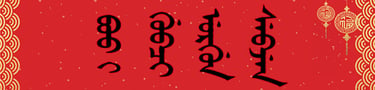
What Are the Manchu Twelve Heads? Traditional Alphabet Guide
What are the Manchu Twelve Heads (满文十二字头)? Explore traditional syllable tables, connected letters, historical teaching methods, and their role in Manchu calligraphy.
MING YE
11/11/20269 min read
What Are the Twelve Syllabic Sections of the Manchu Alphabet?
Understanding the Manchu Twelve Heads, Their Structure, Historical Origins, and Role in Traditional Language Education
By MING YE
What exactly are the “Twelve Heads” of the Manchu script, traditionally known in Chinese as Manwen Shier Zit ou (满文十二字头, more commonly romanized as Manwen Shier Zitou)?
The term is frequently encountered in discussions of traditional Manchu language education, alphabet charts, and historical teaching materials. However, it is sometimes misunderstood as referring to twelve letters, twelve independent characters, or twelve different writing styles.
The Manchu Twelve Heads are a traditional system for organizing and teaching Manchu syllabic spellings. They are not twelve letters or twelve calligraphic styles.
The system groups written syllable patterns into twelve instructional categories, allowing students to study how Manchu letters combine to represent sounds.
Although Manchu is an alphabetic writing system, its connected letterforms and positional variations make syllable-based practice particularly useful.
The Twelve Heads provide a structured bridge between recognizing individual letters and reading complete words.
They have played an important role in traditional Manchu literacy education and remain relevant to modern learners, teachers, calligraphers, and researchers.
To understand the system correctly, it is necessary to distinguish the Manchu alphabet itself from the traditional method used to teach its combinations.
1. What Does “Twelve Heads” Mean?
The Chinese expression 满文十二字头 literally refers to twelve headings or sections used to organize Manchu syllabic forms.
The word zitou (字头) is best understood here as an instructional heading or category rather than an independent Chinese character.
In traditional Manchu educational practice, syllable tables arranged combinations of vowels and consonants into organized groups.
The purpose was to make the script easier to learn and to provide students with a systematic method for practicing its written forms.
This approach reflects the structure of Manchu writing.
Unlike Chinese characters, which generally function as individual graphic units representing morphemes, Manchu letters combine alphabetically.
However, unlike Latin letters in ordinary English typography, Manchu letters are connected and change shape according to their position.
A learner must therefore understand not only the individual letters but also their combinations.
The Twelve Heads help organize these combinations into a manageable teaching sequence.
The system should not be confused with the total number of Manchu letters.
It also does not imply that Manchu has only twelve possible syllables.
Rather, each heading represents a category containing multiple written combinations.
The Twelve Heads are an instructional classification of syllable patterns, not an inventory of twelve alphabetic symbols.
2. How Are the Twelve Heads Organized?
Traditional presentations of the Twelve Heads commonly organize Manchu syllabic patterns according to their structure.
The arrangement begins with simple vowel syllables and progresses through increasingly complex combinations involving consonants and final sounds.
The following table summarizes the conventional twelve-part organization in Romanized structural notation.
SectionGeneral syllable patternExplanationFirst HeadVVowel-only syllablesSecond HeadCVConsonant followed by a vowelThird HeadVCVowel followed by a final consonantFourth HeadCVCConsonant–vowel–consonant combinationsFifth HeadVCCVowel with a two-consonant endingSixth HeadCVCCConsonant–vowel combinations with a two-consonant endingSeventh HeadCCVTwo-consonant onset followed by a vowelEighth HeadCCVCTwo-consonant onset with a final consonantNinth HeadCCVCCComplex onset and ending combinationsTenth HeadVCCCVowel followed by a more complex consonant endingEleventh HeadCVCCCConsonant–vowel sequence with a more complex endingTwelfth HeadCCVCCCMore complex combinations involving onset and final consonants
In this notation, C represents a consonant and V represents a vowel.
This table is a schematic explanation of increasing structural complexity, rather than a diplomatic transcription of a particular historical Twelve Heads chart. Traditional teaching tables must be consulted for their actual section contents and order; they should not be assumed to correspond mechanically to every possible combination shown above.
The important principle is that the system arranges written forms into recognizable patterns.
Students begin with simpler combinations and proceed toward forms requiring greater familiarity with letter connections.
Not every theoretically possible combination corresponds to an ordinary Manchu syllable or a standard written form.
Historical tables reflect the spelling conventions and instructional practices of the Manchu writing tradition.
The Twelve Heads are best understood through authentic historical syllable charts, not through an unrestricted mathematical combination of consonants and vowels.
3. Why Did Traditional Manchu Education Use Syllable Tables?
The use of syllable tables reflects a practical educational problem.
Manchu is alphabetic, but recognizing isolated letters does not automatically prepare a learner to read connected writing.
The appearance of a letter can change depending on whether it occurs at the beginning, middle, or end of a written sequence.
Some distinctions are also indicated by dots, circles, and other graphical details.
A student who memorizes an alphabet chart may therefore still struggle to recognize the same letters in words.
Syllable-based practice helps address this problem.
By studying recurring combinations, learners become familiar with how letters connect in actual writing.
The method also supports pronunciation.
Rather than learning letters exclusively as abstract shapes, students encounter them in combinations corresponding to pronounceable units.
This provides a connection between writing and speech.
Traditional Manchu education required students to develop practical reading skills for administrative, military, educational, and other purposes.
A systematic introductory method was therefore useful.
The Twelve Heads supplied a framework through which learners could repeatedly practice common structural patterns.
The system also allowed instructors to organize lessons in a consistent sequence.
Although teaching practices varied across historical contexts, the underlying objective was clear: to make the connected alphabet easier to recognize and use.
The educational importance of the Twelve Heads lies in their ability to turn knowledge of individual letters into practical familiarity with written combinations.
4. Are the Twelve Heads the Same as the Manchu Alphabet?
No. The Manchu alphabet and the Twelve Heads are related but different concepts.
The alphabet consists of the letters used to represent the language.
The Twelve Heads organize combinations of those letters for teaching and practice.
This distinction can be compared with learning English.
An English-speaking child may first study the alphabet.
The child then learns combinations such as ba, be, bi, and bo.
These combinations are not additional letters.
They are patterns formed from letters.
The same general distinction applies to Manchu, although the connected structure of Manchu writing makes the visual aspect of syllable practice especially important.
The Manchu alphabet provides the basic symbols.
The Twelve Heads provide an organized method for practicing their combinations.
The relationship can be summarized as follows:
FeatureManchu alphabetTwelve HeadsMain purposeIdentify the letters of the scriptOrganize syllabic combinationsBasic contentIndividual letters and their formsConnected letter combinationsEducational roleEstablish script recognitionDevelop reading and spelling familiarityRelationship to pronunciationRepresents speech soundsPractices combinations of soundsRelationship to calligraphyProvides basic letter structureProvides models for connected writing
The distinction is particularly important for beginners.
A student who has memorized the Twelve Heads may possess useful knowledge of common written combinations.
However, this does not automatically mean the student understands Manchu vocabulary or grammar.
Likewise, someone familiar with the individual letters may still benefit from syllable-based practice.
The alphabet teaches what the letters are; the Twelve Heads help teach how those letters combine.
5. What Is the Historical Background of the Twelve Heads?
The historical background of the Twelve Heads is connected to the development and teaching of the Manchu script.
The script was created in 1599 through adaptation of traditional Mongolian writing during the rule of Nurhaci.
In 1632, an important reform associated with Dahai introduced graphical distinctions that improved the representation of certain sounds.
As Manchu became an important language of the Qing state, the need for systematic literacy instruction increased.
The Qing administration employed Manchu in official documents, correspondence, historical records, and educational materials.
Language instruction therefore required practical methods for teaching spelling and reading.
Syllable tables were well suited to this purpose.
They organized the combinations of the alphabet into a form that students could study systematically.
The Twelve Heads became associated with the traditional introductory presentation of Manchu syllabic spelling.
However, a distinction should be made between the creation of the Manchu script and the historical documentation of particular teaching arrangements.
The fact that the script originated in 1599 does not establish that every later instructional chart existed in its familiar form at that date.
The precise development of particular Twelve Heads tables should be studied through dated educational manuscripts, printed primers, and related historical sources.
Different surviving materials may also vary in presentation or instructional detail.
The Twelve Heads belong to the history of Manchu literacy education, but their individual historical forms should be examined through primary teaching materials rather than assumed to have remained unchanged from the script's creation.
6. Why Are the Twelve Heads Useful for Learning Manchu Today?
The Twelve Heads remain useful because they address a challenge that modern beginners still encounter.
Manchu letters are connected and position-dependent.
Learning isolated symbols is not enough for confident reading.
Syllable tables allow students to practice recurring written combinations.
This helps develop recognition of letter connections and positional forms.
The method can also reinforce pronunciation and spelling.
For example, a learner who understands the basic vowel system can begin examining how vowels combine with different consonants.
The student can then compare the resulting written forms.
Repeated practice makes the structure more familiar.
However, the Twelve Heads should not be treated as a complete language course.
They do not teach the full vocabulary, grammar, or syntax of Manchu.
A learner may recognize many syllabic combinations without understanding the meaning of a sentence.
For this reason, modern instruction should integrate the Twelve Heads with actual vocabulary and grammatical examples.
A useful sequence is to begin with basic letters, introduce the traditional syllable tables, and then practice reading meaningful words.
Students can gradually progress toward simple sentences.
This preserves the educational value of the traditional method while connecting it with practical language comprehension.
The Twelve Heads are most effective when used as a bridge between alphabet study and real Manchu reading.
7. What Is the Relationship Between the Twelve Heads and Manchu Calligraphy?
The Twelve Heads are also relevant to Manchu calligraphy.
Calligraphy requires accurate knowledge of letter structure and connection.
Because Manchu letters change form according to position, a calligrapher must understand how they appear within different written combinations.
Syllable tables provide opportunities to practice these relationships systematically.
A student can use them to study stroke direction, spacing, proportion, and continuity.
Repeatedly writing connected combinations helps develop control over the vertical structure of the script.
This is particularly important for beginners who are accustomed to writing individual Chinese characters or separate Latin letters.
Manchu calligraphy involves a different relationship between the basic written elements.
The artist must maintain continuity without losing the identity of individual letters.
However, syllable practice and artistic calligraphy should not be confused.
A correctly written syllable demonstrates knowledge of the writing system.
A successful calligraphic work requires additional control over composition, rhythm, line quality, and artistic expression.
The Twelve Heads provide technical foundations rather than a complete artistic theory.
They are also distinct from decorative or seal-script-inspired Manchu calligraphy.
The number twelve refers to an instructional classification, not to twelve artistic styles.
For calligraphers, the Twelve Heads can serve as a systematic exercise in connected letterforms, but artistic development requires additional study beyond the syllable tables.
8. What Do Beginners Commonly Misunderstand About the Twelve Heads?
Several misunderstandings arise when the Twelve Heads are discussed without historical or linguistic context.
The first is the assumption that Manchu has only twelve letters.
This is incorrect.
The Twelve Heads are categories of written combinations, not the total number of alphabetic letters.
The second is the belief that the system represents twelve different calligraphic styles.
It does not.
Although the tables can be used for handwriting practice, their primary function is instructional and orthographic.
The third misunderstanding is that memorizing the Twelve Heads is equivalent to mastering the Manchu language.
The tables help learners recognize and reproduce written combinations.
They do not provide a complete understanding of vocabulary, grammar, or historical texts.
The fourth is the assumption that every conceivable consonant–vowel combination belongs to the traditional system.
Authentic Manchu syllable tables reflect established spelling patterns.
They should not be reconstructed simply by combining letters without regard to Manchu phonology and orthography.
The fifth misunderstanding concerns historical uniformity.
Modern reproductions may simplify, reorganize, or reformat traditional teaching materials.
Researchers should distinguish these adaptations from the arrangement of particular historical editions.
Finally, Romanized explanations can be useful, but they do not fully represent the visual structure of connected Manchu writing.
To understand the Twelve Heads as a traditional literacy system, learners should examine correctly rendered Manchu forms.
The central mistake is treating the Twelve Heads as a list of twelve symbols rather than a structured method for learning the combinations of the Manchu alphabet.
Conclusion: What Exactly Are the Manchu Twelve Heads?
The Manchu Twelve Heads are a traditional twelve-part instructional system for organizing and practicing Manchu syllabic spellings.
They are neither twelve independent letters nor twelve calligraphic styles.
Their purpose is to help learners understand how the letters of the Manchu alphabet combine into connected written forms.
This is particularly important because Manchu is written vertically and its letters change shape according to position.
The system reflects the practical needs of traditional Manchu literacy education.
It also remains relevant to modern learners who want to develop accurate reading and handwriting skills.
For students of Manchu calligraphy, the Twelve Heads provide useful exercises in letter connection, proportion, and structural consistency.
For language learners, they offer a bridge between alphabet recognition and the reading of complete words.
However, the Twelve Heads are only one part of Manchu education.
Vocabulary, grammar, pronunciation, and reading practice are also necessary for genuine language proficiency.
Historical research should further distinguish authentic traditional syllable charts from modern explanatory reconstructions.
The lasting significance of the Twelve Heads is that they transform the Manchu alphabet from a collection of individual letters into a systematic framework for learning connected writing.
Understanding this distinction is an important step toward appreciating both the linguistic structure and the educational history of the Manchu script.
— MING YE
References and Research Materials
Linguistic and Educational Studies
Gertraude Roth Li, Manchu: A Textbook for Reading Documents (2000).
Jerry Norman, A Comprehensive Manchu-English Dictionary (2013).
Liliya M. Gorelova, Manchu Grammar (2002).
Paul Georg von Möllendorff, A Manchu Grammar (1892).
Erich Hauer, Handwörterbuch der Mandschusprache (1952–1955).
Juha Janhunen, Manchuria: An Ethnic History (1996).
Primary Historical and Educational Materials
Traditional Manchu alphabet primers and Twelve Heads syllable charts (满文十二字头), with attention to the arrangement and dating of individual editions.
Yuzhi Qingwen Jian (御制清文鉴, Imperially Commissioned Mirror of the Manchu Language).
Yuzhi Zengding Qingwen Jian (御制增订清文鉴, Imperially Commissioned Expanded and Revised Mirror of the Manchu Language).
Manwen Laodang (满文老档, Old Manchu Archives).
Research Collections
First Historical Archives of China. Historical Manchu manuscripts and related documentary collections.
The Palace Museum, Beijing. Qing manuscripts and Manchu-language cultural materials.
National Palace Museum, Taipei. Qing multilingual manuscripts and historical collections.
Research note: The conventional Twelve Heads should be studied from actual Manchu syllable tables. Abstract consonant–vowel formulas are useful for explaining syllable structure but should not be presented as verified transcriptions of the twelve historical sections without reference to a specific source.