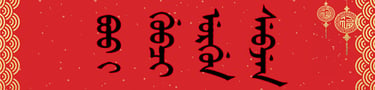
Rethinking Manchu through the International Phonetic Alphabet: The Relationship Between Sound, Script, and Manchu Calligraphy
Rethinking Manchu through the International Phonetic Alphabet: The Relationship Between Sound, Script, and Manchu Calligraphy
ACADEMIC VIEWS
MING YE
9/23/20267 min read


Rethinking Manchu through the International Phonetic Alphabet: The Relationship Between Sound, Script, and Manchu Calligraphy
By MING YE
When people begin learning Manchu, one of the first things they usually encounter is the alphabet.
How is a letter written? How are words formed? How are letters combined into syllables? These are among the most visible and immediate aspects of learning the Manchu script. Yet as one goes deeper, an unavoidable question emerges:
How should the words we see in Manchu script actually be pronounced?
This seemingly simple question involves three closely related concepts that should not be treated as identical:
the Manchu language, the Manchu script, and Manchu transliteration.
Manchu is first of all a language. The Manchu script is the writing system used to record that language. Romanized transliteration and the International Phonetic Alphabet, or IPA, are modern tools that help us record, analyze, and understand its sounds.
If these different levels are not clearly distinguished, it is quite possible to recognize Manchu letters and read their transliterations without fully understanding the sounds represented by them.
For me, whether one is studying the Manchu language or practicing Manchu calligraphy, this question cannot ultimately be avoided.
Because Manchu writing is not simply a collection of static visual forms. It was created to record a spoken language.
I. Transliteration Is Not the Same as Pronunciation
Modern students of Manchu frequently use Roman letters to transliterate the script.
This is extremely useful.
It allows people who are not yet familiar with Manchu letters to record words, while also making dictionaries, cataloguing, searching, teaching, and international academic communication much easier.
But one point must be made clear:
The primary purpose of transliteration is to represent writing, not to reproduce speech in every phonetic detail.
The appearance of a Latin letter in a Manchu transliteration system does not necessarily mean that it should be pronounced in the same way as a similar letter in modern English or in Chinese Pinyin.
This is where the International Phonetic Alphabet becomes useful.
The IPA does not simply ask, “Which Roman letter should be used to transliterate this Manchu letter?” Instead, it asks a more precise question:
How is this sound actually produced?
In the Manchu IPA materials examined here, consonants are further described according to their place and manner of articulation, including distinctions involving the tongue, lips, stops, fricatives, affricates, and aspirated versus unaspirated sounds.
This reminds us of an important distinction:
script, transliteration, and pronunciation exist at three different levels.
They are closely connected, but they are not interchangeable.
II. Aspiration and Non-Aspiration as an Entry Point into Manchu Consonants
For native speakers of Chinese, the distinction between aspirated and unaspirated consonants is not entirely unfamiliar.
Modern Mandarin itself makes extensive use of this contrast.
The Manchu consonant charts presented in these materials likewise distinguish several consonants according to aspiration, including pairs of voiceless stops and affricates articulated at similar positions but differentiated by whether a strong release of air is present.
When viewed only through Romanized transliteration, some of these relationships may not be immediately obvious. When represented through the IPA, however, their phonetic relationships become much clearer.
Two sounds may share a similar place of articulation while differing significantly in aspiration.
For language learners, this distinction is important.
Instead of memorizing only:
“This letter is pronounced like this,”
we can gradually begin asking more precise questions:
Where is the tongue positioned? How is the airflow released? Is the sound aspirated? Is it a stop, a fricative, or an affricate?
Once these questions become familiar, Manchu pronunciation begins to emerge as an organized phonetic system rather than a collection of sounds memorized through imitation.
III. Some Manchu Sounds Cannot Be Accurately Explained through Chinese Characters Alone
Chinese-language Manchu instruction has long made practical use of Chinese descriptions and approximations to explain pronunciation.
For beginners, this can be extremely helpful.
Terms describing tongue position, lip position, aspiration, and non-aspiration can quickly guide Chinese-speaking learners toward an approximate articulation.
There is, however, an important limitation:
A Chinese phonetic approximation can help us approach a Manchu sound, but it cannot always define that sound precisely.
This becomes particularly important when a Manchu sound does not correspond exactly to a phoneme in modern Mandarin. If we insist on finding the “closest Chinese sound,” learners may eventually mistake an approximation for an exact equivalence.
This is one of the reasons the International Phonetic Alphabet is useful.
It provides a system for describing speech sounds that is relatively independent of any single language or writing system.
In my view, a practical approach to learning Manchu pronunciation should therefore neither abandon traditional Chinese explanations nor require every beginner to master advanced phonetics from the outset. Instead, several tools can be used together:
Manchu letters tell us what is written;
Romanized transliteration helps us record, search, and identify words;
Chinese phonetic explanations provide an accessible starting point for Chinese-speaking learners;
and the IPA allows us to approach the actual phonetic values more precisely.
These methods do not compete with one another. They serve different purposes.
IV. Understanding Manchu Vowels through the IPA Vowel Chart
Vowels may appear simpler than consonants, but their phonetic relationships are often more complex than they first seem.
In everyday speech, we tend to think of a vowel as a single, straightforward sound. From a phonetic perspective, however, vowels are distinguished by factors such as tongue height, tongue position from front to back, and whether the lips are rounded.
The IPA vowel chart provides a visual way of representing these relationships.
Its vertical dimension broadly corresponds to tongue height, while its horizontal dimension represents the front-to-back position of the tongue. Sounds in similar positions may also be distinguished according to whether they are rounded or unrounded.
Placing Manchu vowels within this framework has an important advantage: it helps us move away from the habit of forcing Manchu pronunciation into the categories of Chinese Pinyin.
We begin to see that:
Manchu vowels are not merely a collection of isolated letters. They form a system of related sounds.
For learners, this understanding can be more useful than simply memorizing how each vowel is “supposed to sound.”
Once a learner begins to understand where vowels are formed in the mouth, unfamiliar words can be approached through an existing phonetic framework rather than through memorization alone.
V. Why Does Pronunciation Matter to Manchu Calligraphy?
One might reasonably ask:
If my purpose is simply to practice Manchu calligraphy, why should I study the International Phonetic Alphabet?
For me, this question is particularly interesting.
Calligraphy is primarily visual, while pronunciation belongs to the auditory world. At first glance, the two seem to have little direct connection.
But the situation changes once we understand Manchu as an actual writing system.
Manchu letters are not decorative symbols placed together arbitrarily. They connect within words. The spelling of a word and the combinations of letters within it are directly related to the language itself.
If we merely imitate the outward appearance of a Manchu word, what we see is:
line.
But when we understand its pronunciation, structure, and meaning, what we begin to see is:
writing.
For calligraphic creation, these are not the same thing.
I have always believed that Manchu calligraphy can and should allow transformation. Artists should be free to explore new lines, structures, and visual forms.
But transformation should begin with understanding.
Changing a structure without knowing why it exists is fundamentally different from understanding why it exists and then deliberately transforming it.
This is where linguistic study and calligraphic practice truly meet.
VI. The Connected Structure of Manchu Emerges from Both Language and Script
One of the most distinctive visual features of Manchu calligraphy is its vertical continuity.
Chinese characters generally function as relatively self-contained visual units. In Manchu, letters change according to their positions within words and connect vertically to form larger written structures.
A Manchu word is therefore both a linguistic unit and a visual structure.
Once written on paper, its sound temporarily “disappears,” leaving us with lines. Yet those lines did not develop randomly.
Behind them is language.
This is something I pay particular attention to in my own Manchu calligraphy:
The line may be free, but the writing must have a foundation.
When a calligrapher genuinely understands how a word is constructed, how it is pronounced, and what it means, the visual treatment of that word also begins to change.
At that point, calligraphy is no longer simply the imitation of letterforms. It becomes a visual expression of language.
VII. From “Learning the Alphabet” to Understanding Manchu
Learning Manchu today is in many ways easier than it was in the past.
We have textbooks, dictionaries, Romanized transliteration systems, digital fonts, audio materials, and the International Phonetic Alphabet.
Yet the more tools we have, the easier it can become to separate the learning process into unrelated parts:
Learning the alphabet becomes one task.
Learning transliteration becomes another.
Pronunciation becomes another.
And calligraphy becomes something else entirely.
In my view, these elements should be connected again.
A more complete learning process might look like this:
See the Manchu script → recognize the letters → understand the transliteration → learn the pronunciation → understand the word → write it.
For those who move further into calligraphy and artistic creation, the process can continue:
Understand the writing → understand its structure → control the line → transform the form → create the work.
This is why I do not see a modern linguistic tool such as the International Phonetic Alphabet as being in conflict with traditional Manchu writing.
On the contrary, it helps contemporary learners rediscover the sounds that exist behind the written forms.
VIII. Manchu Is a Script, but Behind the Script Is Always a Language
When we look at a work of Manchu calligraphy today, what first attracts us may be its elongated structure, continuous lines, and distinctive visual character.
These qualities are part of what makes Manchu writing so compelling.
But if only the lines remain, while the sounds, words, and meanings behind them are forgotten, Manchu can easily be reduced to a decorative symbol associated vaguely with history or an “Eastern” aesthetic.
That is not how I understand Manchu calligraphy.
I want Manchu writing to develop new forms in contemporary art, and I am interested in exploring new relationships between Manchu, Chinese, English, and other writing systems.
But all such experimentation should begin from one place:
First, understand the writing itself.
And understanding a writing system cannot end with knowing what it looks like.
We should also know:
how its words are formed,
how they are pronounced,
what they mean,
and why they are written as they are.
The International Phonetic Alphabet is only one modern tool for entering this world.
What truly matters is the sound system that lies behind those phonetic symbols—and behind that sound system is the Manchu language, once spoken, read, written, and used in everyday human communication.
For today’s students and practitioners of Manchu writing, perhaps the relationship can be expressed simply:
First hear the language, then see the script. Once you understand the script, you can truly begin to write it.
MING YE
Manchu Calligraphy Artist / Researcher of Manchu Writing and Visual Culture