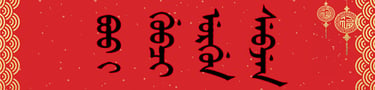
Reading a Manchu Translation of The Art of War: Manchu Writing, Translation, and Visual Order
Reading a Manchu Translation of The Art of War: Manchu Writing, Translation, and Visual Order
Reading a Manchu Translation of The Art of War: Manchu Writing, Translation, and Visual Order
9/23/20265 min read


Reading a Manchu Translation of The Art of War: Manchu Writing, Translation, and Visual Order
By MING YE
The Art of War is one of the most widely transmitted works of classical Chinese thought. Discussions of the text today usually focus on military philosophy, strategic principles, or its translation and circulation across different languages. When I examine an old Manchu version of The Art of War, however, my attention is drawn to a somewhat different question:
What happens when a classical Chinese text enters the Manchu language?
This transformation takes place on at least three levels: language, writing, and the visual order created when a text is reorganized through another writing system.
For those who study the Manchu language, read the Manchu script, or practice Manchu calligraphy today, historical texts such as this offer valuable material for understanding all three.
I. A Manchu Translation Is More Than Replacing Chinese Characters with Manchu Script
One common misunderstanding about translating classical Chinese texts is that the process simply involves finding Manchu equivalents for individual Chinese words and replacing one with another.
In practice, the process is far more complex.
Classical Chinese is highly condensed. Many sentences in The Art of War are extremely brief while containing complex relationships of meaning and logic. When such passages are rendered in Manchu, the translator must do more than ask, “What is the Manchu word for this Chinese expression?” The more important question is how the meaning of the original can be reconstructed within the grammatical structure of the Manchu language.
The surviving pages make this distinction visually apparent. The Manchu text forms continuous vertical lines, while Chinese characters appear alongside it as corresponding or supplementary textual information. Although the two languages convey related content, they do not assume the same visual form. Each follows the structural principles of its own writing system.
For this reason, Manchu in such a text should not be treated merely as an auxiliary notation attached to Chinese.
It is, first of all, a language.
Only when we approach it as Manchu language can we begin to understand its value as a written system.
This is also why I have long believed that the study of Manchu must pay attention to both the language and the script. The script tells us how something is written; the language helps us understand why it is written that way.
II. The Vertical Structure of Manchu Changes the Visual Rhythm of the Page
If we temporarily set aside the meaning of the words and look at these pages simply as visual objects, one characteristic immediately becomes apparent.
Manchu writing possesses a strong vertical movement.
Letters connect to form words, and words develop downward along the vertical axis. When a large amount of Manchu text occupies a page, the first visual impression is therefore not a collection of square units, as in Chinese characters, but a series of vertically oriented lines with their own rhythm and direction.
This is one reason Manchu calligraphy deserves to be studied on its own terms.
In Chinese calligraphy, the individual character often functions as a fundamental visual unit. A single character such as fu (福, fortune) can itself become an independent calligraphic work.
Manchu operates differently.
The visual character of a Manchu word often emerges through the continuous relationship among its letters. Beginning strokes, connections, turns, extensions, and endings work together to form a larger linear structure.
For this reason, I do not think the aesthetics of Chinese calligraphy can simply be transferred unchanged to Manchu calligraphy.
Chinese calligraphy often begins by examining the structure of an individual character. In Manchu calligraphy, we must pay particular attention to the linear relationships created by connected letters.
The pages preserved in this volume provide very direct examples. Even without reading the text, one can see the repetition, density, spacing, and rhythm created by vertical Manchu writing. When Chinese characters are placed within the same page, another visual layer emerges. In the later pages especially, the contrast between the vertical lines of Manchu and the more compact visual blocks of Chinese characters becomes particularly clear.
III. Manchu and Chinese Together: A Dialogue Between Two Writing Structures
Much of my own work with Manchu writing has involved observing what happens when different writing systems occupy the same visual space.
The relationship between Manchu and Chinese is particularly interesting.
The Chinese character tends toward a square structure.
Manchu naturally develops vertically.
One is visually closer to a block; the other is closer to a line.
A Manchu-Chinese composition, therefore, is more than two languages expressing the same sentence. From a visual perspective, it brings two fundamentally different writing structures into a shared space.
In historical texts, such arrangements primarily served practical purposes: reading, translation, education, and the transmission of knowledge. For those working with Manchu calligraphy and contemporary text-based art today, however, they also suggest another possibility:
The differences between writing systems can themselves become part of the composition.
This is why, when I create works combining Manchu and Chinese, Manchu and English, or Manchu, Chinese, and English together, I do not try to force the different scripts into identical visual forms.
Doing so would remove precisely what makes each of them distinctive.
Manchu can retain its vertical extension and flowing line.
Chinese can retain the structural strength of the individual character.
English can contribute horizontal movement and the rhythm of alphabetic forms.
What must ultimately be unified is not the shape of the scripts themselves, but the visual order of the work as a whole.
IV. Historical Manchu Texts as Sources for Understanding Manchu Calligraphy
When Manchu calligraphy is discussed today, attention can easily turn first to brushes, copying models, and calligraphic styles.
But before asking how Manchu should be written beautifully, I believe there is a more fundamental question:
How was Manchu actually written and used historically?
Archives, memorials, inscriptions, dictionaries, translated classics, manuscripts, and printed Manchu books preserve different forms of the script in different contexts.
This version of The Art of War belongs to that broader body of material.
Its pages show Manchu functioning first and foremost as a practical written language carrying continuous textual information. It was not created simply to display isolated examples of beautiful calligraphy. Precisely for this reason, its letterforms, spacing, vertical organization, and relationships between lines can help modern learners understand the natural rhythm of historical Manchu writing.
For me, this point is particularly important.
Manchu calligraphy with genuine vitality should not simply consist of exaggerating Manchu letters, making them decorative, and then describing the result as “artistic.”
It should begin with an understanding of the structure of the script itself.
First understand what the writing is; then consider what it can become.
V. From Historical Texts to Contemporary Manchu Art
Reading historical Manchu texts today does not mean that we must simply reproduce the past.
On the contrary, I believe their greatest value lies in helping us understand the foundations from which Manchu can continue to develop in the present.
If a writing system survives only in museums, archives, and reproductions of old books, it certainly retains historical value. But when people continue to read it, study it, write it, and explore new materials, compositions, and artistic forms through it, the script enters contemporary life again.
This question has remained central to my own practice of Manchu calligraphy.
I work with traditional Manchu script, but I also experiment with Manchu seal-script forms. At times I place Manchu alongside Chinese; at other times, alongside English. The purpose is not to fit as many writing systems as possible into a single composition. Rather, I am interested in finding visual relationships between scripts that genuinely work.
Looking again at this Manchu version of The Art of War, an interesting connection begins to emerge.
Centuries ago, Manchu translators faced the question of how another language could enter Manchu.
Those working with Manchu art today face a different question: how can Manchu enter new visual environments?
The first belongs to translation and the transmission of knowledge; the second belongs to writing and artistic creation.
They are, of course, not the same thing.
Yet both reveal something important:
Manchu has never been merely a system of symbols confined to the past.
Historically, it served translation, record keeping, education, and the circulation of knowledge. Today, it can also participate in calligraphy, design, and cross-script artistic creation.
For me, therefore, the study of Manchu in historical books ultimately returns to the act of writing.
The better we understand how a script was used in the past, the more clearly we can consider how it might be written in the present.
MING YE
Manchu Calligraphy Artist / Researcher of Manchu Writing and Visual Culture