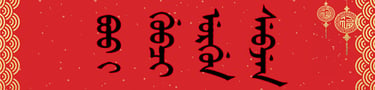
Qing Dynasty Manchu Writing vs. Modern Manchu: Key Differences
Explore how Manchu writing on Qing dynasty artifacts differs from modern Manchu in spelling, dots and circles, calligraphy, imperial seal script, and digital fonts.
MING YE
10/17/202613 min read
How Is Manchu Writing on Qing Dynasty Artifacts Different from Modern Manchu Writing?
Historical Orthography, Calligraphy, Seal Script, Writing Materials, and the Modern Revival of the Manchu Alphabet
By MING YE
A visitor examining a Qing dynasty artifact may encounter a Manchu inscription that looks noticeably different from the Manchu writing found in a modern textbook, digital font, or contemporary calligraphy work.
The historical inscription might appear more elaborate, angular, compressed, or irregular. Some letters may be difficult to recognize. Dots and circles may look different from those in modern printed examples.
Does this mean that Qing dynasty Manchu and modern Manchu use different writing systems?
Not generally.
Most Manchu writing on Qing dynasty artifacts and modern standard Manchu writing belong to the same historical script tradition. The principal differences involve orthographic development, handwriting and calligraphic styles, writing materials, specialized inscriptional forms, and modern digital typography.
However, the comparison requires an important distinction: Qing dynasty writing was not uniform, and modern Manchu writing is not represented by a single universal style.
An early seventeenth-century manuscript, an eighteenth-century imperial seal, and a nineteenth-century palace plaque may look very different from one another.
Similarly, a modern handwritten Manchu inscription may differ substantially from a computer-generated text.
Understanding these variations is essential for identifying, reading, and interpreting Manchu inscriptions on historical artifacts.
1. Are Qing Dynasty Manchu and Modern Manchu the Same Script?
In most cases, yes.
The standard Manchu alphabet used today developed from the writing system established and refined during the late sixteenth and seventeenth centuries.
Manchu belongs to the Tungusic language family.
Its traditional script developed from the vertical writing system used for classical Mongolian.
According to Qing historical accounts, Nurhaci commissioned the creation of an early Manchu script in 1599.
Important reforms associated with Dahai around 1632 helped establish the distinguishing dots and circles characteristic of later standard Manchu orthography.
The script subsequently became an important written language of the Qing state.
Modern students and calligraphers generally learn the later standardized form of this writing system.
Therefore, a reader trained in modern standard Manchu can often recognize historical Qing inscriptions.
However, recognizing the alphabet does not guarantee that every historical inscription will be easy to read.
Differences in spelling conventions, letterforms, terminology, and writing styles may create difficulties.
2. The Most Important Historical Difference: Early and Standardized Manchu
One of the most significant distinctions concerns the early development of Manchu orthography.
The earlier writing tradition is commonly described as tongki fuka akū hergen, or writing without the later standardized dots and circles.
The later system is known as tongki fuka sindaha hergen, referring to writing with distinguishing dots and circles.
The reforms traditionally associated with Dahai around 1632 helped clarify distinctions between letters representing different sounds.
This development is particularly important when examining early Manchu manuscripts.
An inscription from the early seventeenth century may not follow the same graphic conventions as an eighteenth-century official document.
A modern reader who applies later standardized spelling rules without considering the date may incorrectly identify historical letterforms as mistakes.
However, the change should not be understood as an instantaneous replacement of every earlier practice.
Historical orthography developed through actual scribal use, and surviving materials must be evaluated individually.
3. Did the Manchu Alphabet Change Completely During the Qing Dynasty?
No.
The standard Manchu script did not undergo a complete replacement comparable to adopting an entirely unrelated alphabet.
Its basic structure remained recognizable.
Manchu continued to be written vertically.
Letters remained connected within words.
Position-dependent letterforms remained important.
Dots and circles continued to distinguish particular letters in standard orthography.
However, the appearance of the script varied across different historical periods and contexts.
Formal inscriptions could use styles different from ordinary handwriting.
The shape of a letter could also be influenced by the writing instrument or the material on which it appeared.
Therefore, the history of Manchu writing is better understood as the development of a continuing script tradition rather than a sequence of entirely separate alphabets.
4. Why Does Manchu on Qing Artifacts Often Look More Decorative?
Historical inscriptions were frequently designed to suit the objects on which they appeared.
A palace plaque was intended to be seen from a distance.
An imperial seal had to fit within a limited surface.
A stone monument required durable carved lettering.
A ceremonial object might incorporate writing into a larger decorative composition.
These requirements affected the appearance of the script.
Letters could be elongated, compressed, thickened, or stylized.
Some inscriptions emphasized symmetry and visual balance.
Others followed established formal calligraphic conventions.
Modern textbook writing, by contrast, is usually designed for legibility and instruction.
This difference in purpose helps explain why historical inscriptions may look more elaborate than modern printed Manchu.
However, decorative appearance alone does not establish that an inscription is old.
Modern calligraphers can reproduce historical styles.
5. How Did Writing Materials Affect Historical Manchu?
The material of an artifact strongly influenced its lettering.
Manchu written with a brush on paper differs visually from Manchu carved into stone or engraved on metal.
A brush can produce flowing strokes with variations in thickness.
A carving tool creates incised or raised forms according to the material and technique.
Casting can soften small details.
Painting on wood may produce broad, carefully controlled strokes.
These differences can affect the appearance of individual letters.
For example, a small distinguishing dot may look rounded in handwriting but appear as a carved depression on a stone surface.
A connected stroke may be interrupted by wear or damage.
Therefore, historical Manchu inscriptions should not be compared with modern digital fonts solely on the basis of stroke shape.
The production technique must be considered.
6. What Is the Difference Between Historical Handwriting and Modern Printed Manchu?
Historical handwritten Manchu could vary according to the writer's training, purpose, and personal habits.
Letters might be written with flowing connections.
Stroke thickness could change according to brush pressure.
Spacing could be irregular.
Some letters might be abbreviated or formed in ways familiar to contemporary scribes but difficult for modern beginners.
Modern printed Manchu generally aims for consistent letterforms and spacing.
Digital fonts reproduce predefined glyph shapes.
This makes modern text easier to standardize visually.
However, printed Manchu still requires correct contextual shaping.
The appearance of a letter depends on its position within a word and sometimes on surrounding letters.
Consequently, a modern digital rendering is not necessarily a perfect model for interpreting historical handwriting.
7. Did Qing Officials Use a Standard Form of Manchu?
Qing institutions developed and maintained conventions for official written Manchu.
Government documents, dictionaries, and educational materials contributed to the transmission of standardized spelling and terminology.
The Yuzhi Qingwen Jian (御制清文鉴), an imperially commissioned Manchu dictionary, is an important historical reference for Qing vocabulary and written language.
However, standardization did not eliminate all variation.
Different institutions used specialized terminology.
Scribes could have individual handwriting habits.
Certain document types followed established formulae.
Earlier and later texts could also differ in vocabulary and orthographic details.
Therefore, the existence of official standards does not mean that every Qing inscription should look identical.
8. Why Is Manchu Seal Script So Different?
Manchu seal script is one of the most distinctive forms encountered on Qing artifacts.
Some official and imperial seals used specialized letterforms that differ considerably from ordinary handwriting.
During the Qianlong period, the court supported the classification and standardization of Manchu seal-script styles.
The Qinding Qingwen Zhuanti (钦定清文篆体) is an important historical source associated with this tradition.
Formal seal-script letters could be more geometric, angular, or decorative than ordinary written Manchu.
Their arrangement also had to accommodate the shape of the seal.
For this reason, a modern reader familiar with textbook Manchu may struggle to identify the letters.
However, the unusual appearance does not mean that the inscription belongs to a different language.
It may represent a specialized calligraphic form of Manchu.
9. Can Modern Manchu Calligraphers Write in Historical Seal Script?
Yes, historical styles can be studied and reproduced.
Modern calligraphers may examine Qing seals, manuscripts, and formal inscriptions.
They can use these examples to reconstruct or adapt historical letterforms.
However, accurately reproducing a historical style requires more than imitating its general appearance.
The letters must remain linguistically meaningful.
Dots, circles, connections, and word structure must be handled correctly.
A visually attractive inscription may still contain spelling errors.
Conversely, a historically informed modern work can use accurate Manchu while adopting an older visual style.
Therefore, historical appearance and historical age must be distinguished.
A modern calligraphy work can look traditional without being a Qing artifact.
10. Are Dots and Circles Different in Modern Manchu?
Their basic orthographic function remains important.
In standard Manchu writing, dots and circles distinguish particular letters.
Modern educational materials generally present these marks clearly.
Historical inscriptions, however, may display them in different ways.
Their size, placement, and visibility can be affected by calligraphy, carving, casting, painting, or damage.
An early text may also reflect orthographic conventions that differ from later standard Manchu.
Therefore, an apparent difference in dots or circles does not automatically indicate an error.
The researcher must identify the relevant historical script tradition and determine whether the mark is part of the original writing.
A missing dot on a damaged coin is not the same as an intentionally different early letterform.
11. Did Manchu Spelling Change Between the Qing Dynasty and Today?
The answer depends on which historical period and writing convention is being compared.
Modern standard Manchu largely preserves the established orthography of the later Qing written tradition.
Therefore, many words in eighteenth- and nineteenth-century texts can be recognized using modern reference materials.
However, earlier manuscripts may contain historical spellings that differ from later conventions.
Personal names and foreign words can also present special problems.
Transcription practices may vary across historical sources.
Modern Romanization introduces another distinction.
A historical Manchu word may be represented in Latin letters according to a scholarly transcription system.
That Romanization is not the original Qing inscription.
Researchers should therefore distinguish the historical script, its modern transcription, and its translation.
12. Is Modern Manchu Pronunciation the Same as Qing-Era Pronunciation?
Not necessarily in every respect.
Language pronunciation can change over time.
The historical pronunciation of Manchu is studied through written sources, comparative linguistics, dictionaries, and surviving spoken-language traditions.
However, written Manchu and spoken Manchu should not be treated as identical subjects.
A Qing inscription records a written form.
It does not directly preserve every feature of the speaker's pronunciation.
Modern learners may pronounce written Manchu according to reconstructed, taught, or community-based conventions.
The Sibe language, spoken by a related community and historically connected with Qing-era Manchu-speaking populations, is also relevant to linguistic research.
However, modern Sibe should not simply be equated with every historical variety of Manchu.
The relationship requires careful linguistic distinction.
13. What About Modern Sibe Writing?
Sibe is a closely related Tungusic language with an important historical connection to Manchu.
Its written tradition developed from Manchu script.
Modern Sibe writing preserves many recognizable features of the historical Manchu alphabet.
However, modern Sibe orthography and language use are not identical to standardized Qing Manchu.
Differences may appear in spelling conventions, vocabulary, pronunciation, and certain written forms.
Therefore, a text written in modern Sibe should not automatically be classified as a Qing Manchu inscription.
Similarly, a Qing artifact should not be interpreted solely through modern Sibe spelling.
The two traditions are related, but their historical and linguistic identities must be distinguished.
14. How Do Qing Palace Plaques Compare with Modern Manchu Signs?
Certain Qing palace plaques display Manchu and Chinese inscriptions.
The Manchu often identifies a building, gate, or institution.
The letters may be large and formally arranged.
Their appearance is influenced by architectural scale and traditional calligraphic design.
Modern Manchu signs may use digital fonts, hand-painted lettering, or contemporary calligraphy.
The visual differences can be considerable.
However, the underlying alphabet may remain recognizable.
A modern sign using historically informed calligraphy may resemble a Qing plaque.
Conversely, a restored palace plaque may contain relatively recent lettering based on an older design.
Therefore, the appearance of the script alone cannot establish the date of the physical object.
15. How Do Qing Coins Compare with Modern Manchu Writing?
Many Qing cash coins contain short Manchu mint designations.
The letters were adapted to the small available surface.
Casting quality, wear, and production variation can affect their appearance.
A modern textbook presents Manchu letters at a larger scale and with clearer distinctions.
This can make the coin inscriptions seem unusually compressed or irregular.
However, a numismatic inscription should be evaluated according to the conventions of its coin type.
For example, the established mint designations Boo Ciowan and Boo Yuwan should be compared with documented historical coin examples.
A modern font rendering of the same words may not reproduce the exact shapes used on a particular coin.
The difference does not necessarily indicate incorrect spelling.
16. How Do Historical Manuscripts Compare with Modern Digital Text?
Historical manuscripts preserve the physical movements and habits of individual writers.
Their letterforms may vary.
Ink density may change.
Words may be closely spaced.
Paper damage can obscure details.
Modern digital text is generated through fonts and shaping software.
Its appearance is usually more consistent.
However, digital typography introduces its own technical problems.
Manchu requires correct support for vertical layout, contextual letterforms, and script-specific shaping.
A system that does not handle these features properly may display incorrect or disconnected forms.
Therefore, modern digital text is not automatically more accurate than historical handwriting.
Accuracy depends on both the underlying text and its visual rendering.
17. Why Can Unicode Manchu Look Different from Historical Manchu?
Unicode provides a standardized way to encode characters for digital text processing.
Manchu is represented within the Mongolian script block of Unicode.
However, character encoding is not the same as calligraphy.
The encoded text specifies characters and relevant distinctions.
A font and shaping engine determine how those characters appear visually.
Different fonts may produce different letter shapes while representing the same underlying text.
Historical calligraphy contains additional variation that cannot always be reproduced through an ordinary modern font.
Therefore, a Unicode rendering should not be treated as an exact visual reproduction of a Qing inscription.
For historical research, photographs, rubbings, and diplomatic transcriptions remain important.
18. Can Modern Manchu Writing Contain More Errors Than Qing Writing?
It is not possible to make a universal claim.
Historical Qing texts were produced in different institutional and social settings.
Some were prepared by trained scribes and officials.
Others may contain copying or engraving mistakes.
Modern Manchu writing is also produced by people with different levels of linguistic training.
Some contemporary scholars and calligraphers possess substantial expertise.
Other writers may rely on incomplete online references or inaccurate digital tools.
Therefore, the accuracy of an inscription depends on the knowledge and care of its producer, not simply on whether it is historical or modern.
A modern text can be correct.
A Qing text can contain errors.
The reverse is also true.
19. Can Historical Letterforms Help Date an Artifact?
They can provide evidence, but they rarely establish a precise date independently.
An inscription using an early Manchu orthographic form may be relevant to the study of seventeenth-century writing.
A specialized seal-script style may be associated with particular Qing institutional traditions.
However, historical forms can be copied in later periods.
A modern reproduction may imitate an early inscription.
A restored object may contain newly produced lettering.
Therefore, paleographic evidence must be combined with material analysis, provenance, and historical documentation.
The appearance of Manchu writing should be treated as one part of the dating process.
20. Comparison: Qing Dynasty and Modern Manchu Writing
The following table summarizes major differences.
FeatureQing dynasty Manchu writingModern Manchu writingBasic scriptHistorical Manchu alphabetGenerally the same inherited script traditionWriting directionTraditionally verticalTraditionally vertical, including in properly supported digital layoutsEarly orthographySome early texts predate later standardized dots and circlesUsually based on later standard orthographyLetter connectionsConnected, position-dependent formsSame general principleCalligraphic stylesHandwritten, monumental, official, and seal-script traditionsHandwritten, revived historical styles, and digital typographyWriting materialsPaper, silk, wood, stone, metal, and other surfacesPaper, digital displays, printed media, and artistic surfacesSeal scriptSpecialized historical formal stylesCan be studied and reproducedSpellingVaried by period, genre, and conventionGenerally follows established reference orthographyVocabularyIncludes historical Qing institutions and terminologyMay include historical vocabulary and modern expressionsRomanizationOriginal inscriptions normally use Manchu scriptLatin-letter transcription widely used in scholarship and teachingDigital encodingNot applicable to original productionUnicode and modern font technologiesVisual consistencyVaries by writer, workshop, and materialOften more standardized in printed fonts, but varies in calligraphy
The table describes broad tendencies rather than absolute distinctions.
Both historical and modern Manchu writing include substantial variation.
21. How Can You Compare a Qing Inscription with Modern Standard Manchu?
A useful comparison should proceed in stages.
Step 1: Identify the artifact and its proposed date.
Determine whether the inscription belongs to an early manuscript, official seal, plaque, coin, or another object.
Step 2: Confirm that the script is Manchu.
Distinguish it from traditional Mongolian and other scripts.
Step 3: Establish the writing style.
Is it ordinary handwriting, formal monumental lettering, or specialized seal script?
Step 4: Transcribe the visible letters.
Record the inscription without silently replacing historical forms.
Step 5: Compare the historical orthography.
Use references appropriate to the object's date.
Step 6: Prepare a modern normalized reading.
Where appropriate, show how the word would appear in standard modern reference spelling.
Step 7: Identify the differences.
Separate spelling differences from calligraphic and material differences.
Step 8: Explain the historical context.
Determine whether the variation is expected for the period and object type.
Step 9: Record uncertainty.
If the inscription is damaged or unclear, distinguish visible evidence from reconstruction.
This method helps prevent historical variation from being misidentified as incorrect writing.
22. Why Does This Distinction Matter for Museums and Collectors?
Museums and collectors frequently encounter Qing artifacts with Manchu inscriptions.
A modern reader may compare these inscriptions with textbook examples or online fonts.
If the historical letters look different, the object may be incorrectly described as containing mistakes.
Conversely, a modern reproduction may use perfectly standardized Manchu while imitating an older artifact.
Therefore, the visual resemblance between historical and modern writing cannot determine authenticity.
Accurate cataloging requires attention to script history, object type, and production technique.
For museums, this helps preserve the integrity of historical inscriptions.
For collectors, it reduces the risk of incorrect attribution.
For researchers, it allows historical spelling and calligraphic conventions to be studied without imposing modern expectations on earlier materials.
23. What Is the Main Difference Between Qing Artifact Inscriptions and Modern Manchu?
Returning to the original question:
The Manchu writing found on most Qing dynasty artifacts and the standard Manchu writing used today share the same fundamental alphabetic tradition. Their most important differences are historical orthography, calligraphic style, material execution, specialized formal scripts, and modern digital presentation.
Early Manchu texts may preserve writing conventions that differ from later standardized orthography.
Qing imperial seals may use specialized seal-script forms unfamiliar to modern beginners.
Palace plaques and stone monuments may contain monumental lettering shaped by their materials and functions.
Historical manuscripts preserve individual handwriting practices.
Modern digital Manchu, by contrast, often presents standardized forms through fonts and text-shaping systems.
These differences should not be confused with a complete change of alphabet.
Nor should every unfamiliar historical form be classified as an error.
The most reliable approach is to distinguish three questions:
What does the inscription say?
How was it written in its historical context?
How would the same text ordinarily be written or displayed today?
Answering these questions separately makes it possible to understand the relationship between historical Qing inscriptions and modern Manchu writing.
The script connects the two periods, but the history of its use explains why the same language can look different across centuries, materials, and artistic traditions.
— MING YE
References and Research Materials
Manwen Laodang (满文老档, Old Manchu Archives). Early Manchu historical records relevant to the development of written Manchu.
Yuzhi Qingwen Jian (御制清文鉴, Imperially Commissioned Mirror of the Manchu Language). An important Qing imperial dictionary for historical Manchu vocabulary and spelling.
Qinding Qingwen Zhuanti (钦定清文篆体, Imperially Commissioned Manchu Seal-Script Forms). A Qing imperial work concerning specialized Manchu seal-script styles.
Da Qing Huidian (大清会典, Collected Statutes of the Great Qing). A primary source for Qing administrative terminology and institutional conventions.
The Palace Museum, Beijing. Historical Qing seals, palace plaques, inscriptions, and related material culture.
National Palace Museum, Taipei. Qing manuscripts, imperial objects, seals, and multilingual historical materials.
First Historical Archives of China. Qing Manchu-language archival documents and manuscripts.
Gertraude Roth Li, Manchu: A Textbook for Reading Documents (2000). A reference for Manchu orthography, grammar, and historical document reading.
Jerry Norman, A Comprehensive Manchu-English Dictionary (2013). A major reference for Manchu vocabulary and historical terminology.
Mark C. Elliott, The Manchu Way: The Eight Banners and Ethnic Identity in Late Imperial China (2001). A study of Manchu identity, Qing institutions, and language practices.
Juha Janhunen, Manchuria: An Ethnic History (1996). A study relevant to the linguistic and historical context of Manchu and related peoples.
Unicode Consortium, Unicode Standard, Mongolian Script. Technical documentation concerning the digital representation of Mongolian-script characters, including those used for Manchu.