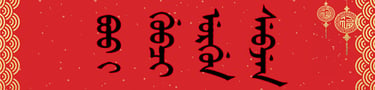
The Secrets Hidden in Old Beijing Door Stones: Rare Manchu Inscriptions on Traditional Mendun
The Secrets Hidden in Old Beijing Door Stones: Rare Manchu Inscriptions on Traditional Mendun
MING YE
9/29/20267 min read


The Secrets Hidden in Old Beijing Door Stones: Rare Manchu Inscriptions on Traditional Mendun
By MING YE
Among the architectural details of old Beijing courtyard houses, one of the most distinctive is the mendun (门墩), the carved stone support positioned at the base of a traditional gateway.
Also known as a door base, door platform, door drum, or baogushi (抱鼓石), the mendun is the portion of the stone door support that projects outward beyond the entrance.
Although these stones originally served an important structural purpose, over time they also developed into a distinctive form of architectural decoration. Their carvings preserve an extraordinary visual language of traditional Beijing life—expressing hopes for prosperity, longevity, family harmony, official advancement, protection, and good fortune.
Among surviving examples, those bearing Manchu inscriptions are particularly unusual. They remind us that the architectural landscape of Qing-period Beijing was not exclusively Chinese in language and visual culture, but was also shaped by the Manchu presence in the imperial capital.
What Is a Mendun?
A traditional Chinese doorway was composed of several interconnected structural elements.
The stone support beneath the doorway was known as the menzhen shi (门枕石), or door-pillow stone. The projecting portion outside the doorway developed into what Beijing residents commonly call a mendun.
The entire stone was normally carved from a single block.
A groove in the central section supported the wooden doorframe, while the interior portion contained a socket into which the pivot of the door could be inserted. Together with the corresponding wooden components above, this allowed the door to rotate securely when opened and closed.
The stone was therefore not originally created merely as decoration.
It was an integral part of the engineering of the traditional wooden gateway.
Yet because its outer section was prominently visible, it naturally became a surface for increasingly elaborate carving.
Architecture and decorative art gradually became inseparable.
“Men Dang Hu Dui”: A Traditional Expression Hidden in Architecture
Traditional explanations also connect the doorway with the familiar Chinese expression men dang hu dui (门当户对).
The stone door support was known as the mendang (门当), while the projecting wooden pegs positioned above the doorway were called hudui (户对).
One pair was below and the other above.
This architectural terminology later became associated in popular culture with the expression men dang hu dui, today commonly used to describe two families or marriage partners of comparable social standing.
Whether approached as architectural terminology or later cultural interpretation, the doorway itself thus became closely connected with ideas about household identity and social status.
Different Forms of Old Beijing Door Stones
The most common mendun were generally box-shaped or drum-shaped, but many other forms also existed.
Some were carved as:
lions,
multi-sided columns,
vases,
and other sculptural forms.
Traditional interpretations sometimes associated particular forms with the status or identity of the household.
Box-like forms were associated with civil officials, while forms incorporating animal imagery could be connected with military households.
At princely residences, stone lions could be considerably larger and more imposing.
The entrance to a residence was therefore more than simply a passage between street and courtyard.
It could also function as a visual representation of the family living behind the gate.
The Stone Lion: A Guardian of the Courtyard Gate
Lion-shaped mendun and stone tigers were once common sights outside Beijing courtyard houses.
The lion possessed especially rich symbolic meanings.
In Chinese, the pronunciation of shi (狮, lion) resembles shi (世, generation). Nine lions could therefore be interpreted as “nine generations living together”, expressing the hope that an extended family would remain united and harmonious across generations.
Powerful and wealthy households might place a pair of large white-marble lions outside the entrance.
Traditionally, the male lion stood on the left, with one paw resting on an embroidered ball.
The female lion stood on the right, accompanied by a cub.
These images expressed ideas of authority, continuity, prosperity, and flourishing descendants.
Most ordinary courtyard residences did not possess monumental stone lions.
Instead, smaller lions or tigers might be carved directly into the door stones on either side of the entrance.
Whether sitting, standing, crouching, or raising their heads, they resembled a pair of guardians watching over the household.
A Language of Symbols Carved in Stone
The carvings on Beijing mendun were rarely arbitrary.
People used human figures, plants, animals, everyday objects, legends, and geometric patterns to express hopes for:
long life,
wealth,
protection from misfortune,
a harmonious marriage,
successful descendants,
and a flourishing family.
One of the most common methods was the use of Chinese homophones.
A fish, yu (鱼), evokes yu (余), meaning abundance or surplus, and could therefore symbolize prosperity.
Other combinations used similar relationships between the pronunciation of objects and auspicious expressions.
Through this visual language, a stone carving became more than decoration.
It became a message.
Buddha's Hand, Peach, and Pomegranate: Three Wishes for the Family
Even small decorative elements could carry carefully constructed meanings.
A combination of Buddha's hand citron, peach, and pomegranate represented three traditional wishes.
The Buddha's hand was associated through sound and symbolism with fu (福)—good fortune or blessings.
The peach represented longevity.
The pomegranate, containing numerous seeds, symbolized many descendants.
Together, these three images expressed a family's desire for:
blessings, longevity, and flourishing descendants.
Such symbolic combinations were widespread in traditional Chinese decorative arts and appeared on architecture, furniture, porcelain, textiles, paintings, and stone carvings.
The mendun brought this symbolic world directly to the entrance of the home.
Bats and the Five Blessings
The bat is one of the most familiar auspicious motifs in traditional Chinese art.
The Chinese word for bat, fu (蝠), resembles fu (福), meaning blessing or good fortune.
For this reason, five bats could represent the Five Blessings.
Traditional interpretations associated these blessings with such ideals as:
longevity, prosperity, happiness or peace, virtue, and health.
A bat combined with a peach and a deer could form another auspicious composition representing:
Fu, Lu, Shou (福禄寿) — fortune, prosperity or official emolument, and longevity.
To someone unfamiliar with this symbolic system, the carvings might appear simply decorative.
To the original residents of the courtyard, however, they formed a readable visual vocabulary.
Deer, Cranes, and the Arrival of Spring
Animals could also be combined through visual and phonetic symbolism.
A deer and a crane accompanied by flowers could represent the auspicious expression “Liuhe Tongchun” (六合同春)—the idea that harmony and spring extend throughout the world.
Likewise, three sheep formed another traditional auspicious image.
The motif referred to the expression “Sanyang Kaitai” (三阳开泰), symbolizing the end of adversity and the beginning of favorable circumstances.
In architectural decoration, such images transformed the entrance of a residence into a permanent expression of hope.
Every person entering or leaving the courtyard passed these symbols.
Monkey, Maple, Bee, and Official Advancement
Some mendun carvings expressed ambitions for success in official life.
One traditional composition depicts a monkey climbing a maple tree toward an official seal, while bees fly nearby.
Through visual wordplay, these elements could be interpreted as the auspicious phrase “Fenghou Guayin” (封侯挂印)—to be granted noble rank and receive the official seal.
The image therefore symbolized advancement, official success, and social distinction.
Another famous motif depicts a carp leaping through rushing water between mountains.
This represents the legend of the carp leaping over the Dragon Gate.
The image became a symbol of overcoming difficult examinations or obstacles and achieving dramatic advancement in life.
For families hoping that their sons would succeed in education and government service, such imagery carried obvious meaning.
The Eight Auspicious Symbols
Some decorative patterns found on traditional architecture drew inspiration from Buddhist art.
Among the best known are the Eight Auspicious Symbols, commonly represented as:
the parasol,
the victory banner,
the treasure vase,
the pair of golden fish,
the lotus,
the conch shell,
the endless knot,
and the Dharma wheel.
These symbols entered a broad range of decorative traditions and could appear on architecture, ritual objects, textiles, ceramics, and other works of art.
Their presence on architectural stonework illustrates how religious imagery could gradually become incorporated into the broader visual culture of everyday life.
The Eight Immortals Hidden in Eight Objects
Traditional Chinese folk and Daoist culture also contributed motifs to doorway decoration.
The Eight Immortals could be represented not through human figures but through the objects associated with them.
These included such items as:
Zhongli Quan's fan,
Lü Dongbin's sword,
Zhang Guolao's instrument,
Cao Guojiu's clappers,
Li Tieguai's gourd,
Han Xiangzi's flute,
He Xiangu's lotus,
and Lan Caihe's flower basket.
Together, these objects could symbolize the presence of the Eight Immortals and convey wishes for longevity and auspiciousness.
This technique—representing a figure through an identifying object—allowed craftsmen to compress complex stories into relatively small architectural surfaces.
Rare Manchu Inscriptions on Old Beijing Door Stones
Most surviving mendun are known for their carved animals, plants, religious symbols, geometric designs, and auspicious Chinese visual wordplay.
For this reason, examples containing Manchu writing are especially noteworthy.
Beijing was not merely the political capital of the Qing dynasty.
For more than two and a half centuries, it was also one of the most important centers of Manchu political, military, linguistic, and cultural life.
Manchu could be seen in imperial edicts, official archives, seals, palace plaques, temples, monuments, and other forms of Qing material culture.
A Manchu inscription appearing on something as ordinary and domestic as a doorway stone therefore carries a different kind of historical significance.
It brings the Manchu script out of the palace and the archive and places it within the physical environment of old Beijing.
Such objects remind us that Manchu was once not simply a language preserved in books.
It was a visible script within the city itself.
A Small Stone Can Preserve a Large History
The cultural value of the old Beijing mendun lies precisely in the combination of the ordinary and the historical.
At first glance, it is simply a stone supporting a doorway.
Structurally, it helped hold the doorframe and door pivot in place.
Artistically, however, it became a miniature stone sculpture.
Socially, it could express the identity and aspirations of a household.
Culturally, its carvings preserve traditional beliefs about family, prosperity, longevity, marriage, descendants, official advancement, religion, and protection.
And in rare examples containing Manchu inscriptions, the mendun preserves another layer of Beijing's history—the multilingual cultural landscape of the Qing capital.
Palaces and monumental buildings naturally attract attention when people study history.
Yet sometimes a much smaller object tells an equally important story.
A weathered stone beside an old courtyard gate may preserve traces of language, family life, belief, social status, and urban culture that have survived for generations.
The old Beijing mendun is therefore more than an architectural component.
It is a piece of history carved in stone.
— MING YE