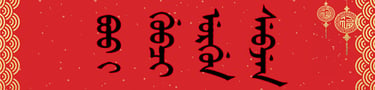
The Ode to Mukden Written in Thirty-Two Styles of Manchu Seal Script: The Distinctive Beauty of Manchu Calligraphy
The Ode to Mukden Written in Thirty-Two Styles of Manchu Seal Script: The Distinctive Beauty of Manchu Calligraphy
MING YE
9/24/20268 min read


The Ode to Mukden Written in Thirty-Two Styles of Manchu Seal Script: The Distinctive Beauty of Manchu Calligraphy
The Formation and Artistic Character of Manchu Seal Script as Seen through the Imperial Ode to Mukden
By Ming Ye (MING YE)
When people today first encounter the Ode to Mukden (Shengjing Fu, 盛京赋) written in the thirty-two styles of Manchu seal script developed during the Qianlong period, they may find it difficult to believe that these highly varied and decorative forms all belong to the same writing system: Manchu.
Manchu is most commonly recognized as a vertically written script characterized by elongated letterforms. During the Qing dynasty, however, Manchu was by no means confined to a single style of writing. As Manchu calligraphic culture developed, the script gradually acquired a range of stylistic forms comparable to regular, running, cursive, and seal-script traditions.
Among these, the most distinctive—and the most closely associated with Qing imperial culture—were the thirty-two styles of Manchu seal script systematically developed during the Qianlong period.
The most important work created to display these thirty-two styles was the celebrated Imperial Ode to Mukden.
1. 1748: The Systematic Creation of Manchu Seal Script
In the thirteenth year of the Qianlong reign, corresponding to 1748, the Qianlong Emperor ordered Fuheng and other officials to redesign and develop Manchu seal-script forms with reference to the traditions of Chinese seal script.
The project ultimately produced thirty-two distinct styles of Manchu seal script:
Yujin Seal Script (玉筋篆), Zhiying Seal Script (芝英篆), Shangfang Large Seal Script (上方大篆), Small Seal Script (小篆), Bell-and-Tripod Seal Script (钟鼎篆), Hanging-Dew Seal Script (垂露篆), Willow-Leaf Seal Script (柳叶篆), Shu Seal Script (殳篆), Hanging-Needle Seal Script (悬针篆), Dragon Seal Script (龙篆), Sui Script (穗书), Bird-Track Seal Script (鸟迹篆), Hanging-Cloud Seal Script (垂云篆), Luan-and-Phoenix Seal Script (鸾凤篆), Tadpole Script (科斗书), Turtle Script (龟书), Inverted-Chive Seal Script (倒薤篆), Bird Script (鸟书), Fen Script (坟书), Large Seal Script (大篆), Qilin Script (麟书), Zhuansu Seal Script (转宿篆), Carved-Insect Seal Script (雕虫篆), Inscribed-Tally Seal Script (刻符篆), Gold-Inlaid Seal Script (金错篆), Swan-Head Seal Script (鹄头篆), Flying-White Script (飞白书), Dragon-Claw Seal Script (龙爪篆), Qizi (奇字), Yingluo Seal Script (缨络篆), Scissors Seal Script (剪刀篆), and Biluo Seal Script (碧落篆).
The names themselves are revealing.
“Jade Tendon,” “Willow Leaf,” “Hanging Dew,” “Hanging Needle,” “Dragon Claw,” “Bird Track,” “Luan and Phoenix,” and “Bell and Tripod” all clearly draw upon aesthetic concepts associated with traditional Chinese calligraphy and ancient scripts.
What makes this development particularly interesting, however, is that these traditional aesthetic concepts were applied to a writing system structurally very different from Chinese characters: Manchu.
The thirty-two styles should therefore not be understood simply as Chinese seal-script forms reproduced in Manchu.
Rather, they represent a distinctive process of visual transformation:
the aesthetic vocabulary of traditional Chinese seal script was used as a point of reference for redesigning the lines, structures, and graphic forms of Manchu letters.
From this point onward, Manchu seal script possessed a richer repertoire of styles, with increasingly standardized forms and terminology.
2. Why Was the Ode to Mukden Printed in Thirty-Two Different Styles?
Once the new styles had been created, an appropriate work was needed to display them systematically.
The Imperial Ode to Mukden became an exceptional vehicle for doing so.
Mukden, or Shengjing in Chinese, is present-day Shenyang. It was one of the most important political centers of the Qing state before the conquest of China proper and continued to possess profound historical and symbolic significance throughout the Qing dynasty.
The Qianlong Emperor's composition of the Ode to Mukden itself reflected an interest in commemorating the dynastic homeland and emphasizing the historical importance of Shengjing.
When a literary work carrying such powerful imperial symbolism was combined with the newly systematized thirty-two styles of Manchu seal script, the result became more than a literary text.
It also became a systematic display of Manchu calligraphic and typographic forms.
To promote and demonstrate the newly created Manchu seal scripts, the Imperial Ode to Mukden was printed using all thirty-two styles.
In other words, although the language remained Manchu, different portions of the work could be presented through dramatically different forms of seal script.
For scholars and practitioners of Manchu calligraphy today, this is precisely what gives the Ode to Mukden its exceptional significance:
it allows us to observe systematically the remarkable range of visual transformations that Manchu seal script had achieved by the mid-eighteenth century.
3. Manchu Was Never Limited to the “Ordinary” Script Familiar Today
For many people, their first encounter with Manchu comes from the bilingual inscriptions displayed on buildings in the Forbidden City.
Such Qing-period Manchu-Chinese inscriptions create a recognizable visual impression: Manchu letters are elongated, written vertically, and connected to one another.
These are indeed among the most characteristic visual features of the script.
Yet a closer examination of surviving Qing Manchu calligraphy reveals a much richer artistic tradition than ordinary printed or everyday handwriting might suggest.
The development of the thirty-two Manchu seal-script styles greatly expanded the artistic possibilities of the script.
The same Manchu letters could undergo striking visual transformations through different methods of organizing lines and structures.
Some styles appear solemn and orderly.
Others are slender and upright.
Some emphasize graceful and flowing lines.
Others convey an archaic and monumental character.
Still others possess strongly decorative and almost pictorial qualities.
One of the most fascinating experiences of viewing the thirty-two-style Ode to Mukden is therefore that:
the linguistic content remains unchanged, while the visual personality of the writing continually changes.
This is one of the fundamental ways in which calligraphy differs from ordinary writing.
4. Manchu Seal Script as a Cross-Script Experiment in Visual Design
Viewed from the perspective of contemporary script and type design, the thirty-two styles of Manchu seal script raise a particularly interesting question.
Chinese characters and Manchu are based on fundamentally different structural principles.
Chinese characters generally organize strokes within an approximately square spatial framework. Manchu, by contrast, is constructed around a vertical axis, with letters connected and extended downward.
Transferring the concept of Chinese “seal script” into Manchu could therefore never be achieved simply by reproducing the external appearance of Chinese characters.
The real challenge was:
How could the aesthetic principles of one writing tradition be transformed into a visual structure appropriate to another writing system?
This is one reason why the thirty-two Manchu seal-script styles remain worthy of study today.
Willow-Leaf Seal Script, for example, does not attempt to make Manchu letters resemble Chinese characters. Instead, the slenderness, extension, and flowing quality suggested by the image of the willow leaf are reorganized within the structural logic of Manchu letters.
The same principle can be observed in Hanging-Needle, Hanging-Dew, Bell-and-Tripod, Dragon-Claw, and other styles.
They borrow names and visual concepts from traditional Chinese calligraphy, yet ultimately produce graphic forms belonging to the Manchu writing system itself.
It is therefore insufficient to regard the thirty-two styles simply as “thirty-two beautiful Manchu fonts.”
Behind them lies a systematic exploration, undertaken within the Qing imperial court, of the relationship between writing, calligraphy, visual order, and cultural tradition.
5. Manchu Calligraphy Has Its Own Fundamental Brush Techniques
Although Manchu calligraphy developed within a cultural environment deeply influenced by Chinese calligraphy, the structure of the Manchu script necessarily produced its own distinctive principles of brushwork.
Traditional Manchu writing may be analyzed through eight fundamental elements:
line, letter head, letter tooth, bubble, dot, circle, kui, and hook.
These elements form the graphic foundations of Manchu letters and word forms.
In one sense, this resembles the concept of fundamental strokes in Chinese calligraphy. Yet the structural logic of the two writing systems is different.
Chinese calligraphy primarily organizes strokes within a two-dimensional, roughly square space, whereas Manchu writing places much greater emphasis on vertical continuity.
A Manchu word generally develops downward along a vertical axis.
Consequently, the Manchu calligrapher must consider not only the beauty of individual letters, but also:
how letters connect with one another;
how the center of visual gravity changes within a word;
how vertical lines generate rhythm;
and how individual words interact spatially within the composition as a whole.
This vertical continuity is one of the most distinctive characteristics of Manchu calligraphy.
6. From Imperial Seals to Palace Plaques: Manchu Calligraphy Was Once Everywhere
During the Qing dynasty, Manchu was by no means confined to books.
From emperors, empresses, princes, and senior officials to central government institutions and local administrative offices, Manchu was widely employed in the political and social life of the empire.
Imperial decrees, edicts, proclamations, instructions, memorials, reports, petitions, official correspondence, seals, tallies, inscriptions, stone monuments, and plaques all preserve substantial examples of Manchu writing.
These texts were written, carved, engraved, or cast on a variety of materials:
paper, silk, wood, stone, and metal.
Different materials further expanded the expressive possibilities of Manchu calligraphy.
Even today, substantial numbers of Manchu and bilingual Manchu-Chinese inscriptions survive at Qing historical sites such as the Forbidden City, the Summer Palace, Beihai, and the Chengde Mountain Resort.
These inscriptions are not merely carriers of historical information. They are themselves part of the visual culture of the Qing dynasty.
7. Millions of Manchu Archival Documents: Another Surviving Treasure
Beyond the artistic value of Manchu calligraphy lies an even larger world:
historical documents written in Manchu.
Most surviving Manchu texts were written in the reformed form of the script.
They include works such as the Record of Foreign Regions (Yiyulu, 《异域录》), the Tale of the Nišan Shaman (Nishan Saman, 《尼山萨满》), and numerous dictionaries and linguistic works bearing the title Qingwen Jian (清文鉴).
Throughout much of the Qing dynasty, Manchu functioned as one of the important official languages of the state and was used alongside Chinese within the imperial administrative system.
At the same time, Manchu was used for works of history, literature, language, and translation.
A large number of Chinese classics and literary works were translated into Manchu, including the Mencius, the Outline and Details of the Comprehensive Mirror for Aid in Government, the Romance of the Three Kingdoms, and the Strange Tales from a Chinese Studio.
Millions of Manchu archival documents survive today.
These materials constitute invaluable sources for the study of Qing political institutions, social history, China's relations with the outside world, and the historical development of the Manchu language and script.
8. Why Does the Thirty-Two-Style Ode to Mukden Still Matter Today?
To revisit the Ode to Mukden written in the thirty-two styles of Manchu seal script today is to do more than appreciate an old form of imperial calligraphy.
The work preserves at least three different dimensions of historical information.
The first is the history of the Manchu writing system.
It demonstrates that Manchu was not a static script during the Qing dynasty, but one that continued to develop new modes of writing and artistic expression.
The second is the history of Qing calligraphy and script design.
The thirty-two Manchu seal-script styles demonstrate how aesthetic principles could be transferred, transformed, and recreated across different writing systems.
The third concerns the historical memory of Manchu culture itself.
When a writing system ceases to be widely used, the first thing to disappear may simply be the ability to read it.
As time passes, however, the calligraphy, aesthetics, literature, documents, and cultural memories associated with that writing system may also become increasingly unfamiliar.
For this reason, the contemporary study, documentation, and creation of Manchu seal-script calligraphy should not be understood merely as the reproduction of eighteenth-century letterforms.
More importantly, it allows us to rediscover:
the extraordinary visual world that once existed within the Manchu writing tradition.
Conclusion: Thirty-Two Styles, Thirty-Two Visual Expressions of a Single Script
The thirty-two styles of Manchu seal script developed in the thirteenth year of the Qianlong reign represent an exceptional episode in the history of Manchu calligraphy.
The Imperial Ode to Mukden, in turn, preserved and displayed this creative achievement in a concentrated form.
Yujin, Zhiying, Willow Leaf, Hanging Dew, Hanging Needle, Bell and Tripod, Dragon Claw, Luan and Phoenix...
Thirty-two names represent thirty-two different visual conceptions.
Together, they demonstrate a fundamental principle:
Writing is not only something to be read. It is also something to be seen.
When Manchu letters entered the domains of seal script and calligraphy, they no longer served solely as instruments for recording language. They also became a form of visual art with an aesthetic value of their own.
Nearly three centuries later, when we once again open the Ode to Mukden written in thirty-two styles of Manchu seal script, what we encounter is more than a Qing imperial text.
We also encounter an extraordinarily rich world of Manchu calligraphy—a world that once flourished, but which today remains largely unfamiliar to the wider public.
— Ming Ye (MING YE)


