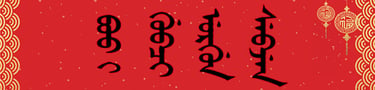
Manchu vs. Mongolian Calligraphy: Key Differences Explained
Compare Manchu and Mongolian calligraphy, from their shared script origins and vertical writing to letterforms, artistic styles, Qing history, and cultural heritage.
MING YE
11/13/202611 min read
What Is the Difference Between Manchu Calligraphy and Mongolian Calligraphy?
A Comparative Study of Their Shared Origins, Writing Systems, Artistic Structures, Historical Traditions, and Cultural Significance
By MING YE
Manchu calligraphy and Mongolian calligraphy often look remarkably similar.
Both traditionally use vertical writing, connected letters, flowing strokes, and distinctive forms that can appear highly decorative to people unfamiliar with the scripts.
At first glance, a viewer may even mistake one for the other.
This resemblance has a clear historical explanation: the traditional Manchu script was developed through adaptation of the traditional Mongolian script.
However, the two calligraphic traditions are not identical.
Manchu and Mongolian represent different languages, have different orthographic conventions, and developed within distinct historical and cultural environments.
Their similarities are particularly visible in the underlying writing systems, while their differences become clearer when examining individual letterforms, spelling conventions, manuscript traditions, and artistic practices.
The most important distinction is that Manchu calligraphy is based on the Manchu language and its adapted alphabet, while Mongolian calligraphy is based on Mongolian writing traditions and their associated linguistic and cultural conventions.
Understanding their relationship requires looking beyond superficial visual similarities.
It involves examining how one writing system influenced another and how both developed their own identities as forms of written expression.
1. Manchu and Mongolian Calligraphy Share a Historical Writing-System Origin
The relationship between Manchu and Mongolian calligraphy begins with the history of their scripts.
Traditional Mongolian writing developed in the early thirteenth century, drawing upon the Old Uyghur writing tradition.
The script was adapted to represent the Mongolian language and became an important medium for administration, literature, religion, and cultural communication.
Several centuries later, the Manchu writing system emerged through adaptation of this established Mongolian script.
In 1599, during the rule of Nurhaci, a writing system for the language then associated with the Jurchen-speaking population of his emerging state was developed using traditional Mongolian letters.
Historical accounts associate this development with the scholars Erdeni and Gagai.
The early Manchu script initially retained many features of its Mongolian model.
In 1632, a significant reform traditionally associated with Dahai introduced additional graphical distinctions, particularly dots and circles, to distinguish certain sounds more clearly.
These developments helped establish the recognizable form of the later Manchu script.
The relationship can be summarized as follows:
Historical featureTraditional MongolianManchuEarlier writing-system ancestryAdapted from Old Uyghur writingAdapted from traditional MongolianMajor period of developmentEarly thirteenth centuryBeginning in 1599Traditional writing directionVertical, top to bottomVertical, top to bottomColumn arrangementLeft to rightLeft to rightLetter connectionsConnected alphabetic formsConnected alphabetic formsImportant historical adaptationRepresentation of Mongolian soundsAdaptation to Manchu phonology, including later graphical reforms
This shared ancestry explains many visual similarities.
However, the scripts should not be treated as interchangeable.
The Manchu adaptation was intended to represent a different language with its own sound system and grammatical structure.
Manchu calligraphy inherited a fundamental visual framework from traditional Mongolian writing, but the adaptation of that framework produced a distinct written tradition.
2. The Two Scripts Look Similar but Have Different Orthographic Rules
The most obvious similarity between Manchu and Mongolian writing is their vertical, connected structure.
Both scripts organize letters into continuous written sequences.
Individual letterforms may change depending on their position within a word.
Both also feature a central vertical connecting structure and strokes extending from it.
These shared characteristics produce similar visual rhythms.
However, the orthographic systems differ.
Traditional Mongolian spelling preserves historical conventions that do not always correspond directly to modern spoken pronunciation.
Its letters and positional variants must be interpreted according to Mongolian orthographic rules.
Manchu writing developed its own conventions for representing the Manchu language.
The reforms of the seventeenth century introduced important distinctions that made certain Manchu letters easier to differentiate.
Dots and circles became particularly significant in the standard Manchu script.
Although traditional Mongolian also uses dots and other distinguishing graphical features, their distribution and orthographic functions are not identical to those of Manchu.
A calligrapher must therefore understand the specific spelling rules of the language being written.
A visually plausible Manchu word may still be incorrect if its distinguishing details are misplaced.
Likewise, Mongolian writing cannot be accurately reproduced simply by applying Manchu spelling conventions.
The similarity of the scripts can make such errors difficult for inexperienced viewers to recognize.
The difference between the scripts lies not only in their appearance but also in the rules that determine which letterforms are correct in particular words.
3. Manchu and Mongolian Represent Different Languages
An important distinction concerns the languages themselves.
Manchu belongs to the Tungusic language family.
Mongolian belongs to the Mongolic language family.
The two languages have experienced extensive historical contact, and Manchu contains vocabulary borrowed from Mongolian.
However, they are not generally classified as members of the same established language family.
Both languages exhibit grammatical characteristics often associated with agglutinative languages.
They also commonly use subject–object–verb word order.
These similarities can make their sentence structures appear comparable.
Nevertheless, grammatical resemblance does not establish a close genealogical relationship.
The historical Altaic hypothesis, which proposed relationships among several northern Eurasian language families, remains disputed and is not accepted as an established classification.
For calligraphy, the linguistic distinction is particularly important.
Calligraphy represents written language.
A work written in Manchu and a work written in Mongolian may look similar, but they contain different words and follow different spelling conventions.
Their meanings may also be entirely unrelated.
For example, the Manchu word bithe means “book” or “writing.”
The Mongolian word nom commonly means “book,” a term historically borrowed into Mongolian from a wider Buddhist linguistic tradition.
These words illustrate that the two languages can express similar concepts using different vocabulary.
Their written forms must follow the conventions of their respective scripts.
Manchu and Mongolian calligraphy are related through writing-system history, not through the assumption that the languages themselves are identical.
4. Dots, Circles, and Letter Details Create Different Visual Effects
One of the most recognizable features of standard Manchu writing is the use of dots and circles to distinguish particular letters.
These details became especially important following the seventeenth-century reform of the script.
They are not simply decorative additions.
They serve orthographic purposes.
A small graphical distinction may identify a different consonant and therefore affect the spelling and meaning of a word.
For Manchu calligraphers, this creates a specific artistic challenge.
Dots and circles must be executed accurately while remaining visually integrated with the surrounding strokes.
Their size, position, and relationship to the main connecting structure influence the appearance of the word.
Traditional Mongolian writing also contains small distinguishing features, including dotted letterforms.
However, its inventory of letters and the distribution of these details follow different conventions.
As a result, the visual texture of a Manchu passage may differ from that of a Mongolian passage.
A composition containing numerous dotted or circled Manchu letters can create distinctive points of emphasis.
A Mongolian composition may produce a different pattern of strokes and graphical details.
These tendencies should not be exaggerated into absolute visual rules.
The appearance of any passage depends on the actual words, handwriting style, materials, and composition.
The differences in letter details provide one of the clearest ways to distinguish the two scripts, especially when the viewer understands their orthographic systems.
5. Their Vertical Composition Is Similar, but Their Word Structures Differ
Both Manchu and traditional Mongolian are written vertically.
Text proceeds from top to bottom, and columns are arranged from left to right.
This shared direction creates a strong resemblance between their calligraphic compositions.
In both traditions, the artist must consider the relationship between connected letters, complete words, vertical spacing, and the overall arrangement of columns.
However, the written forms of the two languages are not identical.
Different vocabulary, grammatical endings, and spelling conventions influence the length and structure of words.
Manchu and Mongolian both use extensive morphological patterns, but their specific grammatical forms differ.
Consequently, even when two passages express similar meanings, their written compositions may have different lengths and visual rhythms.
This affects calligraphic design.
A longer word may create an extended vertical sequence.
A shorter word may introduce a compact visual element.
The artist must balance these variations within the available space.
In both traditions, successful composition involves controlling the relationship between repetition and variation.
The shared writing direction provides a similar framework, but the linguistic content creates different graphic arrangements.
Compositional featureManchu calligraphyTraditional Mongolian calligraphyMain writing directionVerticalVerticalLetter connectionsContinuous within wordsContinuous within wordsWord lengthInfluenced by Manchu vocabulary and morphologyInfluenced by Mongolian vocabulary and morphologyPositional letterformsGoverned by Manchu orthographyGoverned by Mongolian orthographyColumn compositionBased on Manchu written sequencesBased on Mongolian written sequencesArtistic variationDepends on technique and styleDepends on technique and style
The two traditions share a vertical compositional framework, but their different linguistic structures produce distinct patterns of written forms.
6. Mongolian Calligraphy Has a Distinct Cultural and Artistic History
Traditional Mongolian writing has a long history as a medium of literature, administration, religious expression, and artistic production.
Its development is closely connected to the political and cultural history of Mongolian-speaking societies.
The script was used in imperial administration and later became important in Buddhist literary and religious traditions.
Manuscripts, inscriptions, and formal documents provide evidence of its varied historical applications.
Mongolian calligraphy also developed distinctive approaches to letterforms and artistic presentation.
The ornamental folded script, often called evkhemel in Mongolian contexts, is especially notable.
It uses stylized and geometrically arranged forms associated with the traditional Mongolian script.
Such works demonstrate how a writing system can be transformed into elaborate visual compositions while retaining a relationship to written language.
The history of Mongolian calligraphy therefore includes both practical writing and specialized decorative traditions.
In the modern period, Mongolian calligraphy has also become an important expression of cultural heritage.
In 2013, UNESCO inscribed Mongolian Traditional Calligraphy on its List of Intangible Cultural Heritage in Need of Urgent Safeguarding.
This recognition concerns Mongolian traditional calligraphy and its associated cultural practices.
It should not be interpreted as automatically covering Manchu calligraphy.
The inscription demonstrates the importance of preserving specialized knowledge of traditional writing, including the transmission of calligraphic techniques.
Mongolian calligraphy possesses a documented cultural heritage and artistic identity that extends well beyond its historical relationship with the Manchu script.
7. Manchu Calligraphy Developed Within the Qing Historical Environment
Manchu calligraphy developed within a different historical setting.
After the creation and reform of the Manchu script, Manchu became a major written language of the Qing state.
It was used in imperial documents, official correspondence, historical records, and administrative communication.
The Qing court maintained Manchu as an important element of imperial institutions and identity.
Manchu writing appeared on plaques, monuments, ceremonial inscriptions, and multilingual official materials.
These settings contributed to the formal visual presentation of the script.
Manchu-Chinese bilingual inscriptions are particularly recognizable examples.
They demonstrate how two different writing systems could be integrated within a single architectural or commemorative composition.
The Qing court also used Mongolian and other languages in various administrative and ceremonial contexts.
This multilingual environment created opportunities for different scripts to appear together.
However, the historical use of Manchu writing should not be equated automatically with a fully independent calligraphic art tradition in the modern sense.
Many surviving manuscripts and inscriptions were created for practical or ceremonial purposes.
Their visual quality may be significant, but their original function must be considered.
Contemporary Manchu calligraphy can draw inspiration from these historical materials while developing additional artistic approaches.
Manchu calligraphy is closely connected to Qing historical culture, particularly the formal written practices of imperial administration and multilingual representation.
8. How Do Their Decorative and Seal-Script Traditions Compare?
Both Manchu and Mongolian writing can be adapted into highly decorative forms.
However, historical classification is important.
Traditional Mongolian has documented ornamental writing practices, including folded-script forms.
These styles may emphasize symmetry, geometry, and complex visual arrangements.
Manchu also possesses a history of formal and ornamental writing, including stylized forms associated with Qing imperial culture.
In discussions of Manchu calligraphy, the term “seal script” may refer to historically documented decorative forms or to contemporary artistic interpretations inspired by seal-script aesthetics.
These categories should be distinguished carefully.
Chinese seal script, Mongolian ornamental writing, and Manchu stylized writing have different historical foundations.
Their visual similarities do not make them identical traditions.
For example, a geometric Manchu composition may resemble Mongolian folded script.
However, the artist must still use correct Manchu letters and spelling.
Likewise, a Mongolian ornamental work should follow the conventions appropriate to its own writing system.
Contemporary artists may experiment with cross-cultural techniques.
Such experimentation can produce visually compelling results.
Nevertheless, accurate labeling is essential.
A modern Manchu design inspired by Mongolian ornament should be identified as a contemporary adaptation rather than presented automatically as an established historical style.
Decorative Manchu and Mongolian calligraphy can share artistic principles, but their historical styles and linguistic foundations must be evaluated separately.
9. Can the Same Calligraphic Techniques Be Used for Both Scripts?
Many calligraphic techniques can be applied to both Manchu and Mongolian writing.
Both traditions benefit from careful control of line quality, stroke rhythm, spacing, proportion, and composition.
Brushes, pens, and other writing instruments can produce expressive variations in the connected letterforms.
However, technical similarity does not eliminate the need for script-specific knowledge.
A calligrapher trained in Mongolian writing may recognize the general vertical structure of Manchu.
This provides a useful foundation.
Nevertheless, accurate Manchu calligraphy requires knowledge of Manchu spelling, positional forms, and distinguishing details.
The reverse is equally true.
A Manchu calligrapher cannot assume that Mongolian words should be written using Manchu orthographic conventions.
Differences in letterforms and spelling must be studied directly.
The most reliable approach is to separate general artistic technique from linguistic accuracy.
General skills such as brush control, line variation, and compositional balance may transfer between the traditions.
Specific letterforms, orthographic rules, and historical styles require independent study.
This distinction is particularly important in contemporary artistic projects.
A work may be visually impressive but linguistically incorrect.
For cultural exhibitions and educational materials, such errors can undermine the work's authenticity.
Calligraphic techniques can be shared, but accurate Manchu and Mongolian calligraphy each require knowledge of their respective writing systems.
10. How Can Viewers Tell Manchu and Mongolian Calligraphy Apart?
Distinguishing Manchu from traditional Mongolian writing can be difficult for someone unfamiliar with either script.
Both use vertical connected letters and share a common historical writing-system ancestry.
Their overall appearance can therefore be remarkably similar.
However, several approaches can help.
First, examine the orthographic details.
Standard Manchu contains characteristic dots and circles used to distinguish certain letters.
Traditional Mongolian has its own inventory of letterforms and distinguishing features.
Second, consider the language.
Recognizing a familiar word can provide stronger evidence than judging the overall appearance.
Third, examine the historical context.
A Qing imperial bilingual plaque may contain Manchu alongside Chinese.
A Mongolian religious manuscript may belong to a different textual tradition.
However, historical context alone is not conclusive because the Qing state also used Mongolian extensively.
Fourth, look for reliable transcriptions or translations.
A documented reading of the text can establish the language more confidently than visual impression.
Finally, distinguish ordinary writing from ornamental styles.
Highly stylized calligraphy may conceal features that would otherwise make the script easier to identify.
In such cases, expert examination may be necessary.
The most reliable identification combines letterform analysis, linguistic content, and documentary context.
Manchu and Mongolian calligraphy are best distinguished through their actual spelling and language, not simply through their shared vertical appearance.
Conclusion: What Is the Main Difference Between Manchu and Mongolian Calligraphy?
Manchu and Mongolian calligraphy share a common writing-system ancestry, but they represent different languages, follow different orthographic rules, and developed within distinct cultural traditions.
Traditional Mongolian writing provided the structural model from which the Manchu script was adapted in 1599.
The Manchu reforms of the seventeenth century introduced important graphical distinctions that helped establish its recognizable standard form.
Both scripts are traditionally written vertically, use connected letters, and offer considerable opportunities for artistic expression.
Their similarities are therefore genuine and historically grounded.
However, their differences are equally important.
Manchu belongs to the Tungusic language family, while Mongolian belongs to the Mongolic language family.
Their vocabulary, grammatical forms, spelling conventions, and letter details are not interchangeable.
Mongolian calligraphy has a long and distinctive history, including documented ornamental traditions and internationally recognized intangible cultural heritage.
Manchu calligraphy developed within the historical environment of the Qing state, where the script played important administrative, ceremonial, and cultural roles.
Contemporary artists working with either script can explore new artistic possibilities, but accurate knowledge of the underlying writing system remains essential.
The relationship between the two traditions demonstrates an important principle in the history of writing.
A script can be adapted from another writing system while developing its own linguistic identity, historical significance, and artistic possibilities.
Manchu calligraphy and Mongolian calligraphy are therefore best understood as closely related visual traditions with distinct cultural and linguistic foundations.
Recognizing both their similarities and their differences allows viewers to appreciate the artistic qualities of each more accurately.
— MING YE
References and Research Materials
Linguistic and Historical Studies
Gertraude Roth Li, Manchu: A Textbook for Reading Documents (2000).
Jerry Norman, A Comprehensive Manchu-English Dictionary (2013).
Liliya M. Gorelova, Manchu Grammar (2002).
Juha Janhunen, Manchuria: An Ethnic History (1996).
Nicholas Poppe, Grammar of Written Mongolian (1954).
Christopher P. Atwood, Encyclopedia of Mongolia and the Mongol Empire (2004).
Mark C. Elliott, The Manchu Way: The Eight Banners and Ethnic Identity in Late Imperial China (2001).
Pamela Kyle Crossley, A Translucent Mirror: History and Identity in Qing Imperial Ideology (1999).
Primary Historical Sources
Manwen Laodang (满文老档, Old Manchu Archives).
Yuzhi Qingwen Jian (御制清文鉴, Imperially Commissioned Mirror of the Manchu Language).
Qing Taizong Shilu (清太宗实录, Veritable Records of Qing Taizong).
Qing-period Manchu-Mongolian-Chinese multilingual inscriptions and manuscripts.
Historical Mongolian manuscripts, inscriptions, and ornamental writing examples.
Cultural Heritage and Research Resources
UNESCO. Mongolian Traditional Calligraphy, inscribed in 2013 on the List of Intangible Cultural Heritage in Need of Urgent Safeguarding.
The Palace Museum, Beijing. Qing multilingual inscriptions, manuscripts, and imperial material culture.
National Palace Museum, Taipei. Qing Manchu and Mongolian historical collections.
First Historical Archives of China. Qing multilingual administrative records.
Unicode Consortium. The Unicode Standard, Mongolian script documentation, including Manchu-related encoding and rendering conventions.
Research note: The historical relationship between Manchu and traditional Mongolian writing is well established. Specific claims about ornamental styles, calligraphic schools, and the origins of individual decorative forms should be evaluated using dated manuscripts, inscriptions, and specialized historical studies.