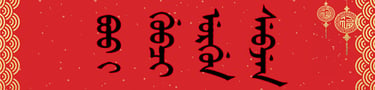
The Manchu Translation of Jin Ping Mei: The Qing Translation Bureau and a Rare Manchu Book
The Manchu Translation of Jin Ping Mei: The Qing Translation Bureau and a Rare Manchu Book
MING YE
9/25/20268 min read


The Manchu Translation of Jin Ping Mei: The Qing Translation Bureau and a Rare Manchu Book
From the 1708 Manchu Edition to the Cultural Exchange Between Manchu and Chinese
By Ming Ye (MING YE)
Jin Ping Mei is one of the most important vernacular novels of late imperial China. What is far less widely known, however, is that during the Qing dynasty this famous Chinese novel was translated in its entirety into Manchu.
The translation was not simply the work of an individual scholar. It emerged from the broader translation culture of the early Qing court and was closely associated with an institution commonly known as the Translation Bureau, or Fanshufang (翻书房).
In 1708, the forty-seventh year of the Kangxi reign, a Manchu translation of Jin Ping Mei, consisting of forty juan and one hundred chapters, was printed with a preface.
Today, this edition is far more than a linguistic curiosity. It is an important historical source for studying Manchu-Chinese translation, the history of the Manchu language, Qing publishing culture, textual transmission, and cultural interaction between Manchu and Chinese intellectual traditions.
Why Did the Qing Court Translate Chinese Books into Manchu?
During the early Qing dynasty, Manchu occupied an important position in government, military affairs, and court life.
At the same time, the Qing rulers increasingly engaged with the enormous textual tradition inherited from China. Chinese historical works, Confucian classics, literary texts, and administrative writings all became important sources of knowledge for the new dynasty.
This created a practical problem.
Many Manchu officials in the early Qing were not sufficiently proficient in Chinese to read complex Chinese texts directly. At the same time, a growing number of Manchu scholars and officials became highly accomplished in both Manchu and Chinese.
Translation therefore became an important bridge between the two languages.
The Qing court selected officials who were proficient in Manchu and knowledgeable in Chinese learning to undertake translation work. This institutional activity became associated with the Fanshufang, literally the “Book Translation Office” or “Translation Bureau.”
The institution played an important role in transforming a large body of Chinese writing into Manchu.
What Was the Fanshufang?
The Qing scholar and imperial clansman Zhaolian (昭梿) later described the Translation Bureau in his Xiaoting Xulu (《啸亭续录》).
According to his account, after the Qing established its capital in Beijing, the Translation Bureau was located near the western corridor of the Taihe Gate. Officials from the banners who were proficient in the Qing language—that is, Manchu—were selected to work there.
Zhaolian specifically mentioned works such as the Zizhi Tongjian (《资治通鉴》), Xingli Jingyi (《性理精义》), and Guwen Yuanjian (《古文渊鉴》) among the books translated into Manchu.
Other Qing institutional records indicate that the Translation Bureau was responsible for translating a much broader range of material, including imperial edicts, records of imperial activity, lectures, investiture texts, proclamations, sacrificial texts, inscriptions, poetry, and prose.
Its work was therefore not limited to books.
It formed part of the larger bilingual machinery of Qing imperial government.
The Translation Bureau also participated in the standardization of Manchu terminology, the creation or selection of written forms, and the transcription of foreign or Chinese names and expressions.
At one stage, its organization included senior administrators, coordinating officials, archival personnel, and dozens of translators.
The Translation Bureau Did Not Translate Only Confucian Classics
One particularly interesting feature of early Qing translation culture is that translation was not confined to government documents and orthodox Confucian literature.
The Four Books and Five Classics naturally occupied an important place, as did historical and philosophical works.
But literary works were translated as well.
Among them were texts such as the Romance of the Western Chamber (Xixiang Ji) and, most remarkably, Jin Ping Mei.
This is important because it demonstrates that written Manchu was not used only for military commands, imperial decrees, or administrative documents.
It could also serve as a language of literary reading.
A complex Chinese novel—filled with dialogue, social relationships, descriptions of everyday life, idiomatic expressions, poetry, songs, names, and cultural references—could be transferred into Manchu.
From the perspective of language history, this makes the Manchu Jin Ping Mei particularly valuable.
Heshu and the 1708 Manchu Jin Ping Mei
The Manchu translation of Jin Ping Mei consists of forty juan and one hundred chapters and carries a preface dated to the forty-seventh year of the Kangxi reign, or 1708.
The translation project was associated especially with Heshu (和素, 1652–1718), one of the best-known Manchu translators and scholars of the Kangxi period.
Heshu, whose courtesy names included Cunzai and Chunde, belonged to the Wanyan clan and was affiliated with the Bordered Yellow Banner of the Imperial Household Department.
He became highly accomplished in Manchu and Chinese and eventually served in important scholarly and educational positions. He was also associated with the Translation Bureau and with the compilation of the imperial Manchu dictionary Yuzhi Qingwen Jian (御制清文鉴).
His translation activities extended beyond Jin Ping Mei. Works associated with his translation work included the Sushu, Xiaojing, and other texts.
Zhaolian's Xiaoting Xulu gives particularly high praise to Heshu's abilities as a translator, mentioning his translations of both the Romance of the Western Chamber and Jin Ping Mei and describing his handling of their language as exceptionally precise.
The preface to the Manchu Jin Ping Mei also indicates that the translation underwent editorial review and revision.
This means that the surviving Manchu text should not simply be understood as a casual translation of a popular novel. It belonged to a much more sophisticated environment of bilingual scholarship and textual production.
Why Translate Jin Ping Mei?
This question is particularly interesting.
Jin Ping Mei was not a Confucian classic, an official history, or a government manual.
It was a novel concerned with human desire, wealth, family relations, social behavior, moral corruption, and the complexities of everyday life.
The preface to the Manchu translation interpreted the novel in strongly moral terms, emphasizing its function as a work of warning and admonition.
In this interpretation, the behavior depicted in the novel was not presented simply for entertainment. The narrative demonstrated the consequences of human excess and misconduct.
This moral reading provided one intellectual framework through which such a work could be translated and circulated.
Yet from a modern perspective, the significance of the translation extends much further.
The very existence of the Manchu Jin Ping Mei demonstrates that Manchu translation culture was capable of engaging with vernacular Chinese literature at an extraordinarily complex linguistic level.
An Important Clue in the Debate over the Authorship of Jin Ping Mei
The preface to the Manchu edition contains another historically interesting detail.
It associates the authorship of Jin Ping Mei with Lu Nan (卢柟).
The authorship of Jin Ping Mei has long been one of the major unresolved questions in the study of the novel. The original author is traditionally concealed behind the pseudonym Lanling Xiaoxiao Sheng (兰陵笑笑生), and many different candidates have been proposed over the centuries.
The identification of Lu Nan in connection with the Manchu translation is therefore noteworthy.
It should not be treated by itself as definitive proof of authorship, but it constitutes an early piece of evidence in the long history of speculation and scholarship surrounding the identity of the author.
The historical context is also intriguing. The Manchu translation was produced during a period when the Qing court was gathering and organizing extensive documentation concerning the preceding Ming dynasty.
For this reason, the statement preserved in the Manchu edition deserves attention in the textual and historiographical study of Jin Ping Mei.
Which Chinese Edition Was Used for the Manchu Translation?
Textual comparison suggests that the Manchu translation was based primarily on a Chongzhen-period edition of Jin Ping Mei.
However, it also appears to show influence from the famous commentary edition associated with Zhang Zhupo (张竹坡).
Zhang's edition appeared in 1695, thirteen years before the 1708 preface to the Manchu translation.
Comparison of chapter titles and textual details has therefore become important for determining the relationship between the Manchu translation and different Chinese textual traditions.
This is one reason the Manchu edition matters even to scholars who do not primarily study the Manchu language.
A translation can preserve evidence about the Chinese source text from which it was produced.
In other words, the Manchu Jin Ping Mei is not merely a translation—it is also a witness in the complicated textual history of Jin Ping Mei itself.
What Does the Manchu Edition Look Like?
Surviving copies provide fascinating evidence about how the work was read.
One complete printed copy described in Chinese collections consists of forty volumes in six cases, containing all one hundred chapters.
The text is printed vertically in Manchu.
Particularly interesting is the use of Chinese characters beside certain proper names and culturally specific expressions.
Titles such as Romance of the Three Kingdoms, Water Margin, and Journey to the West, as well as personal names such as Yan Song and Yan Shifan, could be accompanied by Chinese annotations.
This created a remarkable bilingual textual environment.
The main narrative was presented in Manchu, while selected Chinese expressions remained visible beside it.
For historians of translation, these small annotations can be extremely valuable because they reveal how Qing translators dealt with proper names, literary titles, culturally specific vocabulary, and expressions that were difficult or unnecessary to translate completely.
Printed Editions, Manuscripts, and Fragmentary Copies
The Manchu Jin Ping Mei is today a rare book.
Surviving materials include complete printed editions, manuscript copies, and fragmentary copies preserved in different collections.
Chinese holdings reported in scholarship include materials associated with institutions such as the Minzu University of China Library, the National Library of China, the Dalian Library, and other academic and cultural institutions.
Some surviving copies have particularly complicated histories.
A manuscript preserved in Dalian, for example, bears evidence connecting it with the former library of the South Manchuria Railway Company. Notes associated with the copy also provide clues about the circulation, identification, and acquisition of Manchu editions during the late Qing and Republican periods.
Another finely copied but incomplete manuscript preserved at Jilin University contains only several surviving chapters and has been dated approximately to the Qianlong period.
Such manuscripts remind us that the history of the Manchu Jin Ping Mei did not end with its original printing.
The book continued to be copied, collected, circulated, catalogued, and studied.
Copies Outside China
Materials related to the Manchu Jin Ping Mei also entered collections outside China.
Records and scholarship have identified copies or reproductions associated with collections in Japan and North America.
Japanese collections mentioned in research include the Tenri Central Library and the Seikado Bunko Library. Scholars in Japan have also produced important studies and annotated translations based on surviving Manchu editions.
A reproduced Manchu edition has also been consulted in the East Asian collection of the University of Toronto, reportedly connected with a copy preserved in a North American collection.
Historical accounts from the early twentieth century further suggest that Manchu copies were being purchased by Japanese collectors during the final years of the Qing dynasty and the early Republican period.
The geographical dispersal of these books has made the Manchu Jin Ping Mei part of an international history of collecting and scholarship.
Why Is the Manchu Jin Ping Mei Important Today?
For modern researchers, the value of this book operates on several levels.
For scholars of Manchu, it preserves a large body of vocabulary, grammar, idiomatic expression, and literary translation from the Kangxi period.
For scholars of translation history, it demonstrates how highly complex vernacular Chinese prose could be reconstructed in Manchu.
For researchers studying Jin Ping Mei, it provides evidence relevant to the textual history, editions, chapter titles, terminology, and reception of the novel.
For historians of the Qing dynasty, it reveals something broader about the intellectual world of the early Qing court.
Manchu was not simply a language of conquest or military administration.
It became a language through which Chinese history, philosophy, Confucian classics, literature, and popular narratives could be read and interpreted.
A Chinese Novel Reborn in Manchu
The Manchu translation of Jin Ping Mei therefore represents something larger than the translation of a single book.
Behind its pages was an entire institutional and intellectual world: translators who moved between Manchu and Chinese, officials who edited manuscripts, scholars who debated terminology, craftsmen who prepared printed editions, and readers who encountered Chinese literature through the Manchu language.
More than three centuries later, relatively few people can read the surviving edition directly.
Yet this is precisely what makes it so valuable.
When a major Ming-dynasty Chinese novel was transformed into a complete Manchu text, it became more than another version of a literary work.
It became a historical record of language contact, translation, textual transmission, and cultural exchange in the Qing world.
And today, opening the Manchu Jin Ping Mei allows us to see a side of Manchu literary culture that is too often forgotten: Manchu was once not only a language of imperial archives and official documents, but also a language in which readers could encounter some of the most complex works of Chinese literature.
— Ming Ye (MING YE)