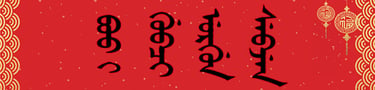
Is Manchu Script Suitable for Tattoos and Decorative Art?
Discover why Manchu script works beautifully for tattoos, jewelry, and home decor. Learn how to choose meaningful words and avoid common translation and lettering mistakes.
MING YE
11/16/20264 min read
Is Manchu Script Suitable for Tattoos and Decorative Art?
The Beauty, Meaning, and Cultural Value of Manchu Lettering in Modern Design
By MING YE
The Manchu script is well suited to tattoos, jewelry, home decoration, and personalized artwork. Its flowing vertical lines, connected letters, and distinctive dots and circles give it an appearance unlike most familiar writing systems. Even a short word can create an elegant composition.
But there is more to Manchu lettering than its appearance. Every letter belongs to a writing system with its own pronunciation and spelling rules. A beautiful design becomes more meaningful when the words are accurate and the person wearing or displaying them understands what they say.
1. Why Does Manchu Look Attractive in Decorative Designs?
Traditional Manchu is written vertically, from top to bottom, with columns arranged from left to right. Its letters connect within words, creating continuous lines that naturally lend themselves to decorative compositions.
Unlike Chinese characters, which generally occupy individual square-shaped spaces, Manchu words can form long, slender shapes. This makes them particularly suitable for narrow surfaces such as pendants, bracelets, bookmarks, and vertical wall hangings.
The script also has a distinctive balance between straight strokes, curves, and small graphical details. When carefully arranged, these features can produce an elegant design without requiring additional ornamentation.
Manchu lettering can work in both traditional and contemporary styles. Fine lines may create a delicate appearance, while broader brushstrokes can produce a stronger visual effect.
2. What Manchu Words Are Suitable for Tattoos?
Short expressions are often the most practical choices for tattoos. Words associated with personal values, relationships, or wishes can carry lasting significance.
Some examples of concepts that people may wish to express include:
English conceptChinese meaningDesign significanceLove爱Affection and emotional connectionPeace平静、和平Inner calm and harmonyFamily家庭Belonging and relationshipsHappiness幸福Joy and well-beingStrength力量Courage and perseveranceWisdom智慧Knowledge and understandingFreedom自由Independence and personal choiceBlessing祝福Good wishes and protection
These are concepts for translation, rather than verified Manchu spellings.
A suitable Manchu expression should be selected from reliable linguistic sources or translated by someone familiar with the language. Some English words have several meanings, and a literal translation may not communicate the intended idea.
Personal names are another possibility. English or Chinese names can be represented phonetically in Manchu, although the spelling must be checked carefully.
For a tattoo, the meaning and spelling should be settled before the artistic design begins.
3. What Should Be Checked Before Getting a Manchu Tattoo?
The greatest risk with a Manchu tattoo is incorrect lettering.
Manchu letters change shape depending on their position within a word. Small dots and circles can distinguish different letters, while connections between letters follow established writing conventions.
An error that appears insignificant to someone unfamiliar with the script may change the spelling or make the word difficult to read.
Digital design introduces another problem. Some fonts and graphic applications do not display Manchu correctly. Letters may appear disconnected, incorrectly shaped, or arranged in the wrong direction.
Before using a design permanently, three things deserve particular attention:
Correct translation: Confirm that the chosen Manchu word expresses the intended meaning.
Correct spelling: Check the letters, connections, dots, and circles against reliable references.
Correct artwork: Review the final design at its actual tattoo size, ensuring that small details remain visible.
The tattoo artist should work from an approved final design rather than attempting to redraw unfamiliar letters from memory.
A handwritten calligraphic original can be particularly useful because it allows the lettering to be reviewed before it is transferred to the skin.
4. Can Manchu Be Used for Jewelry, Clothing, and Home Decoration?
Manchu lettering offers possibilities beyond tattoos.
Its vertical structure makes it suitable for pendants, engraved jewelry, decorative scrolls, framed calligraphy, and personalized gifts.
A single word can serve as the central element of a minimalist design. Longer phrases can be arranged in vertical columns for wall art or decorative panels.
Manchu can also be combined with Chinese characters or English text. Such compositions may present the same idea in different writing systems, allowing viewers to appreciate both the meaning and the visual contrast.
For example, a framed artwork might feature a Manchu word accompanied by its English meaning. This approach makes the piece accessible to people who cannot read Manchu while preserving the character of the original script.
Traditional brush calligraphy offers expressive lines and variations in ink density. Modern digital lettering can provide greater consistency for engraving, printing, and product design.
Both approaches have value, provided that the written forms remain accurate.
5. Is It Appropriate to Use Manchu as a Decorative Element?
Yes. Using Manchu in contemporary design can be a meaningful way to introduce the script to new audiences.
The important consideration is how it is presented.
Manchu is part of a living cultural heritage, with a history connected to the Manchu people, the Qing dynasty, and centuries of written records. Its letters should be treated as language rather than meaningless exotic symbols.
Designers should also distinguish historical forms from modern artistic interpretations. A contemporary decorative composition can be attractive without claiming to reproduce an ancient imperial style.
For tattoos and personalized artwork, a brief explanation of the chosen word can add considerable value. Knowing what the inscription means, how it is pronounced, and why it was selected makes the design more personal.
The strongest decorative works bring together three elements: accurate language, thoughtful composition, and a genuine connection to the intended meaning.
Conclusion
Manchu script is an excellent choice for tattoos and decorative art because its vertical structure, connected letters, and flowing forms offer distinctive visual possibilities.
It can be used for personal names, meaningful words, jewelry, clothing, and interior decoration. Short inscriptions are particularly effective when the design needs to remain clear at a small size.
The essential requirement is accuracy. Translation, spelling, and letterforms should be verified before a design is permanently applied or reproduced.
A Manchu tattoo or decorative object can be more than an attractive pattern. When the writing is correct and its meaning is understood, it becomes a personal expression connected to a centuries-old cultural tradition.
— MING YE
References and Research Materials
Gertraude Roth Li, Manchu: A Textbook for Reading Documents (2000).
Jerry Norman, A Comprehensive Manchu-English Dictionary (2013).
Liliya M. Gorelova, Manchu Grammar (2002).
Mark C. Elliott, The Manchu Way: The Eight Banners and Ethnic Identity in Late Imperial China (2001).
Yuzhi Qingwen Jian (御制清文鉴), a major historical Manchu dictionary.
Unicode Consortium, The Unicode Standard, Mongolian script documentation, including Manchu letterforms and digital rendering.