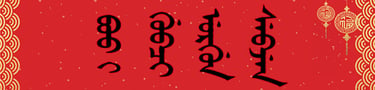
Is Manchu Script Suitable for Calligraphy Art? History and Styles
Discover why Manchu script is ideal for calligraphy, from its flowing vertical letters and Qing history to brush techniques, seal-script art, and modern creativity.
MING YE
11/10/202610 min read
Is the Manchu Script Suitable for Calligraphy Art?
Exploring the Artistic Beauty, Historical Traditions, Vertical Composition, and Contemporary Potential of Manchu Calligraphy
By MING YE
Is the Manchu script suitable for calligraphy as an art form?
Yes. The Manchu script is particularly well suited to calligraphic expression because of its flowing connected letters, vertical writing structure, rhythmic strokes, and distinctive visual composition.
Manchu calligraphy is more than the decorative reproduction of an unfamiliar alphabet. It is an artistic practice grounded in a historical writing system, linguistic structure, and cultural tradition.
The traditional Manchu script was developed in 1599 through adaptation of Mongolian writing and underwent an important reform in 1632. Over the following centuries, it became an important written language of the Qing dynasty, appearing in imperial documents, official inscriptions, manuscripts, plaques, and other cultural materials.
Its visual characteristics offer considerable opportunities for artistic development.
Unlike Chinese characters, which are generally organized into individual square-shaped units, Manchu letters connect vertically within words. This creates flowing structures that can extend through a composition.
The artist must consider the relationship between individual strokes, connected letters, complete words, vertical columns, and the surrounding space.
These characteristics make Manchu calligraphy visually distinctive.
However, its artistic value cannot be explained by appearance alone.
A successful Manchu calligraphic work must also respect the structure of the script, preserve linguistic accuracy, and demonstrate deliberate artistic expression.
Understanding these principles reveals why Manchu writing can function as both a practical communication system and an independent form of visual art.
1. What Makes the Manchu Script Visually Suitable for Calligraphy?
The most obvious artistic advantage of Manchu writing is its connected vertical structure.
Traditional Manchu is written from top to bottom, with columns arranged from left to right.
Within a word, letters connect to form a continuous written sequence.
This differs significantly from the structure of Chinese characters.
In Chinese calligraphy, individual characters generally occupy recognizable spatial units, even when cursive writing creates visual connections between them.
In Manchu writing, connectedness is a normal feature of the script itself.
The artist therefore works with a continuous sequence of letterforms rather than a collection of entirely separate character units.
This creates opportunities to explore movement, continuity, proportion, and rhythm.
A long Manchu word may produce an extended vertical form.
A shorter word creates a more compact structure.
When several words are arranged in a column, their differing lengths and shapes influence the overall composition.
The artist can respond to these variations through stroke weight, spacing, and visual balance.
Another distinctive feature is the relationship between the central connecting structure and the strokes extending from it.
The forms of individual letters contribute to a recognizable visual rhythm.
Dots, circles, and other orthographic details also create points of emphasis.
These features are not merely decorative. They are part of the writing system and must be preserved where required.
The artistic potential of Manchu calligraphy emerges from the interaction between connected letterforms, vertical movement, and the structural rhythm of written language.
2. Does Manchu Calligraphy Have a Historical Tradition?
Yes. Manchu writing has a substantial historical tradition, including formal handwriting, manuscript production, imperial inscriptions, and decorative applications.
During the Qing dynasty, Manchu was an important language of government and imperial administration.
Officials and scribes produced extensive written materials, including memorials, administrative records, edicts, and correspondence.
The imperial court also promoted Manchu literacy and maintained institutions responsible for language instruction and document production.
These activities created environments in which handwriting quality, consistency, and legibility were important.
Manchu writing appeared in different material contexts, from ordinary administrative manuscripts to formal inscriptions.
Imperial plaques and bilingual inscriptions are especially visible examples of the script's public presentation.
The historical record also includes Manchu writing executed with considerable attention to proportion and visual form.
However, an important distinction must be maintained.
Not every carefully written Manchu document was intended as an independent work of calligraphic art.
Much historical writing served administrative, educational, or ceremonial purposes.
Its visual quality may be impressive, but its original function was not necessarily artistic exhibition.
Likewise, modern Manchu calligraphy should not be assumed to reproduce an uninterrupted artistic tradition identical in organization to Chinese calligraphy.
The two traditions developed within overlapping cultural environments but have different structural foundations.
Historical Manchu writing provides an important foundation for calligraphic study, while contemporary Manchu calligraphy can develop additional artistic approaches appropriate to the script.
3. How Is Manchu Calligraphy Different from Chinese Calligraphy?
Manchu and Chinese calligraphy share certain artistic concerns, including brush control, rhythm, balance, proportion, and composition.
However, the underlying writing systems differ substantially.
Chinese writing is character-based.
Each character generally forms a distinct visual unit, with strokes organized within a relatively compact spatial structure.
Manchu writing is alphabetic and connected.
Its letters combine vertically to form words, and their shapes depend partly on their positions within those words.
These differences affect the artist's approach.
Artistic featureChinese calligraphyManchu calligraphyWriting systemChinese charactersConnected alphabetic scriptBasic structural unitCharacterLetterforms organized into wordsTraditional writing directionHistorically vertical, also horizontalTraditionally verticalVisual continuityDepends on calligraphic styleBuilt into ordinary letter connectionsSpatial organizationCharacter structure and relationships between charactersLetter connections, word length, and column structureArtistic challengeStroke relationships and character compositionAccurate connected forms and rhythmic vertical composition
These distinctions do not establish that one tradition is artistically superior.
They demonstrate that each writing system offers different possibilities.
For example, Chinese calligraphy often emphasizes the internal architecture of individual characters.
Manchu calligraphy must pay particular attention to the continuity of connected forms.
The artist also needs to consider how different word lengths affect the balance of a column.
Chinese calligraphic techniques may provide useful inspiration, particularly in brush handling and the treatment of ink.
However, their application to Manchu requires adaptation.
A technique appropriate for a square Chinese character may not automatically suit a long connected Manchu word.
Manchu calligraphy should be developed according to the structural principles of Manchu writing rather than treated simply as Chinese calligraphy using different symbols.
4. Why Are Vertical Lines and Connected Letters Artistically Important?
Vertical composition is one of the defining features of Manchu calligraphy.
Because the script runs from top to bottom, the viewer's eye naturally follows the downward progression of connected letters.
This creates a strong directional quality.
The artist can emphasize continuity through controlled stroke movement and consistent letter connections.
At the same time, the composition must avoid becoming visually monotonous.
Differences in letter shapes, word lengths, stroke weight, and spacing can create variation.
These variations contribute to rhythm.
A useful comparison is the relationship between musical structure and performance.
A written musical composition contains an organized sequence, but performers can interpret it through timing, emphasis, and expression.
Similarly, Manchu writing has established orthographic rules, while the calligrapher can interpret its forms through artistic technique.
However, this freedom has limits.
The artist cannot arbitrarily eliminate essential letters or change their identifying features without affecting the written content.
The challenge is to create expressive variation while preserving recognizable structure.
Negative space is equally important.
The spaces between columns, words, and extending strokes influence the visual balance of the work.
An effective composition uses both written forms and surrounding empty space deliberately.
The vertical continuity of Manchu writing provides a natural foundation for artistic rhythm, but successful calligraphy requires careful control of proportion and spacing.
5. Can Manchu Calligraphy Be Created with Traditional Chinese Brushes?
Yes. Traditional Chinese brushes can be used to create Manchu calligraphy.
Brushes, ink, paper, and other materials associated with East Asian calligraphy provide a wide range of expressive possibilities.
However, the choice of tool affects the appearance of the script.
A soft brush can produce substantial variation in line width.
A firmer brush may offer greater control over fine details.
Different papers also influence how ink spreads and how sharply the edges of strokes are defined.
For Manchu writing, these considerations are particularly important because the script contains connected forms and small distinguishing details.
Excessive ink spreading may obscure dots, circles, or narrow spaces.
Overly heavy strokes can also interfere with the recognition of individual letters.
The calligrapher must therefore balance expressive brushwork with orthographic clarity.
Brush technique should be adapted to the script rather than applied mechanically.
For example, an artist may use variations in pressure to emphasize the flow of a vertical word.
However, those variations should not distort the letter connections beyond recognition.
Other writing instruments can also be used.
Historical Manchu manuscripts were produced in a variety of writing contexts, and contemporary artists may experiment with pens, brushes, and digital tools.
The artistic quality of a work depends on the skillful relationship between the writing system, the chosen materials, and the intended expression.
Traditional brushes are suitable for Manchu calligraphy, but their techniques must be adapted to the connected structure and orthographic requirements of the script.
6. Is Manchu Seal-Script Calligraphy Possible?
Manchu seal-script calligraphy is an especially interesting area of artistic exploration.
The term requires careful explanation because Chinese seal script and Manchu writing belong to different writing systems.
Chinese seal script developed within the historical evolution of Chinese characters.
Its forms and conventions cannot simply be transferred unchanged to Manchu.
However, Manchu letters can be interpreted through decorative and formalized structures that emphasize symmetry, geometry, and controlled composition.
Historically, Qing imperial culture employed various forms of ornamental and formal writing.
The court also commissioned works involving multilingual inscriptions and decorative scripts.
These materials provide an important historical context for studying stylized Manchu letterforms.
At the same time, contemporary artistic adaptations should be distinguished from historically documented forms.
A modern artist may develop a Manchu seal-script-inspired style using geometric arrangements, carefully controlled strokes, and ornamental principles.
Such work can be artistically meaningful, but its historical classification should be supported by evidence rather than assumed.
The central challenge is maintaining the identity of the Manchu letters.
Stylization should not erase distinctions necessary for accurate reading.
This is particularly important when the work includes words, names, or historical expressions.
Manchu seal-script art offers significant possibilities for contemporary development, provided that historical terminology and the structural rules of the script are treated carefully.
7. Can Manchu Calligraphy Become a Form of Contemporary Art?
Yes. The Manchu script has considerable potential within contemporary visual art.
Its distinctive structure allows artists to explore relationships between language, identity, history, and visual expression.
Traditional calligraphy generally begins with the written word.
Contemporary approaches may extend this foundation through experimentation with scale, material, composition, and presentation.
For example, Manchu calligraphy can be incorporated into large-format works, mixed-media compositions, installations, or digital visual projects.
The vertical structure of the script may create striking visual effects when presented at different scales.
Its connected letterforms can also interact with geometric or abstract elements.
However, an important distinction should be maintained between authentic Manchu writing and artwork merely inspired by its appearance.
A design may resemble Manchu without containing correctly written Manchu words.
Such a work may still possess artistic value, but it should be described accurately.
When an artwork is presented as Manchu calligraphy, linguistic correctness becomes part of its artistic integrity.
This is particularly important for public exhibitions and educational projects.
Viewers may not be able to read the language themselves.
They therefore depend on the artist's accuracy when interpreting the work.
Contemporary Manchu calligraphy can also serve as a bridge between historical cultural materials and modern audiences.
It can introduce the script to people who might never encounter it through traditional language study.
The strongest contemporary Manchu calligraphy combines artistic innovation with genuine knowledge of the language and writing system.
8. What Makes a Good Work of Manchu Calligraphy?
A successful Manchu calligraphic work should be evaluated through several complementary criteria.
The first is linguistic accuracy.
The written words should be correctly spelled, and essential letter distinctions should be preserved.
The second is structural integrity.
Letters should connect appropriately, and their positional forms should remain recognizable.
The third is technical execution.
Stroke control, line quality, proportion, and consistency contribute to the work's visual character.
The fourth is composition.
The arrangement of words and columns should create a coherent relationship between written forms and empty space.
The fifth is artistic expression.
A technically correct work may still lack individuality or visual impact.
Calligraphy becomes an art form when the artist uses the script deliberately to create rhythm, tension, harmony, or other expressive qualities.
Finally, cultural and historical understanding can deepen the meaning of a work.
A calligraphic composition using a historical phrase may benefit from knowledge of its original context.
Likewise, a contemporary work addressing cultural heritage can gain significance through thoughtful selection of language and form.
These criteria should be considered together.
A visually impressive work containing incorrect Manchu spelling has a significant weakness.
A perfectly legible transcription may be valuable as handwriting but may not necessarily demonstrate accomplished artistic expression.
Good Manchu calligraphy requires both fidelity to the writing system and the artistic ability to transform accurate writing into meaningful visual expression.
9. Why Does Manchu Calligraphy Matter Today?
Manchu calligraphy has cultural significance beyond its visual appearance.
The Manchu language played an important role in the history of northeastern Asia and the Qing dynasty.
Its written records preserve information about government, society, religion, diplomacy, and everyday life.
Today, the traditional spoken language is severely endangered, while knowledge of the script survives primarily through scholarship, education, cultural practice, and specialized communities.
Calligraphy offers one way to introduce the script to wider audiences.
People who may not initially be interested in learning Manchu grammar can become curious after encountering a visually compelling calligraphic work.
This curiosity may lead to questions about the language, its history, and its relationship to Manchu cultural heritage.
Calligraphy can therefore support cultural education.
It can also encourage the preservation of accurate letterforms and traditional writing knowledge.
However, artistic practice and language revitalization are not identical.
Producing calligraphy does not automatically create fluent speakers.
The two activities can nevertheless complement one another.
Calligraphy may increase public visibility, while language instruction provides the linguistic foundation needed to understand the written content.
Museums, cultural organizations, schools, and independent artists can all contribute to this relationship.
For contemporary audiences, Manchu calligraphy also demonstrates that the script is not confined to historical archives.
It can continue to function as a medium of artistic creation.
The contemporary value of Manchu calligraphy lies in its ability to connect historical literacy, cultural heritage, and modern visual expression.
Conclusion: Is Manchu Script a Good Medium for Calligraphy?
The Manchu script is exceptionally well suited to calligraphic art because of its connected letters, vertical structure, distinctive proportions, and possibilities for rhythmic composition.
Its historical use in Qing manuscripts, inscriptions, and formal writing provides an important foundation for artistic study.
At the same time, its structural differences from Chinese characters offer a distinctive visual language.
Manchu calligraphy requires attention to connected letterforms, word length, column arrangement, and the relationship between strokes and empty space.
Traditional brushes can provide expressive possibilities, while contemporary materials and artistic methods can expand the range of presentation.
Stylized and seal-script-inspired approaches also offer opportunities for further exploration, provided that historical distinctions and linguistic accuracy are respected.
The most important principle is that Manchu calligraphy should remain grounded in authentic Manchu writing.
Artistic freedom and orthographic accuracy are not opposing goals.
When handled skillfully, they reinforce one another.
A calligrapher who understands the script can use its structural characteristics as a source of artistic creativity.
This gives Manchu calligraphy a distinctive place within the broader world of written art.
Manchu is not merely a historical language that happens to have an attractive script. Its writing system possesses structural qualities that can support serious, original, and culturally meaningful calligraphic expression.
As interest in historical scripts and cultural heritage continues, Manchu calligraphy offers opportunities for both preservation and innovation.
Its future artistic development will depend on the ability of practitioners to combine accurate knowledge of the writing system with technical skill, historical understanding, and creative imagination.
— MING YE
References and Research Materials
Historical and Linguistic Studies
Gertraude Roth Li, Manchu: A Textbook for Reading Documents (2000).
Jerry Norman, A Comprehensive Manchu-English Dictionary (2013).
Liliya M. Gorelova, Manchu Grammar (2002).
Mark C. Elliott, The Manchu Way: The Eight Banners and Ethnic Identity in Late Imperial China (2001).
Pamela Kyle Crossley, A Translucent Mirror: History and Identity in Qing Imperial Ideology (1999).
Evelyn S. Rawski, The Last Emperors: A Social History of Qing Imperial Institutions (1998).
Juha Janhunen, Manchuria: An Ethnic History (1996).
Primary Historical Sources
Manwen Laodang (满文老档, Old Manchu Archives).
Yuzhi Qingwen Jian (御制清文鉴, Imperially Commissioned Mirror of the Manchu Language).
Qing Taizong Shilu (清太宗实录, Veritable Records of Qing Taizong).
Qing imperial inscriptions, plaques, and Manchu-language archival manuscripts.
Museum and Research Collections
The Palace Museum, Beijing. Qing imperial inscriptions, manuscripts, and material culture.
National Palace Museum, Taipei. Qing court manuscripts, inscriptions, and multilingual cultural materials.
First Historical Archives of China. Historical Manchu manuscripts and administrative records.
Unicode Consortium. The Unicode Standard, Mongolian script documentation relevant to Manchu digital typography.
Note: Historical Manchu handwriting, documented ornamental scripts, and modern artistic adaptations are related but distinct categories. Claims about the historical origins of particular calligraphic styles should be evaluated through dated manuscripts, inscriptions, and other primary evidence.