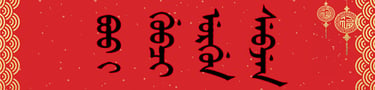
Is Manchu a Phonetic Writing System?
Is Manchu a phonetic alphabet? Learn how Manchu letters represent sounds, why Manchu differs from Chinese Pinyin, and how its traditional script works.
MING YE
10/13/202610 min read


Is Manchu a Phonetic Writing System?
Understanding the Manchu Alphabet, Phonetic Writing, Chinese Pinyin, and Romanization
By MING YE
When people begin learning Manchu, a natural question often arises: Is Manchu a phonetic writing system?
Unlike Chinese characters, which primarily represent morphemes and syllables through individual written characters, Manchu uses combinations of letters to spell words.
For example, the Manchu word for “person” can be Romanized as niyalma, “book” as bithe, and “home” as boo.
These words look somewhat similar to English words because they are represented by combinations of letters.
Does this mean that Manchu can be understood as a writing system similar to Chinese Pinyin?
The answer is that Manchu is an alphabetic writing system, a type of phonographic writing in which letters represent speech sounds. However, Manchu is not Chinese Pinyin, nor is it merely a system of Latin letters used to indicate Manchu pronunciation. It is an independent traditional writing system.
Understanding this distinction requires separating several concepts that are often confused: phonographic writing, alphabetic writing, phonetic transcription, and Romanization.
What Is a Phonetic Writing System?
In everyday language, a phonetic writing system is often understood as a system that uses letters or other sound-based symbols to record spoken language.
In linguistics, however, phonographic writing is a broader category.
Different phonographic writing systems represent speech sounds in different ways.
For example:
Writing systemMain characteristicsExamplesAlphabetUses letters to represent vowels and consonantsEnglish, ManchuAbjadPrimarily represents consonants; vowels may be indicated in other waysArabic, HebrewAbugidaConsonant symbols generally have an inherent vowel, with other vowels indicated through additional formsDevanagariSyllabaryA basic symbol generally represents a syllable or moraJapanese kana
These categories are broad classifications used in writing-system typology. Individual scripts may have historical variations and special conventions.
Manchu primarily uses letters to represent vowels and consonants, combining them to spell words.
Therefore, describing Manchu as an alphabetic writing system is more precise than simply calling it a phonetic writing system.
Why Is Manchu Classified as an Alphabetic Writing System?
Because letters are the basic units of Manchu writing.
In common introductory teaching systems, Manchu is described as having six basic vowel letters and a number of consonant letters. Some textbooks use a classification of 25 basic letters, while others present different totals depending on how supplementary letters are counted.
The six basic vowels are commonly Romanized as:
a, e, i, o, u, ū.
Consonants include letters Romanized as n, m, b, p, t, d, k, g, and h, among others.
These letters combine to represent Manchu words.
For example:
Manchu RomanizationChinese meaningEnglish meaningama父亲Fathereme母亲Motherboo家、房屋Home / Housebithe书、文书Book / Documentniyalma人Personusiha星星Star
Consider ama.
It is the Manchu word for “father.”
In Romanization, it is represented by the three Latin letters a, m, and a.
However, in actual Manchu writing, this word is written using Manchu letters rather than Latin letters.
The Manchu letters represent the sounds of the word, and their combination records a complete lexical item.
This is the fundamental reason Manchu is classified as an alphabetic writing system.
Is Manchu the Same as Chinese Pinyin?
No.
Although both Manchu writing and Chinese Pinyin can represent speech sounds, their historical status and practical functions are very different.
Chinese Pinyin is a modern Romanization system for Standard Mandarin Chinese.
The Hanyu Pinyin Scheme was officially promulgated in 1958.
It primarily uses Latin letters to represent Mandarin pronunciation and is used in literacy education, pronunciation guidance, spelling, and other language-related applications.
However, Chinese Pinyin has not replaced Chinese characters as the principal writing system used in everyday modern Chinese.
For example:
Chinese characters: 北京
Hanyu Pinyin: Běijīng
Both forms represent the same Chinese place name, but they use different writing systems.
Manchu is different.
From its creation, Manchu script was intended to record the Manchu language directly.
It could be used to write complete Manchu words, sentences, books, and official documents.
Qing dynasty Manchu archives, imperial orders, historical texts, and other documents demonstrate its role as a practical writing system.
Manchu was therefore not created merely to provide pronunciation guidance for another script.
Chinese Pinyin is primarily a modern Romanization system for Mandarin Chinese, while Manchu is an independent historical writing system used to record the Manchu language itself.
Why Does Manchu Look Different from English but Still Spell Words with Letters?
Because alphabetic writing systems do not necessarily use the Latin alphabet.
English is primarily written using Latin letters.
Manchu developed from traditional Mongolian script.
According to Qing historical records, in 1599 Nurhaci instructed Erdeni, Gagai, and others to create an early Manchu writing system based on Mongolian script.
During the seventeenth century, Manchu underwent important reforms involving letterforms and spelling conventions.
As a result, Manchu retained several structural features inherited from traditional Mongolian writing, including vertical orientation, connected letters, and positional variations.
Manchu is traditionally written from top to bottom, with columns progressing from left to right.
English, by contrast, is written horizontally from left to right.
The two scripts look very different, but both use combinations of letters to record words.
This demonstrates that the visual appearance of a script and its structural classification are two separate matters.
A writing system does not need to use Latin letters such as A, B, and C to qualify as alphabetic.
Does Manchu Spell Words Exactly as They Are Pronounced?
Manchu is phonographic in nature, but this does not mean that words can be spelled arbitrarily according to whatever sounds a person hears.
In natural languages, actual pronunciation and standardized spelling do not always correspond perfectly.
Manchu has its own traditional orthography.
The spelling of certain words reflects historical conventions, sound distinctions, and the development of standardized writing practices.
For example, Manchu follows particular spelling rules when representing vowels and consonants.
The same letter may have different shapes at the beginning, middle, or end of a word.
Certain letters must also be distinguished through marks such as dots and circles.
Therefore, although Manchu writing is based on representing speech sounds, its spelling conventions must still be learned.
A limited comparison can be made with English.
English is also alphabetic, but the spelling of English words cannot always be predicted directly from their modern pronunciation.
The specific spelling rules of Manchu and English differ, but both illustrate an important principle:
A phonographic writing system does not necessarily have a perfect one-to-one correspondence between every letter and a single fixed sound in every context.
Is Romanized Manchu the Same as Manchu Script?
No.
This is one of the most common misunderstandings among beginners.
Today, many Manchu textbooks, dictionaries, and academic publications use Latin letters to transcribe Manchu words.
For example:
niyalma — Person
bithe — Book / Document
boo — Home / House
ama — Father
These forms make Manchu easier to study, search, and discuss.
However, they are Romanized representations, not the original written forms of Manchu letters.
Traditional Manchu uses its own letters and has features such as vertical writing, connected forms, and positional variations.
Therefore, someone who can read niyalma, bithe, and boo fluently in Romanization is not necessarily able to read original Manchu documents.
Romanization can assist in learning Manchu, but it cannot completely replace the traditional script.
Researchers studying Qing dynasty Manchu archives must ultimately become familiar with actual Manchu letterforms and historical spelling conventions.
Are Both Manchu and Mongolian Phonetic Writing Systems?
In terms of writing-system classification, both Manchu and traditional Mongolian use letters to record language.
However, they represent different languages.
Manchu belongs to the Tungusic language family.
Mongolian belongs to the Mongolic language family.
The two languages differ in pronunciation, vocabulary, and grammar.
Manchu script resembles traditional Mongolian script because the former was developed through a direct historical adaptation of the latter.
This relationship concerns the history of writing systems. It does not prove that the two languages share the same linguistic origin.
After adopting Mongolian letterforms, Manchu gradually developed distinctions and spelling conventions suited to the sounds of the Manchu language.
In particular, seventeenth-century reforms involving the standardization of distinguishing marks, including dots and circles, made certain letters easier to differentiate.
Thus, Manchu retained structural features of traditional Mongolian writing while developing its own orthographic conventions.
Why Doesn't Manchu Use One Character to Represent One Meaning Like Chinese?
The difference lies in the basic units used by the two writing systems.
Chinese characters are primarily morphosyllabic.
A Chinese character generally corresponds to a syllable and is often associated with a morpheme.
For example, the characters 山, 水, and 人 can represent meaningful Chinese morphemes associated with mountain, water, and person.
However, modern Chinese also contains many words consisting of two or more characters.
It would therefore be inaccurate to assume that every Chinese character is necessarily an independent word.
Manchu primarily uses letters to represent speech sounds.
Individual Manchu letters do not normally carry the lexical meaning of complete words.
For example, the Manchu word bithe means “book” or “document.”
Its meaning belongs to the complete word rather than to each letter as a separate concept.
This is why Manchu resembles English more closely than Chinese characters in its spelling structure.
However, this does not mean that Manchu grammar is the same as English grammar.
Manchu and English belong to different language families and differ significantly in word order, morphology, and other linguistic structures.
If Manchu Is Alphabetic, Why Must Students Still Learn Grammar?
Because a writing system and a language are not the same thing.
Knowing the alphabet helps learners recognize and spell words.
Understanding complete sentences also requires vocabulary and grammar.
For example, recognizing all 26 English letters does not mean that someone can read an English novel.
Similarly, recognizing the basic Manchu letters does not necessarily mean that a learner can understand historical Manchu documents.
Manchu has its own grammatical structure.
Its basic word order is generally subject–object–verb, unlike the common subject–verb–object order of English.
Manchu also has prominent agglutinative characteristics, using grammatical markers to express noun case relationships and other grammatical meanings.
Learning Manchu therefore involves gradually mastering letters, syllables, vocabulary, grammar, and text comprehension.
Studying Qing dynasty Manchu archives also requires familiarity with historical vocabulary, official titles, institutional terminology, and documentary conventions from different periods.
An alphabetic writing system makes it possible to record a language, but it does not eliminate the need to learn that language.
If Manchu Is Alphabetic, Why Do Its Letters Have Different Shapes?
Because Manchu is an alphabetic script with connected letterforms.
In traditional Manchu, the same letter may take different shapes depending on its position within a word.
Students commonly distinguish between initial, medial, and final forms.
For example, a letter at the beginning of a word primarily needs to connect to the following letter.
In the middle, it generally needs to connect to letters both before and after it.
At the end, it must conclude the word with an appropriate final form.
These variations are called positional forms.
They do not mean that every different shape represents a new letter.
A single letter can have several written forms while remaining the same basic letter.
This is why Manchu alphabet charts often show multiple positional forms.
Certain letters also require distinguishing marks, including dots and circles.
Thus, although Manchu is alphabetic, its actual writing structure is more complex than simply arranging separate Latin letters in sequence.
Are the Manchu Twelve Initials a Type of Phonetic Chart?
A limited comparison can be made in terms of their educational function, but they are not identical.
The traditional Manchu teaching system known as the Twelve Initials, or Shier Zitou (十二字头), is primarily used to teach Manchu syllable combinations and spelling patterns systematically.
By arranging letters and syllable forms in an organized sequence, it helps learners become familiar with Manchu pronunciation, spelling, and changes in letterforms.
In this respect, it has certain similarities to syllable charts used in modern language education.
However, the Twelve Initials have their own historical traditions and organizational principles.
They are not the modern Hanyu Pinyin system, nor are they simply a Manchu translation of a Chinese Pinyin chart.
The name also does not mean that Manchu contains only twelve letters.
The Twelve Initials are a traditional instructional arrangement for syllable learning, not a direct count of basic alphabetic letters.
For beginners, learning the basic letters and their positional forms before studying syllable combinations through the Twelve Initials can provide a useful progression.
This approach helps students gradually understand the actual spelling structure of Manchu.
Why Is Manchu a Complete Writing System Rather Than Merely a Pronunciation Aid?
Because Manchu historically performed a wide range of independent written functions.
Large numbers of Qing dynasty official archives, administrative documents, historical records, translated works, and other materials were written in Manchu.
These documents did not merely provide pronunciation guides for Chinese characters.
They recorded the vocabulary, grammar, and expressions of the Manchu language itself.
Manchu could independently express complete sentences and complex concepts.
It was used in political, military, administrative, and cultural contexts.
Some bilingual Qing dynasty documents contain Manchu and Chinese side by side.
This does not mean that Manchu was simply a phonetic annotation accompanying Chinese characters.
The two scripts were used to record different languages.
Therefore, both historically and linguistically, Manchu is a complete traditional writing system.
Describing it simply as “the Qing dynasty equivalent of Chinese Pinyin” would seriously misrepresent its nature.
So, Is Manchu a Phonetic Writing System?
Returning to the original question:
Manchu can broadly be described as a phonetic or phonographic writing system, but its more precise linguistic classification is an alphabetic writing system.
It uses combinations of letters to represent the sounds of Manchu words and follows its own spelling conventions to construct words and sentences.
Manchu is not Chinese Pinyin, nor is it the same as Romanized Manchu.
It is an independent writing system developed from traditional Mongolian script, characterized by vertical writing, connected letters, positional forms, and distinguishing marks such as dots and circles.
Three distinctions are particularly important.
First, Manchu script is a traditional alphabetic writing system used to record the Manchu language.
Second, Manchu is a language belonging to the Tungusic family, with its own vocabulary and grammar.
Third, Manchu Romanization is an auxiliary method used in modern teaching and research. It is not the original visual form of Manchu writing.
Therefore, when someone asks whether Manchu is a phonetic writing system, an accurate answer is:
Manchu is an alphabetic writing system that represents speech sounds through combinations of letters. However, unlike Chinese Pinyin, which primarily serves as a Romanization and pronunciation system, Manchu is a complete historical script that was extensively used in official documents, historical records, and cultural expression.
Recognizing the alphabetic nature of Manchu is the starting point for understanding its written structure. Mastering its vocabulary, grammar, and historical documents is what ultimately allows readers to understand the language and culture recorded through the script.
— MING YE
References and Research Materials
Gertraude Roth Li, Manchu: A Textbook for Reading Documents (2000). An important reference for Manchu letters, spelling conventions, and historical document reading.
Jerry Norman, A Comprehensive Manchu-English Dictionary (2013). A major reference for Manchu vocabulary, Romanization, and phonological correspondences.
Peter T. Daniels and William Bright (eds.), The World's Writing Systems (1996). An important reference on the classification and structural characteristics of writing systems.
Manzhou Shilu (Records of the Manchus). Historical accounts concerning the creation and early development of Manchu writing.
Hanyu Pinyin Fang'an (Hanyu Pinyin Scheme, 1958). The official scheme establishing the modern Romanization system for Standard Mandarin Chinese.