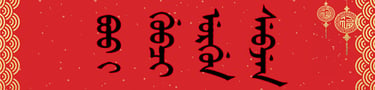
How to Identify Manchu Script on Qing Dynasty Artifacts
Learn how to recognize Manchu script on Qing dynasty coins, seals, plaques, and monuments using vertical writing, connected letters, dots, circles, and comparisons with Mongolian.
MING YE
10/16/202612 min read


How Can You Tell Whether the Writing on a Historical Artifact Is Manchu?
A Practical Guide to Identifying Manchu Script on Qing Dynasty Coins, Seals, Plaques, Monuments, and Museum Objects
By MING YE
A visitor examining a Qing dynasty artifact may encounter an unfamiliar inscription composed of long, connected strokes, small dots, and circular marks.
The writing might appear on a bronze seal, a palace plaque, a stone monument, a coin, a ceremonial object, or a historical manuscript.
Because the letters look very different from Chinese characters, the inscription may immediately attract attention.
But is it actually Manchu?
This question is more difficult than it first appears.
Manchu and traditional Mongolian writing share a historical relationship and several visual characteristics. Other scripts found on Qing dynasty objects, including Tibetan and various decorative or stylized forms, can also be unfamiliar to modern viewers.
The most reliable way to identify Manchu is to examine its writing direction, connected letterforms, distinctive dots and circles, spelling patterns, and the historical context of the object. No single visual feature is sufficient by itself.
This guide explains how to recognize Manchu writing, how to distinguish it from similar scripts, and how to avoid common mistakes when examining Qing historical artifacts.
1. What Is Manchu Script?
Manchu is a language belonging to the Tungusic language family.
Its traditional writing system developed from the script used for classical Mongolian.
According to Qing historical accounts, Nurhaci commissioned the creation of an early Manchu script in 1599, traditionally associated with Erdeni and Gagai.
Important reforms associated with Dahai around 1632 helped establish distinguishing dots and circles that made certain letters easier to identify.
Manchu writing became an important part of the Later Jin and Qing states.
It was used in official documents, military records, imperial communications, administrative registers, seals, architectural inscriptions, and other historical materials.
Although Manchu and Mongolian scripts are related, the languages themselves are different.
Recognizing this distinction is essential when identifying inscriptions on Qing artifacts.
2. First Clue: Manchu Is Usually Written Vertically
Traditional Manchu is written in vertical columns.
The writing normally proceeds from top to bottom within each column.
Successive columns are arranged from left to right.
This differs from the common modern presentation of Chinese, which is frequently written horizontally, although historical Chinese could also be written vertically.
When examining an inscription, look for long vertical sequences of connected letters.
On a manuscript, the writing may appear as several parallel columns.
On a palace plaque, the letters may form one or more vertical groups.
On a seal, the arrangement may be more stylized.
However, vertical writing alone does not prove that an inscription is Manchu.
Traditional Mongolian also uses vertical writing, and Chinese can be written vertically.
The direction is an initial clue, not a final identification.
3. Second Clue: Manchu Letters Connect Within Words
Manchu uses an alphabetic writing system.
Its letters commonly join together within a word.
This gives the script a flowing appearance.
Individual letters may change shape according to whether they appear at the beginning, middle, or end of a word.
Some forms can also depend on neighboring letters.
This is very different from ordinary Chinese characters, which are generally written as separate square units.
When looking at a Manchu inscription, the viewer may notice long connected structures rather than a sequence of independent character blocks.
However, traditional Mongolian also has connected letterforms.
Therefore, the presence of connected vertical letters is not sufficient to distinguish Manchu from Mongolian.
The actual letter shapes and spelling must be examined.
4. Third Clue: Look for Dots and Circles
One of the most recognizable features of standard Manchu writing is its use of dots and circles.
These marks help distinguish letters that might otherwise look similar.
They are associated with the historical development and standardization of the script.
In some Manchu letters, the position and number of dots or circles are essential to identifying the intended sound.
For example, letters representing certain consonants may differ through these additional marks.
However, this feature must be interpreted carefully.
Not every Manchu letter contains a dot or circle.
Not every word contains conspicuous examples.
Historical handwriting, damaged inscriptions, and specialized calligraphic styles may make the marks difficult to see.
Early Manchu writing also differed from later standardized orthography.
Furthermore, the mere presence of a dot does not establish that a script is Manchu.
Dots and circles are important evidence, but the identification must be supported by recognizable Manchu letterforms and plausible spelling.
5. Fourth Clue: Recognize the Shape of Manchu Words
Manchu words often appear as connected vertical units.
The length of each unit depends on the number and forms of its letters.
Some words are short.
Others contain several letters and grammatical endings.
Because Manchu is an agglutinative language, grammatical information can be expressed through suffixes.
This means that longer written forms may contain a lexical root followed by one or more grammatical elements.
However, the apparent length of a word on an artifact can be misleading.
Carving styles, decorative arrangements, and the limited space available on an object may affect how the inscription appears.
A short inscription on a coin may contain only a mint designation.
A longer inscription on a monument may contain complete sentences.
The appearance of a connected word is therefore useful, but accurate reading requires identifying the actual letters.
6. Fifth Clue: Identify Common Manchu Words
Recognizing a few common words can help confirm whether an inscription is Manchu.
Examples include:
ManchuMeaningPossible contextbooHouse, homeOrdinary vocabulary and mint designationsbitheBook, writing, documentManuscripts and official recordshanKhanHistorical titleshūwangdiEmperorImperial documents and titlesgurunState, countryPolitical and historical textsambanHigh official, ministerAdministrative recordshafanOfficialPersonnel recordsniyalmaPersonGeneral written textsabkaHeaven, skyReligious and literary contextsenduriSpirit, deityRitual and religious texts
These are examples of vocabulary, not universal inscriptions.
Their presence can support identification when the original letters are read correctly.
However, a guessed resemblance to a familiar word is not sufficient evidence.
The transcription must be established from the inscription itself.
7. How Is Manchu Different from Traditional Mongolian?
This is one of the most important identification problems.
Manchu script developed from traditional Mongolian writing.
As a result, both scripts are traditionally written vertically and use connected letterforms.
To an unfamiliar reader, they can look very similar.
However, the languages have different vocabulary, grammar, and spelling conventions.
Standard Manchu also uses distinctive dot-and-circle conventions that help distinguish particular letters.
A comparison can be summarized as follows:
FeatureManchuTraditional MongolianLanguage familyTungusicMongolicWriting directionVertical, top to bottomVertical, top to bottomColumn orderLeft to rightLeft to rightConnected lettersYesYesPosition-dependent letterformsYesYesDistinguishing dots and circlesCharacteristic of standard Manchu orthographyDifferent historical orthographic conventionsHistorical use in Qing empireCourt, government, banners, and other institutionsMongolian administration, literature, religion, and other contexts
Because the scripts are related, identification based on general appearance alone is unreliable.
The strongest evidence comes from reading the letters and identifying words that belong to Manchu rather than Mongolian.
8. Can a Qing Artifact Contain Both Manchu and Mongolian?
Yes.
The Qing empire governed a multilingual population.
Certain imperial objects and monuments contained inscriptions in more than one language.
These could include Manchu, Chinese, Mongolian, and Tibetan.
For example, some Qing imperial monuments associated with Tibetan Buddhist institutions used multiple scripts.
A well-known example is the Qianlong-era Lama Shuo (喇嘛说), associated with Beijing's Yonghe Temple.
Its multilingual inscription includes Manchu, Chinese, Mongolian, and Tibetan.
Such objects demonstrate why identifying each script separately is important.
A visitor should not assume that every vertical connected inscription on a Qing monument is Manchu.
One column may be Manchu while another is Mongolian.
The correct identification depends on the letters and language of each text.
9. How Is Manchu Different from Chinese Characters?
Manchu and Chinese use fundamentally different writing systems.
Chinese characters are generally organized into visually distinct units.
Each character represents a morpheme or syllable in typical usage.
Manchu uses an alphabetic system in which letters represent sounds.
The letters are usually connected within words.
This produces a different visual structure.
For example, a Chinese inscription may consist of separate square-shaped characters arranged in rows or columns.
A Manchu inscription normally appears as connected vertical letter sequences.
However, some Chinese calligraphic styles can be highly cursive.
A viewer unfamiliar with cursive Chinese may find it difficult to recognize individual characters.
Therefore, the identification should be based on structural features rather than simply whether the inscription looks unfamiliar.
10. How Is Manchu Different from Tibetan Script?
Tibetan script is another writing system frequently encountered in Qing religious and imperial contexts.
Unlike traditional Manchu, Tibetan is ordinarily written horizontally from left to right.
Tibetan letters are organized according to a different orthographic system.
They often feature a characteristic horizontal head line.
Manchu, by contrast, is traditionally written vertically and uses connected letterforms.
These differences usually make Tibetan easier to distinguish from Manchu than traditional Mongolian.
However, decorative inscriptions and unusual arrangements can complicate identification.
The historical context of the artifact remains useful.
A Qing Buddhist object may contain Tibetan, Manchu, Mongolian, Chinese, or other writing.
The object type alone does not determine the language.
11. What About Manchu Seal Script?
Manchu inscriptions on seals can look quite different from ordinary handwriting.
Certain Qing seals used specialized formal letterforms often described as Manchu seal script.
These forms could be more geometric or decorative than ordinary Manchu writing.
The Qianlong court supported the classification and standardization of formal Manchu seal-script styles.
An important historical reference is the Qinding Qingwen Zhuanti (钦定清文篆体).
Because of their specialized appearance, Manchu seal inscriptions can be difficult for beginners to recognize.
A viewer may mistake them for abstract decoration or an unrelated script.
The most reliable approach is to compare the inscription with documented Qing seal examples.
The inscription should be examined in relation to the seal's function and historical provenance.
12. How Can You Identify Manchu on Qing Coins?
Qing cash coins provide a particularly useful starting point.
Many Qing cash coins have Chinese reign inscriptions on the obverse and Manchu mint designations on the reverse.
For example, a coin bearing the Chinese inscription 乾隆通宝 may have a Manchu mint designation on the opposite side.
Two common examples are:
Boo Ciowan — ᠪᠣᠣ ᠴᡳᠣᠸᠠᠨ
The Board of Revenue mint in Beijing.
Boo Yuwan — ᠪᠣᠣ ᠶᡠᠸᠠᠨ
The Board of Works mint in Beijing.
These inscriptions are useful for beginners because their forms and meanings are well documented in numismatic references.
However, not every Qing coin has the same inscriptional arrangement.
Early Qing coinage and later special issues may differ.
A mint designation also does not prove that a coin is authentic.
Counterfeit or reproduction coins can imitate historical inscriptions.
13. How Can You Identify Manchu on Official Seals?
Official seals may contain Manchu and Chinese inscriptions.
The Manchu text can identify an office, institution, or title.
However, the script may be stylized.
The seal face also presents a special challenge because the engraved characters are often arranged in reverse so that the stamped impression reads correctly.
A photograph of the seal face should therefore not always be read in the same way as a photograph of the impression.
For identification, compare the object with documented Qing official seals.
Look for the institutional name, script style, and historical period.
If the Manchu text is difficult to read, a clear image of the stamped impression may be more useful than a photograph of the engraved surface.
14. How Can You Identify Manchu on Palace Plaques?
Palace plaques often contain large, carefully executed inscriptions.
Certain Qing plaques display both Manchu and Chinese.
The Manchu text is typically written vertically.
Its connected letters may be relatively easy to distinguish from the separate Chinese characters.
However, not every palace plaque is bilingual.
Some contain only Chinese.
Others may have been replaced or restored.
A bilingual plaque can be useful for identification because the Chinese text may provide the building's name.
However, the Chinese inscription should be used as contextual evidence rather than as a substitute for reading the Manchu.
Historical equivalents may differ in structure or wording.
15. How Can You Identify Manchu on Stone Monuments?
Stone inscriptions present additional challenges.
Weathering, erosion, and damage can obscure small letter features.
Dots and circles may become difficult to distinguish.
The original carving may also use formal or monumental styles.
Some Qing monuments contain multiple languages.
In such cases, the researcher must determine which section is Manchu.
The position of the text may provide clues, but placement alone is not definitive.
A reliable identification should use clear photographs, rubbings where available, and comparisons with documented inscriptions.
Historical stone rubbings, known in Chinese as taben (拓本), can sometimes preserve details that are difficult to see on the monument today.
However, rubbings also require careful interpretation.
16. Can Decorative Patterns Be Mistaken for Manchu?
Yes.
Historical artifacts sometimes contain elongated ornamental motifs that resemble writing.
These may include stylized lines, floral patterns, geometric designs, or abstract decorative elements.
A viewer unfamiliar with Manchu may interpret these patterns as letters.
The opposite mistake is also possible.
Highly stylized Manchu seal script may be mistaken for decoration.
To distinguish writing from ornament, look for repeated letter structures and plausible word organization.
Actual inscriptions generally follow an identifiable orthographic system.
Decorative motifs may repeat visually without forming linguistic units.
However, this distinction is not always obvious from a small or blurred photograph.
Clear images and specialist comparison may be necessary.
17. Can the Historical Period Help Identify Manchu?
Yes, but it should not be the only evidence.
The early development of Manchu writing is associated with the late sixteenth and early seventeenth centuries.
Later standardized Manchu became widely used in Qing official contexts.
Therefore, an inscription on a securely dated Qing artifact may be historically consistent with Manchu.
However, the presence of Manchu does not automatically establish a Qing date.
Manchu continued to be written after the Qing dynasty ended in 1912.
Modern artists, scholars, and cultural practitioners also use Manchu writing.
Likewise, some artifacts may be later reproductions of Qing objects.
Dating requires material, stylistic, documentary, and provenance evidence.
18. What Are the Most Common Identification Mistakes?
Several mistakes frequently occur when people examine unfamiliar inscriptions.
MistakeWhy it is unreliableAssuming all vertical writing is ManchuMongolian and historical Chinese can also be verticalAssuming all connected vertical letters are ManchuTraditional Mongolian uses related connected formsIdentifying Manchu solely by dotsDots alone do not establish the languageTreating every Qing inscription as ManchuQing artifacts also used Chinese, Mongolian, Tibetan, and other scriptsAssuming an imperial object must contain ManchuMany imperial objects have Chinese-only inscriptionsTreating decorative patterns as writingOrnament may resemble letters without forming wordsAssuming Manchu writing proves Qing authenticityLater reproductions may imitate historical inscriptionsGuessing the meaning from the object's appearanceThe text must be read independently
These errors can lead to incorrect museum descriptions, translations, and historical attributions.
19. A Practical Identification Checklist
When examining an unfamiliar inscription, use the following procedure.
Step 1: Identify the object.
Is it a coin, seal, plaque, monument, manuscript, or another artifact?
Step 2: Determine the writing direction.
Does the inscription form vertical columns?
Step 3: Examine the letter structure.
Are the characters connected within word-like units?
Step 4: Look for dots and circles.
Are there marks consistent with standard Manchu orthography?
Step 5: Compare Manchu and Mongolian.
Do the actual letters and spelling correspond to Manchu?
Step 6: Check for recognizable words.
Can the inscription be transcribed into plausible Manchu vocabulary?
Step 7: Examine the historical context.
Is Manchu consistent with the object's proposed date and function?
Step 8: Compare reliable museum examples.
Use documented inscriptions from established collections.
Step 9: Record the identification confidence.
If the script cannot be established confidently, describe it as uncertain.
Step 10: Translate only after identification.
Do not invent a meaning before the letters have been read.
This procedure provides a practical framework for museum visitors, collectors, students, and researchers.
20. Can Artificial Intelligence Identify Manchu from a Photograph?
Artificial intelligence can assist with preliminary script identification.
For example, an image-analysis system may recognize vertical connected writing and suggest that it resembles Manchu or traditional Mongolian.
However, visual similarity is not enough for reliable identification.
Historical inscriptions may be damaged, stylized, or partially obscured.
Specialized Manchu seal script can be particularly difficult.
AI systems may also confuse Manchu with Mongolian or produce plausible-looking but incorrect transcriptions.
Therefore, AI-generated readings should be checked against established Manchu orthography, dictionaries, and documented examples.
For scholarly work, the original inscription should remain the primary evidence.
If a letter is unclear, uncertainty should be recorded rather than replaced with a confident guess.
21. What Information Should You Photograph for Identification?
A useful photographic record should include more than a close-up of the inscription.
Ideally, it should contain:
A photograph of the entire artifact.
A clear close-up of the inscription.
Additional photographs from different angles.
Images of both sides, if relevant.
A scale or measurement reference.
Any museum label or catalog number.
Information about the object's material and provenance.
Lighting is particularly important.
Small dots and circles may disappear in shadows or reflections.
For carved inscriptions, side lighting can sometimes make the letterforms easier to see.
However, photographs should not be digitally altered in ways that invent or obscure strokes.
The goal is to preserve the visible evidence.
22. Why Does Correct Script Identification Matter?
Correct identification is essential because it affects every later stage of interpretation.
If a Mongolian inscription is mistaken for Manchu, the resulting transcription and translation may be entirely incorrect.
If a Manchu seal inscription is mistaken for decoration, important institutional information may be overlooked.
If a modern reproduction is misidentified as an original Qing object, the historical attribution may become misleading.
Accurate identification helps researchers establish the language, function, and context of an inscription.
It also supports responsible museum cataloging and public education.
For the study of Manchu culture, this work is especially important because many historical inscriptions remain unfamiliar to general audiences.
A carefully documented inscription can become a valuable source for linguistic, artistic, and historical research.
23. How Can You Tell Whether an Artifact's Writing Is Manchu?
Returning to the original question:
To determine whether the writing on a historical artifact is Manchu, examine the vertical writing direction, connected letterforms, characteristic dots and circles, and recognizable Manchu spelling patterns. Then compare the inscription with traditional Mongolian and other scripts that may appear on Qing objects.
The most important distinction is between visual resemblance and linguistic identification.
A script that looks like Manchu is not necessarily Manchu.
The strongest confirmation comes from reading actual letters and identifying valid Manchu words or grammatical structures.
The artifact's historical context can support the identification, but it should not replace linguistic evidence.
For beginners, Qing cash coins and documented bilingual palace plaques can provide useful examples.
For advanced research, official seals, archival manuscripts, and monumental inscriptions offer more complex material.
Ultimately, the correct question is not simply “Does this look like Manchu?” but “Can the visible letters be read consistently as Manchu?”
That distinction separates an initial visual impression from a reliable historical identification.
— MING YE
References and Research Materials
Manwen Laodang (满文老档, Old Manchu Archives). Important early Manchu documents relevant to the historical development of the writing system.
Qinding Qingwen Zhuanti (钦定清文篆体, Imperially Commissioned Manchu Seal-Script Forms). A Qing imperial work concerning specialized Manchu seal-script forms.
Qing Shilu (清实录, Veritable Records of the Qing Dynasty). Historical records relevant to Qing government institutions and official writing practices.
The Palace Museum, Beijing. Collections and research materials concerning Qing official seals, imperial inscriptions, palace plaques, and historical artifacts.
National Palace Museum, Taipei. Qing manuscripts, seals, imperial objects, and multilingual historical materials.
First Historical Archives of China. Manchu- and Chinese-language Qing archival collections.
Gertraude Roth Li, Manchu: A Textbook for Reading Documents (2000). A reference for Manchu orthography, grammar, and historical document reading.
Jerry Norman, A Comprehensive Manchu-English Dictionary (2013). A major reference for Manchu vocabulary and historical terminology.
David Hartill, Cast Chinese Coins (2005). A numismatic reference covering Qing cash coins and mint inscriptions.
Mark C. Elliott, The Manchu Way: The Eight Banners and Ethnic Identity in Late Imperial China (2001). A study of Manchu identity and Qing institutional history.
Juha Janhunen, Manchuria: An Ethnic History (1996). A study relevant to the historical and linguistic context of Manchu and related peoples.