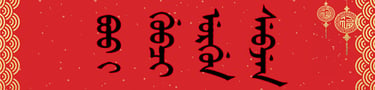
How Many Letters Are in the Manchu Alphabet?
Understanding the 25 Basic Manchu Letters, Vowels, Consonants, and the Twelve Initials
MING YE
10/11/20268 min read


How Many Letters Are in the Manchu Alphabet?
Understanding the 25 Basic Manchu Letters, Six Vowels, Consonants, and the Traditional Twelve Initials
By MING YE
When people begin learning the Manchu language, one of the first questions they often ask is surprisingly simple: How many letters are there in the Manchu alphabet?
English has 26 letters, and the Latin alphabet used in Hanyu Pinyin also contains 26 letters. Does Manchu have a similarly fixed number?
When consulting different Manchu textbooks, alphabet charts, and online learning materials, readers may discover that the number of Manchu letters is not always presented in exactly the same way.
Some textbooks begin with six vowel letters and then introduce the consonants. Others describe the basic Manchu alphabet as containing a little over twenty letters. Still others include additional letters used to represent sounds from foreign languages.
These differences do not necessarily mean that one source is entirely correct and another is entirely wrong.
The number of letters in the Manchu alphabet depends on what is being counted: basic letters alone, additional letters, positional forms, or the different written shapes found in traditional teaching materials.
In a common introductory classification, the Manchu alphabet is described as having six basic vowel letters and nineteen basic consonant letters, making a total of 25 basic letters.
However, this does not mean that every historical Manchu alphabet chart, textbook, or writing tradition must contain exactly 25 symbols.
To understand why different numbers appear, we first need to examine how the Manchu writing system works.
Is Manchu an Alphabetic Writing System?
Yes.
Manchu uses an alphabetic writing system in which letters represent the sounds of the language.
Its basic structure differs from that of Chinese characters.
Chinese characters generally represent morphemes and syllables through relatively independent written characters, while Manchu uses combinations of letters to spell words.
The historical origins of Manchu writing can be traced to traditional Mongolian script.
According to Qing historical accounts, in 1599 Nurhaci instructed Erdeni, Gagai, and others to develop an early Manchu writing system based on Mongolian script.
During the seventeenth century, reforms associated with Dahai further improved the distinction between letters and helped establish more consistent writing conventions.
As a result, Manchu retained the vertical writing direction of traditional Mongolian, along with structural features such as connected letters and positional letterforms.
However, Manchu writing is not simply a sequence of separate, unchanging letters.
The same letter may take different written forms depending on its position within a word.
This is one of the main reasons why counting Manchu letters can be confusing.
How Many Basic Vowels Does Manchu Have?
In common introductory Manchu teaching systems, students usually begin by learning six basic vowel letters.
Their standard Romanized forms are:
VowelRomanizationFirst vowelaSecond voweleThird voweliFourth voweloFifth voweluSixth vowelū
These six vowels provide an important foundation for learning Manchu spelling.
The letters represented by u and ū, for example, differ by only one diacritical mark in Romanization, but they represent distinct letters in the Manchu writing system.
They should therefore not be combined simply because their Romanized forms look similar.
Likewise, Manchu vowel letters should not be understood entirely through the pronunciation of corresponding letters in modern English.
Romanization is a tool for reading, teaching, and linguistic research. It does not imply that Manchu sounds are identical to those represented by the same Latin letters in English.
For beginners, recognizing these six basic vowels is an important first step toward understanding Manchu syllable formation.
How Many Basic Consonants Does Manchu Have?
In the classification that identifies 25 basic Manchu letters, nineteen are commonly listed as consonants.
Their usual Romanized forms include:
n, k, g, h, b, p, s, š, t, d, l, m, c, j, y, r, f, w, ng.
These letters represent different consonantal sounds or consonantal units in Manchu.
Some Romanized forms are familiar to English readers, such as m, n, b, and p.
Others require additional explanation.
For example, š uses a Latin letter with a diacritical mark to distinguish it from ordinary s.
The form ng consists of two Latin letters, but in this traditional classification it is treated as one consonantal unit.
Therefore, the number of Manchu letters cannot be determined simply by counting how many Latin characters appear in their Romanized spellings.
The units being counted are letters within the Manchu writing system, not the number of English letters used to transcribe them.
Why Do Some Manchu Alphabet Charts Contain More Than 25 Letters?
One reason is that different textbooks classify additional letters differently.
Manchu writing was originally developed primarily to record the Manchu language.
However, within the multilingual environment of the Qing dynasty, it was also necessary to represent personal names, place names, and vocabulary from other languages.
As the script was used in a wider range of contexts, certain special letters or supplementary forms were employed to represent foreign sounds.
Some textbooks introduce these additional forms separately rather than including them in the basic alphabet taught to beginners.
When such supplementary letters are included, the total number naturally increases.
In addition, writing conventions changed over different historical periods, and this can affect how individual textbooks organize their alphabet charts.
For these reasons, any discussion of the number of Manchu letters should begin by identifying what is being counted.
If the subject is the basic alphabet used in a common introductory teaching system, the classification of 25 letters can be used.
If the subject is the broader historical writing system, including supplementary letters, the same number may not describe every form in use.
Why Can One Manchu Letter Have Different Shapes?
An important characteristic of Manchu writing is that letters have positional forms.
In traditional Manchu, the same letter may look different depending on where it appears within a word.
Students commonly learn to distinguish initial, medial, and final forms.
For example, a letter at the beginning of a word may have a shape designed to connect with the following letter.
In the middle of a word, it may need to connect with letters on both sides.
At the end of a word, its ending stroke or overall form may change again.
Some letterforms are also influenced by neighboring letters and the surrounding spelling environment.
These variations do not necessarily represent different letters.
A simple comparison can be made with English.
The uppercase letter A and lowercase letter a look different, but they are still forms of the same letter.
Manchu positional forms are more complex than English capitalization, but one underlying principle is similar:
Different written shapes do not necessarily represent different letters.
If every positional form of a Manchu letter were counted separately, the resulting number of written forms would be much larger than the number of basic letters.
This helps explain why some Manchu alphabet charts contain numerous symbols even though the basic alphabet is described as having a much smaller number of letters.
Do the Manchu Twelve Initials Mean There Are Twelve Letters?
No.
This is another concept that can easily cause confusion when learning Manchu.
Traditional Manchu education frequently refers to the Twelve Initials, commonly known in Chinese as Shier Zitou (十二字头).
However, the Twelve Initials do not mean that the Manchu alphabet contains only twelve letters.
They are a traditional instructional arrangement used to organize and teach Manchu syllable spelling.
By arranging vowels, consonants, and their combinations in a systematic sequence, learners can gradually become familiar with Manchu pronunciation, spelling patterns, and changes in letterforms.
The purpose of the Twelve Initials is to teach syllable combinations and spelling, rather than simply count independent letters.
Therefore, the Twelve Initials should not be confused with twelve individual alphabetic letters.
Nor should every syllable combination appearing in the Twelve Initials be counted as a separate basic letter.
For beginners, a useful learning sequence is to recognize the basic letters first, understand their positional forms, and then gradually study syllable combinations and the traditional arrangement of the Twelve Initials.
Is the Number of Manchu Syllables the Same as the Number of Letters?
No.
Letters are basic units of a writing system, while syllables are units of spoken language that may contain one or more sounds.
Manchu uses combinations of letters to record words, allowing many different syllable structures to be represented.
For example, Romanized forms such as ma, me, mi, mo, and mu can help beginners understand the basic principle of combining consonants with vowels.
However, these combinations do not mean that every syllable is an independent letter.
Likewise, a word may contain several syllables, each of which is represented by a combination of letters.
At least three concepts therefore need to be distinguished when studying Manchu:
A letter is a basic unit of the writing system. A letterform is the visible shape a letter takes in a particular writing environment. A syllable is a unit of spoken language formed through the organization of sounds.
Confusing these three concepts can easily produce different answers when attempting to count the letters of the Manchu alphabet.
Why Is Memorizing the Alphabet Not Enough to Read Manchu?
Recognizing the basic letters is the first step in learning Manchu, but it does not mean that a student can already read the language.
This is because Manchu uses a connected writing system.
Even when beginners can identify a letter in isolation, they may not immediately recognize its form within a complete word.
The same letter can look different at the beginning and in the middle of a word.
Some letters also have similar shapes and must be distinguished through particular marks or by considering their context.
Learning to read Manchu therefore generally involves several stages.
First, students recognize the basic vowels and consonants.
Next, they become familiar with the positional variations of individual letters.
They then learn how letters combine to form syllables and words.
Finally, they apply vocabulary and grammatical knowledge to reading complete Manchu sentences.
Those who wish to study Qing dynasty Manchu archives must also become familiar with historical spelling conventions, documentary formats, and variations in writing practices across different periods.
Therefore, memorizing the 25 basic letters does not mean that someone can independently read historical Manchu documents.
Nevertheless, the basic alphabet remains an essential foundation for further study.
Why Does the Number of Manchu Characters Look Different in Computers?
In modern digital environments, counting Manchu letters also raises questions about Unicode character encoding.
Unicode provides character-encoding support for Manchu and related Mongolian writing systems.
However, the number of encoded characters in a computer system is not the same as the number of basic letters taught in language classes.
This is because computers must handle more than the basic alphabet.
Digital text processing may also involve supplementary characters, punctuation, writing controls, and other elements required for representing and displaying text.
Furthermore, the visual display of Manchu depends on fonts and text-rendering systems.
A single letter may appear in different positional forms, with the appropriate shape selected automatically according to the surrounding text.
Therefore, the number of Unicode characters associated with Manchu and related scripts cannot be used directly to determine the number of basic letters in the traditional Manchu alphabet.
These are two different systems of classification.
Language education focuses on letters and spelling rules.
Digital encoding focuses on how computers store, process, and display written text.
The two are related, but they are not interchangeable.
So, How Many Letters Are in the Manchu Alphabet?
Returning to the original question:
In a common introductory classification, the Manchu alphabet is described as having 25 basic letters: six vowels and nineteen consonants.
However, this number must be understood within a clearly defined system of classification.
When supplementary letters, historically used special forms, or positional letterforms are included, different sources may present different totals.
Such differences do not necessarily indicate contradictions within the Manchu writing system. They often reflect differences in what is being counted.
For general readers, three points are particularly important.
First, Manchu is an alphabetic writing system that uses combinations of letters to record language.
Second, Manchu letters connect and change shape according to their position, so a single letter may have several written forms.
Third, the traditional Twelve Initials are a system for teaching syllable spelling and should not be confused with the number of basic alphabetic letters.
Therefore, the most accurate answer to the question "How many letters are in the Manchu alphabet?" is not simply to provide a number without explanation.
It is to explain the classification system on which that number is based.
The 25 basic letters provide one common introductory framework for understanding Manchu writing. Learning the distinction between letters, letterforms, and syllables is the key to understanding how the script actually works.
As students continue studying positional letterforms, syllable combinations, and the traditional Twelve Initials, they discover that the Manchu writing system is considerably richer than a simple alphabet count might suggest.
— MING YE