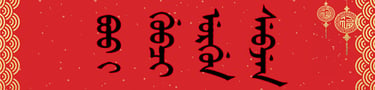
From the “National Script” to Calligraphic Art: The Manchu Writing Tradition and the Formation of Manchu Seal Script
From the “National Script” to Calligraphic Art: The Manchu Writing Tradition and the Formation of Manchu Seal Script
MING YE
9/23/20269 min read


From the “National Script” to Calligraphic Art: The Manchu Writing Tradition and the Formation of Manchu Seal Script
By MING YE
When Manchu calligraphy is discussed today, attention is often drawn first to its elongated forms, vertically connected structure, and linear qualities that differ markedly from those of Chinese characters.
Historically, however, Manchu did not originate primarily as a medium of “calligraphic art.”
It was a writing system used to record language, conduct government affairs, translate texts, compile books, and preserve official records. For a substantial period during the Qing dynasty, Manchu functioned as the “national script” (guoshu) and was widely employed in official documentation and cultural production, often alongside Chinese.
It was through this extensive and sustained practice of writing that Manchu developed its own traditions of regular, running, cursive, and seal-script forms.
For this reason, I believe that an understanding of Manchu calligraphy should not begin simply with the question of how to make Manchu writing visually beautiful.
We should first ask:
How was Manchu historically written, and why did different modes of writing emerge?
I. Manchu Was First and Foremost a Writing System in Extensive Practical Use
Following its creation, Manchu gradually developed from a writing system used within a more limited regional and political context into one embedded in the administrative and cultural institutions of the Qing state.
During the Qing dynasty, Manchu was extensively employed in imperial edicts, decrees, memorials, official reports, and communications between central and local authorities. It was also used in printed books, manuscript copies, lexicographical works, historical writings, and other forms of textual production.
The enormous corpus of surviving Manchu-language archival documents provides direct evidence of this practical use.
These archives encompass an exceptionally wide range of subjects, including politics, society, military affairs, interethnic relations, hydrology, meteorology, geography, and local products and resources. Some preserve information that is absent from corresponding Chinese-language archives or other surviving sources.
Manchu must therefore first be understood as a writing system with substantial practical functions.
This point is essential to any historical understanding of Manchu calligraphy.
A calligraphic tradition does not emerge in isolation.
It generally develops through sustained practices of writing. Only after a writing system has been used extensively enough to establish recognizable conventions of stroke formation, structure, speed, and scribal practice can differentiated modes and styles of writing develop more fully.
From this perspective, the vast body of Qing-period Manchu archives constitutes not only a historical resource, but also a major body of evidence for the study of Manchu writing practices.
II. Regular, Running, and Cursive Forms: Different Modes of Writing for Different Contexts
Traditional Manchu writing developed a range of forms conventionally described as regular, running, cursive, and seal script.
These distinctions were not simply aesthetic categories. Historically, they were also closely related to the practical circumstances in which writing was produced.
Regular Manchu script, with its comparatively standardized and carefully articulated forms, was well suited to formal textual contexts.
It could be used for the printing and careful copying of books, as well as for the preparation of imperial edicts, decrees, memorials, official reports, and other formal documents.
Running script had an even broader range of practical applications.
Ordinary manuscript copies, preliminary drafts, communications between government offices and officials, and the transcription and compilation of administrative records all required a balance between speed and legibility. Running forms therefore constituted an especially practical mode of Manchu writing.
Cursive forms had a more restricted range of use and were more commonly associated with drafts, personal correspondence, notes, and calligraphic works in which individual writing habits could become more pronounced.
This suggests an important point:
A “script style” is, before it becomes an aesthetic category, a way of writing.
Its development is shaped not only by aesthetic preferences but also by speed, function, context, and the habits of individual writers.
This is particularly important in the study of Manchu calligraphy.
If we detach modern ideas of “Manchu running script” or “Manchu cursive script” from historical manuscripts and construct them primarily through contemporary imagination, we risk losing sight of the scribal traditions from which these forms developed.
III. 1748: The Systematization of Manchu Seal Script under the Qianlong Emperor
One particularly significant development in the history of Manchu calligraphy took place during the Qianlong reign.
Seal-style forms of Manchu writing did not suddenly appear in the Qianlong period. Historical accounts indicate that forms of Manchu seal writing had already existed earlier, although their varieties were limited and their transmission relatively restricted.
The Qingchao Tongzhi (Comprehensive Records of the Qing Dynasty) states:
“The seal forms of the Qing script were transmitted from the time of Emperor Wen of Taizong. Thus Qing seal writing emerged alongside the national script itself; only its various forms were not yet fully developed, and its transmission and study remained limited.”
A major systematic reorganization of Manchu seal script took place in the thirteenth year of the Qianlong reign, or 1748.
The Qianlong Emperor ordered Fuheng and others to reorganize and develop Manchu seal forms on the model of Chinese seal-script traditions. Thirty-two distinct styles were established, together with corresponding Manchu-Chinese names.
Some of these names reflected distinctive graphic or ornamental characteristics, including forms conventionally identified as “Yingluo Seal Script” and “Dragon Script.”
To present and promote this newly systematized repertoire, the imperial Shengjing Fu (Ode to Mukden, or Imperially Composed Ode to Shengjing) was printed using the thirty-two styles.
This development is particularly significant to me.
By the mid-eighteenth century, Manchu writing was no longer being considered solely in terms of its practical function as a means of recording language. There was also a conscious exploration of another question:
How many different visual forms could the same Manchu writing system assume?
At this point, we are already entering the conceptual territory of script design and calligraphic formal experimentation.
IV. Why Manchu Seal Script Should Not Be Understood Simply as Chinese Seal Script Applied to Manchu
The Manchu seal scripts systematized during the Qianlong period were clearly influenced by the conceptual and aesthetic traditions of Chinese seal script.
It would nevertheless be misleading, in my view, to interpret Manchu seal script simply as the outward appearance of Chinese seal script transferred onto Manchu writing.
The reason is fundamental: the two writing systems are structurally different.
Chinese characters are organized as relatively discrete graphic units, conventionally occupying more or less bounded spatial fields.
Manchu, by contrast, is an alphabetic writing system. Individual words vary considerably in length according to the number and combination of letters they contain, while letters also assume positional forms and connect vertically within the word.
Consequently:
Chinese seal script largely addresses the reorganization of strokes within discrete character structures; Manchu seal script must additionally confront the problem of how a connected alphabetic writing system can undergo ornamental transformation while remaining recognizable as writing.
The two traditions can influence one another, but they cannot simply operate according to identical principles.
This distinction remains central to my own study and practice of Manchu seal-script forms.
A meaningful Manchu seal script should not merely “look like seal script.”
It must first remain Manchu.
V. One of the Central Challenges of Manchu Calligraphy Is the Organization of the Whole Composition
In Chinese calligraphy, an individual character normally possesses a relatively distinct graphic boundary.
This allows the calligrapher, at least to some extent, to anticipate how many characters may occupy a line or a given area of the composition.
Manchu presents a different problem.
As an alphabetic writing system, its words vary significantly in length according to the number of letters they contain.
This characteristic creates one of the most important challenges in Manchu calligraphy:
composition.
When creating a work of Manchu calligraphy, the writer cannot consider only whether an individual word is well formed.
The entire work must be anticipated at the same time:
How long will one vertical line ultimately become?
How will its length relate to that of the next line?
How should lines of different lengths establish rhythm and density?
How much space should remain between columns?
How should the upper and lower margins be handled?
And how should signatures, seals, and the principal text be integrated into a coherent visual field?
In other words, the structure of Manchu naturally compels the calligrapher to move from the individual written unit toward the composition as a whole.
This is precisely one of the qualities that I find most compelling in Manchu calligraphy.
Its aesthetic unit cannot be confined to an individual letter or even to an individual word.
In many works, what ultimately determines the success of the composition is the vertical rhythm and spatial relationship of the entire piece.
VI. The Basic Graphic Elements of Manchu Differ Fundamentally from the Stroke System of Chinese Characters
Another issue is frequently overlooked when discussing Manchu calligraphy.
When we think about brush writing through the conceptual framework of Chinese calligraphy, we naturally speak of such strokes as the horizontal, vertical, left-falling, right-falling, dot, and rising stroke.
Manchu letters, however, are constructed through a different graphic system. Their characteristic lines, heads, “teeth,” dots, circles, and related elements differ substantially from the conventional stroke vocabulary of Chinese characters.
Thus, even when the same writing instrument—the brush—is used:
Writing Chinese characters and writing Manchu cannot simply be understood as producing different shapes through an identical system of strokes.
The brush must respond to the connective behavior and vertical structure inherent in Manchu writing.
Continuous Manchu writing also generates patterns of pressure, release, turning, and movement that differ from those encountered in Chinese characters.
Historical Manchu brush writing was certainly influenced by Chinese calligraphy, particularly by the techniques and rhythms associated with running and cursive scripts.
Such influence is entirely understandable in a cultural environment in which different writing traditions existed in sustained contact.
Yet the adoption of techniques from Chinese calligraphy does not mean that Manchu calligraphy should be treated as an appendage of Chinese-character calligraphy.
A mature understanding of Manchu calligraphy must still begin with the internal structure of the Manchu script itself.
VII. Manchu Translations of Chinese Classics Preserved Another Important Tradition of Writing
Translation was another major function of Manchu during the Qing dynasty.
A substantial body of Chinese literature and scholarship was translated into Manchu, including works such as the Mencius, the Zizhi Tongjian Gangmu (Outline and Digest of the Comprehensive Mirror for Aid in Government), Romance of the Three Kingdoms, and Strange Tales from a Chinese Studio.
From the perspective of linguistic history, these translations provide valuable evidence for the study of Manchu vocabulary, grammar, and translation practices.
From the perspective of writing, however, they are equally important.
Long Manchu texts allow us to observe the script in sustained textual use:
how one word follows another;
how vertical lines of text are constructed;
how words of different lengths coexist on a page;
and how visual order is maintained across extended passages.
I have previously discussed a similar issue through a Manchu version of The Art of War.
If, for a moment, we set aside the semantic content of such historical texts and look at a page of Manchu simply as a visual field, an important point becomes apparent:
Historical documents themselves constitute the largest surviving archive of Manchu writing practice.
VIII. From Practical Writing to the Art of Script
Following the 1911 Revolution, the practical use of Manchu as a language of state administration declined rapidly.
The decline of its administrative function, however, did not mean that its cultural life necessarily came to an end.
On the contrary, when a writing system no longer bears its former large-scale administrative responsibilities, its historical, linguistic, and artistic significance may become visible in new ways.
The millions of surviving Manchu archival documents, together with books, inscriptions, genealogies, and other written materials, constitute irreplaceable primary sources for the study of Qing history and the Manchu language and script.
At the same time, Manchu has acquired another increasingly visible identity:
a medium of calligraphic art.
Historically, Manchu was written primarily in order to record.
Today, writing Manchu may also serve research, cultural transmission, artistic expression, and intercultural communication.
This does not replace the historical functions of Manchu. Rather, it represents a new extension of them.
IX. Why I Do Not Believe Manchu Calligraphy Should Simply Imitate Chinese Calligraphy
The history of calligraphy in China cannot be reduced to the history of Chinese characters alone.
Across different periods, multiple writing traditions have coexisted within China.
Manchu, Mongolian, and other scripts developed distinctive traditions of brush writing and visual expression. Together, these traditions broaden the cultural and visual scope through which the history of calligraphy in China can be understood.
Manchu calligraphy was unquestionably influenced by Chinese calligraphic practice.
Yet if our primary question today remains:
“How can Manchu be written so that it resembles Chinese calligraphy?”
we may overlook precisely those qualities that are most distinctive to Manchu itself.
For me, more productive questions are:
What possibilities are inherent in the lines of Manchu writing itself?
What kinds of composition can emerge from its vertical structure?
How can words of different lengths generate visual rhythm?
How can Manchu seal script undergo structural transformation while preserving textual recognizability?
And what new relationships become possible when Manchu, Chinese, English, or other writing systems occupy the same artistic space?
These questions extend beyond calligraphic technique in the narrow sense.
They also concern grammatology, historical writing practices, type and script design, and contemporary visual art.
X. The Future of Manchu Calligraphy Is Not Simply the Preservation of an Old Way of Writing
Since its creation in 1599, Manchu has undergone several centuries of historical development.
It served as an important language of state documentation, as a major means of communication within Manchu society, and as a medium of cultural exchange between Manchu and Chinese communities as well as in broader contacts beyond China.
It recorded history and produced an extensive written heritage.
Today, we undoubtedly have a responsibility to preserve these traditions.
But preservation does not mean freezing them in time.
If Manchu survives only in archives and facsimile editions of historical books, what we preserve is its history.
If people today continue to study it, read it, write it, and create with it on the basis of a serious understanding of its historical structure, then what we sustain is a living culture of writing.
From Qing administrative documents to the thirty-two styles of Manchu seal script;
from the imperial Shengjing Fu to contemporary Manchu calligraphy;
from traditional brush writing to contemporary cross-script artistic practice—
Manchu has repeatedly adapted its visual forms to different historical environments.
For me, this is precisely where the future exploration of Manchu calligraphy becomes most meaningful:
to respect the inherited structure of the script while continuing to discover new forms through which it can exist in the contemporary world.
The history of Manchu demonstrates that it is capable of doing more than recording language.
It can also become line, structure, and visual art.
For those of us who write Manchu today, the question may therefore be:
Once we have understood the past, how do we continue writing into the future?
MING YE
Manchu Calligraphy Artist / Researcher of Manchu Writing and Visual Culture