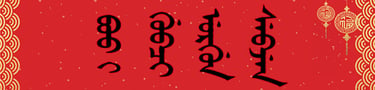
Does the Manchu Script Have Unicode Encoding? A Complete Guide
Does Manchu have Unicode encoding? Explore the U+1800–U+18AF character block, Manchu letters, variation selectors, vertical writing, and digital text support.
MING YE
10/26/20268 min read
Does the Manchu Script Have Unicode Encoding?
How Unicode Represents Manchu Letters, Contextual Forms, Vertical Writing, and Digital Text
By MING YE
Does the Manchu writing system have an official Unicode encoding? Can Manchu characters be represented as standardized digital text, or do they still depend on specialized fonts and images?
Yes. The Manchu script is supported by Unicode, the international character-encoding standard used by modern computers, smartphones, websites, and digital documents.
However, Manchu does not have a completely separate Unicode block under its own name.
Instead, the characters needed to write Manchu are encoded primarily within the Mongolian Unicode block, U+1800–U+18AF.
This arrangement reflects the historical and structural relationship between Manchu and Mongolian writing.
The Manchu script developed from the Mongolian writing tradition and retains many of its fundamental characteristics, including connected letters, contextual letter forms, and traditional vertical writing.
Unicode therefore treats Manchu as a language written using the broader Mongolian script system, while providing characters and mechanisms needed to represent its distinctive orthography.
This distinction is important.
Manchu has standardized Unicode support, but it does not have a separate, independent Unicode block equivalent to those assigned to some other writing systems.
Understanding this arrangement helps explain how Manchu can be typed, displayed, searched, and preserved in modern digital environments.
1. What Is Unicode, and Why Does It Matter for Manchu?
Unicode is an international standard for representing written characters in digital systems.
It assigns standardized identifiers, called code points, to characters used by writing systems around the world.
For example, the Latin capital letter A is represented by U+0041.
Chinese characters, Arabic letters, Tibetan characters, and many other writing systems are also represented through Unicode.
The purpose of Unicode is to allow text to retain its identity when transferred between different computers, operating systems, and applications.
Before widespread Unicode adoption, many writing systems depended on incompatible local encoding systems or custom fonts.
These approaches could create serious problems.
A document might appear correctly on one computer but become unreadable when opened elsewhere.
For Manchu, Unicode provides a standardized foundation for digital text.
It allows characters to be stored independently of the font used to display them.
Consequently, correctly encoded Manchu text can potentially be copied, searched, edited, transmitted, and preserved.
Unicode does not automatically solve every problem involving Manchu typography, but it provides the essential foundation for interoperable digital writing.
2. Where Is Manchu Located in Unicode?
Manchu characters are primarily encoded within the Unicode block named Mongolian.
The block extends from U+1800 to U+18AF.
It includes characters used by traditional Mongolian writing and related scripts, including Manchu.
The block contains general Mongolian-script letters as well as characters specifically associated with Manchu and other related orthographic traditions.
Examples of explicitly named Manchu characters include:
Unicode Code PointUnicode Character NameCharacterU+1873MONGOLIAN LETTER MANCHU IᡳU+1874MONGOLIAN LETTER MANCHU KAᡴU+1875MONGOLIAN LETTER MANCHU RAᡵU+1876MONGOLIAN LETTER MANCHU FAᡶU+1877MONGOLIAN LETTER MANCHU ZHAᡷ
These examples demonstrate that Unicode explicitly recognizes several characters associated with Manchu.
However, they do not represent the complete Manchu alphabet.
Many letters used in Manchu share encoded characters with the broader Mongolian script.
It would therefore be incorrect to assume that only characters whose Unicode names contain the word MANCHU can be used to write Manchu.
The Manchu writing system is represented through a combination of shared Mongolian-script characters and characters specifically encoded for Manchu orthography.
3. Why Does Manchu Share a Unicode Block with Mongolian?
The relationship originates in the history of the writing system.
In 1599, Nurhaci ordered the development of a written form suitable for the Manchu language.
The work is traditionally associated with Erdeni and Gagai, who adapted the existing Mongolian script.
The early Manchu writing system retained the basic vertical structure and connected letter forms of its Mongolian predecessor.
In 1632, during the reign of Hong Taiji, Dahai introduced important modifications traditionally associated with the addition of dots and circles.
These changes helped distinguish sounds that could otherwise be difficult to identify in the earlier script.
The resulting writing system developed its own standardized orthographic conventions.
Nevertheless, its structural relationship with Mongolian remained clear.
Both writing traditions use connected characters and contextual letter forms.
Both are traditionally written vertically.
Unicode's shared encoding framework reflects these historical and technical similarities.
However, shared encoding does not mean that Manchu and Mongolian are the same language.
Manchu belongs to the Tungusic language family, while Mongolian belongs to the Mongolic language family.
Their linguistic structures and vocabularies are distinct.
The relationship between their writing systems should therefore not be confused with a close genealogical relationship between the languages themselves.
4. Does Every Manchu Letter Have Its Own Unicode Code Point?
Not necessarily.
Unicode generally encodes the underlying characters of a writing system rather than assigning separate code points to every visual form.
This distinction is especially important for Manchu.
A Manchu letter may have different forms depending on whether it appears at the beginning, middle, or end of a word.
These are known as positional forms.
Unicode does not normally assign a separate character to each positional form.
Instead, the text-rendering system determines which form should appear.
For example, the Manchu letter represented by a particular Unicode character may appear differently depending on its surrounding letters.
The underlying character remains the same.
Unicode also provides mechanisms for selecting certain alternative forms when they cannot be determined automatically.
These include the Mongolian Free Variation Selectors.
The relevant code points are:
Code PointUnicode NameFunctionU+180BMONGOLIAN FREE VARIATION SELECTOR ONESelects a defined alternative letter formU+180CMONGOLIAN FREE VARIATION SELECTOR TWOSelects another defined alternative formU+180DMONGOLIAN FREE VARIATION SELECTOR THREESelects another defined alternative formU+180FMONGOLIAN FREE VARIATION SELECTOR FOURSupports additional defined variation sequences
These characters are not ordinary letters.
They modify the presentation of preceding characters in specified circumstances.
Their correct use depends on Unicode's defined variation sequences and the applicable orthographic rules.
This system allows Manchu to represent distinctions in letter shape without assigning a completely independent code point to every possible form.
5. Does Unicode Guarantee That Manchu Will Display Correctly?
No.
Unicode provides standardized character encoding, but visual display depends on additional technology.
Manchu requires contextual shaping because its letters connect and change form according to their position and surrounding characters.
A computer must interpret the encoded sequence and select the appropriate glyphs.
This process is performed by the text-rendering system in cooperation with the font.
If either component lacks adequate Manchu support, the result may be incorrect.
Common problems include disconnected letters, inappropriate positional forms, missing dots or circles, and incorrectly displayed variation sequences.
For this reason, a font containing Manchu characters is not necessarily sufficient.
The font must support the required glyph substitutions, and the application must process them correctly.
The Unicode Consortium's technical documentation specifically addresses the complexities of Mongolian-script encoding and shaping.
These technical challenges affect Manchu because it shares the same encoding framework.
6. How Does Unicode Handle Traditional Vertical Manchu Writing?
Traditional Manchu is written vertically.
Letters are arranged from top to bottom, and successive columns progress from left to right.
Unicode identifies the characters but does not independently determine the complete visual layout of a document.
Vertical writing is therefore handled through text-layout systems.
For example, modern web browsers can use CSS writing modes to arrange text vertically.
A website may specify:
writing-mode: vertical-lr;
This establishes vertical text flow with columns progressing from left to right.
However, vertical layout and contextual shaping are separate technical requirements.
A website might arrange characters in vertical columns while still displaying their forms incorrectly.
Conversely, an application might correctly shape Manchu letters but display the text horizontally.
Accurate digital Manchu requires both functions.
This distinction is particularly important for online dictionaries, language-learning websites, historical transcriptions, and digital publications.
7. Can Unicode Manchu Be Used in Websites and Digital Dictionaries?
Yes.
Unicode makes it possible to store Manchu vocabulary and historical texts as machine-readable data.
A digital dictionary can associate a Manchu word with its pronunciation, translation, grammatical information, and examples.
The same underlying text can be reused across multiple applications.
For example, a properly designed database can supply Manchu entries to a dictionary website, a mobile application, and an educational platform without replacing the original characters with images.
Unicode also provides a foundation for searching and indexing Manchu text.
However, search functionality requires additional attention.
Two words may appear visually similar while containing different character sequences or variation selectors.
Legacy font encodings can create further complications.
Search engines and database systems must therefore handle character sequences consistently.
For digital preservation, the preferred approach is to store correctly encoded Unicode text separately from the font and layout instructions used to display it.
This allows the visual presentation to be improved without replacing the underlying linguistic data.
8. What Is the Difference Between Unicode Manchu and Older Custom-Font Systems?
Before Unicode became widely adopted, some digital Manchu materials were created using specialized fonts.
In certain systems, ordinary Latin keyboard characters were visually replaced with Manchu-looking glyphs.
For example, typing a Latin letter might produce a Manchu symbol when a particular font was selected.
This method could create readable documents within a controlled software environment.
However, the underlying character remained the original Latin character rather than a properly encoded Manchu character.
Such systems have several limitations.
A document may become unreadable when the custom font is unavailable.
Copying its contents into another application may reveal Latin letters instead of Manchu.
Search engines may also fail to recognize the text as Manchu.
Unicode addresses these problems by assigning standardized identities to the characters themselves.
The appearance of the text can then be controlled separately through fonts and rendering technology.
Nevertheless, converting older custom-font documents into Unicode may require careful character mapping.
Simply changing the font does not necessarily convert legacy text into correctly encoded Manchu.
9. Why Is Unicode Important for the Future of Manchu?
Unicode provides an essential foundation for the long-term digital preservation of Manchu.
Historical Manchu documents contain valuable information about Qing administration, language, culture, and society.
Making these materials available as searchable text can improve access for researchers and learners.
Unicode also supports the development of modern educational resources.
These include online dictionaries, electronic textbooks, language-learning applications, and digital manuscript collections.
For language revitalization, standardized encoding helps ensure that newly created materials remain usable across different technological platforms.
However, Unicode alone cannot preserve a spoken language.
It provides a technical framework for representing written Manchu.
The survival and development of Manchu as a living language also depend on education, community participation, and opportunities for regular communication.
Unicode is therefore best understood as an important technological foundation rather than a complete solution to language endangerment.
Conclusion: Does the Manchu Script Have Unicode Encoding?
Yes. Manchu has been supported by Unicode since the Mongolian script was incorporated into Unicode 3.0 in 1999.
Its characters are encoded primarily within the Mongolian block, U+1800–U+18AF.
The encoding framework includes both characters shared with traditional Mongolian writing and characters specifically associated with Manchu.
Unicode also provides mechanisms for representing certain alternative letter forms.
However, standardized encoding does not automatically guarantee correct display.
Manchu requires compatible fonts, contextual shaping, and appropriate vertical text layout.
The distinction between encoding and rendering is therefore essential.
Manchu is no longer dependent on images or proprietary fonts for digital representation. It has a standardized international encoding system that supports modern text processing and long-term preservation.
The remaining challenges concern implementation, compatibility, and the accurate digital presentation of its traditional writing conventions.
For researchers, educators, and language learners, Unicode provides the foundation for making Manchu a searchable, editable, and accessible part of the modern digital world.
— MING YE
References and Research Materials
Primary Technical Standards
Unicode Consortium, The Unicode Standard, Chapter 13, Section 13.5: Mongolian. Explains the unified encoding of Mongolian, Todo, Manchu, and Sibe writing systems.
Unicode Consortium, Mongolian Code Chart, U+1800–U+18AF. Official character names and code points.
Unicode Consortium, Unicode Technical Note #57: Encoding and Shaping of the Mongolian Script (2024). Detailed discussion of character representation and shaping.
Unicode Consortium, Unicode Technical Report #54: Unicode Mongolian 12.1 Snapshot (2019). Historical documentation of positional forms and variation sequences.
Unicode Consortium, Unicode Character Database. Standardized character properties and variation sequences.
World Wide Web Consortium (W3C), CSS Writing Modes Level 3. Technical specifications for vertical text layout.
Historical and Linguistic References
Gertraude Roth Li, Manchu: A Textbook for Reading Documents (2000).
Jerry Norman, A Comprehensive Manchu-English Dictionary (2013).
Liliya M. Gorelova, Manchu Grammar (2002).
Mark C. Elliott, The Manchu Way: The Eight Banners and Ethnic Identity in Late Imperial China (2001).

