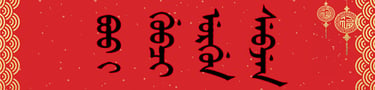
Does Manchu Spell Words with Letters Like English?
Discover how Manchu uses letters to spell words like English, and explore the differences in vertical writing, connected letters, pronunciation, and grammar.
MING YE
10/13/20269 min read


Does Manchu Spell Words with Letters Like English?
Understanding the Similarities and Differences Between Manchu and English: Alphabets, Word Structure, and Vertical Connected Writing
By MING YE
People encountering Manchu writing for the first time often ask an interesting question: Does Manchu use letters to spell words, just like English?
For example, the English word book consists of four letters: b, o, o, and k. Together, these letters form a word meaning a book.
The Manchu word for “book” or “document” can be Romanized as bithe.
At first glance, the two words seem structurally similar: several letters combine to form a complete word with a particular meaning.
However, when people see traditional Manchu writing, they immediately notice that it looks very different from English.
English is written horizontally from left to right, and its printed letters are generally separate. Manchu, by contrast, is written vertically from top to bottom, with letters usually connected. The same letter may also take different shapes depending on its position.
So, do Manchu and English actually follow the same basic spelling principle?
The answer is yes. Both Manchu and English are alphabetic writing systems that primarily use combinations of letters to spell words. However, they employ different alphabets, writing directions, and spelling conventions, and the languages they represent belong to different language families.
Understanding these similarities and differences is an important foundation for learning the Manchu alphabet and reading Manchu words.
Why Are Both Manchu and English Considered Alphabetic Writing Systems?
First, it is important to understand what an alphabetic writing system is.
An alphabetic writing system uses a limited set of letters to represent units of speech.
In a typical alphabet, vowels and consonants can both be represented by corresponding letters.
These letters are combined according to spelling conventions to form words.
English uses the Latin alphabet, which has 26 basic letters in its modern form.
Manchu uses an alphabet developed from traditional Mongolian script.
In one common introductory classification, the Manchu alphabet consists of six basic vowel letters and nineteen basic consonant letters, making a total of twenty-five. However, different textbooks may count supplementary letters and special forms differently.
Although the two scripts look different, they share a fundamental principle:
Letters primarily represent speech sounds, while words are generally formed through combinations of letters.
For example, the English word book is a lexical unit, and the Manchu word bithe is also a lexical unit.
Their individual letters do not need to correspond to separate meaningful morphemes in the way Chinese characters often do.
Therefore, from the perspective of writing-system typology, Manchu and English share important structural similarities.
How Does Manchu Use Letters to Spell Words?
Several common Manchu words can help illustrate this principle.
The following examples use Romanization to show the spelling of Manchu words rather than displaying their original traditional Manchu letterforms.
Manchu RomanizationChinese meaningEnglish equivalentama父亲Fathereme母亲Motherboo家、房屋Home / Housebithe书、文书Book / Documentniyalma人Personusiha星星Starilan三Three
Consider ama.
This Manchu word means “father.”
In Romanization, it is represented by the three Latin letters a, m, and a.
In actual Manchu writing, however, the word is written using the corresponding Manchu letters, connected according to traditional Manchu writing conventions.
Now consider bithe.
It refers to a book, document, or related written material.
In Romanization, we can analyze it as the sequence b, i, t, h, and e.
However, these letters do not individually mean “paper,” “writing,” “binding,” or other components of a book.
Instead, they primarily represent the spoken form of the word.
The complete word bithe carries the lexical meaning.
This is similar to the basic spelling principle of the English word book.
Are Manchu Letters the Same as English Letters?
No.
Although Manchu and English both use alphabets, they employ different writing systems.
English uses the Latin alphabet.
Manchu uses an alphabet developed from traditional Mongolian script.
According to Qing dynasty historical records, in 1599 Nurhaci instructed Erdeni, Gagai, and others to create an early Manchu writing system based on Mongolian script.
Manchu subsequently developed spelling conventions suited to the sounds of the Manchu language.
During the seventeenth century, important reforms were introduced to Manchu letterforms and orthography.
Therefore, Manchu and English are not classified as the same general type of writing system because their letters look alike.
Their common feature is that both use combinations of letters to represent speech sounds.
For example:
FeatureManchuEnglishWriting-system typeAlphabeticAlphabeticScript originTraditional Mongolian scriptLatin alphabetTraditional writing directionTop to bottomLeft to rightLetter connectionsGenerally connected verticallyUsually separate in modern printPositional letterformsSystematic positional variationsNo comparable systematic variation in ordinary printLanguage representedManchuEnglish
This comparison demonstrates that belonging to the same general writing-system category does not mean that scripts share the same visual appearance or specific conventions.
Why Are English Words Written Horizontally While Manchu Words Are Written Vertically?
This is one of the most immediately noticeable differences between the two scripts.
Modern English is generally written horizontally from left to right.
For example:
book →
Readers identify the letters in sequence along a horizontal line.
Traditional Manchu uses vertical writing.
A word is normally written from top to bottom, with successive columns progressing from left to right.
The letters within a Manchu word are therefore generally connected vertically.
This writing convention reflects the historical influence of traditional Mongolian script.
When Manchu writing was developed, it inherited the vertical structure of traditional Mongolian writing and subsequently established its own spelling conventions.
It is important to note that the traditional column order of Manchu differs from that of traditional Chinese vertical writing.
Traditional Chinese vertical writing generally proceeds from top to bottom, with columns progressing from right to left.
Manchu also runs from top to bottom, but its columns progress from left to right.
Thus, even though both Manchu and Chinese can be written vertically, their column arrangements are different.
Why Are Manchu Letters Connected While English Letters Are Usually Separate?
Because the two scripts developed different writing traditions.
In modern printed English, letters are generally arranged as separate characters.
For example, the letters f, a, t, h, e, and r in father usually retain relatively independent printed shapes.
In traditional Manchu, however, letters generally connect vertically.
This connected structure means that the actual shape of a letter is influenced by its position within a word.
For example:
Initial Form
A letter at the beginning of a word generally needs to connect to the following letter.
Medial Form
A letter in the middle of a word generally needs to connect to the letters before and after it.
Final Form
A letter at the end of a word must conclude the word with an appropriate final shape.
As a result, the same Manchu letter may appear in different forms.
This phenomenon is known as positional variation or positional forms.
However, not every Manchu letter has exactly three completely different shapes. Some letters also have isolated forms or additional variations influenced by particular spelling environments.
It is worth noting that English cursive handwriting can also connect letters.
However, connections in English cursive are not equivalent to the systematic positional letterforms found in traditional Manchu orthography.
Manchu should therefore not be understood simply as “English cursive written vertically.”
Can You Read Manchu Words Just by Learning the Letters, as in English?
The basic learning process has certain similarities.
Students must first recognize letters and then understand the relationship between letter combinations and word pronunciation.
However, knowing the letters does not automatically mean that someone can pronounce or understand every word correctly.
For example, English learners who recognize all 26 letters still need to study the pronunciation, spelling, and meanings of individual words.
The same applies to Manchu.
Learners need to understand the basic alphabet, positional letterforms, spelling conventions, and Manchu vocabulary.
Manchu also presents a particular challenge: the same letter may have different appearances in different positions.
Consequently, a learner who recognizes isolated letters in an alphabet chart may still struggle to identify them within complete Manchu words.
This is why learning Manchu cannot stop at memorizing the alphabet.
Students also need reading practice involving syllable combinations and actual words.
The traditional Manchu teaching system known as the Twelve Initials, or Shier Zitou (十二字头), is one important method for systematically learning syllable combinations and spelling patterns.
If Both Manchu and English Are Alphabetic, Why Are Their Pronunciation Rules Different?
Because similar writing principles do not mean that the scripts represent identical sound systems.
English and Manchu have different phonological systems.
Certain vowel and consonant distinctions in English do not correspond directly to those found in Manchu.
Likewise, some Manchu sounds cannot be adequately explained through modern English pronunciation rules.
Manchu has its own vowel and consonant system and its own spelling traditions.
For example, in common Manchu Romanization systems, the six basic vowels are represented as:
a, e, i, o, u, ū.
These symbols help readers understand Manchu pronunciation and spelling.
They do not mean that the same Latin letters necessarily have identical pronunciations in Manchu and English.
For example, the presence of the letter e in Manchu Romanization does not mean that it should automatically be pronounced like e in a particular English word.
Manchu Romanization must be interpreted according to the sound system of Manchu itself.
Traditional Manchu orthography may also preserve certain historical spelling conventions.
Therefore, it would be misleading to assume that every letter always has one completely fixed pronunciation that requires no contextual interpretation.
Do Manchu Words Have the Same Grammatical Structure as English Words?
No.
This is a particularly important distinction.
Manchu and English are both written alphabetically, but the languages belong to different linguistic families.
English belongs to the Germanic branch of the Indo-European language family.
Manchu belongs to the Tungusic language family.
Their vocabulary origins, grammatical structures, and sentence patterns differ considerably.
For example, English generally follows a subject–verb–object word order.
English:
I read a book.
Structure:
Subject → Verb → Object
The typical basic word order of Manchu is:
Subject → Object → Verb
Using English words to illustrate the arrangement, it can be represented as:
I → book → read
This is only a simplified illustration of word order, not a complete grammatical Manchu sentence.
Manchu also has prominent agglutinative characteristics.
It can express different grammatical relationships through grammatical markers and morphological changes.
Therefore, the fact that Manchu uses letters to spell words does not mean that Manchu can be learned according to English grammar rules.
Similar writing-system types do not imply identical language structures.
Does Every Manchu Word Have Only One Meaning?
No.
In this respect, Manchu is similar to English.
A word may have different meanings depending on context.
For example, the English word book usually refers to a written or printed work, but it can also function as a verb meaning “to reserve.”
Manchu words can likewise have multiple related meanings.
For example, bithe may refer to books, documents, or other written materials depending on the historical text and context.
Therefore, it would be inaccurate to assume that every Manchu word always corresponds to exactly one Chinese or English meaning.
Manchu also has rules for word formation and grammatical modification.
Some words can form new lexical items or express grammatical meanings through affixes or other morphological processes.
English has comparable word-formation processes.
For example, happy can form unhappy or happiness through the addition of different elements.
However, the specific rules of word formation in Manchu and English are not identical.
Thus, “spelling words with letters” explains how a writing system records words. It does not mean that the meaning of every word is simple or fixed.
If Both Manchu and English Use Letters, Why Does Manchu Have Dots and Circles?
This is an important feature of the historical development of Manchu writing.
Early Manchu script was developed with reference to traditional Mongolian writing.
Because Manchu and Mongolian have different sound systems, certain early letterforms could be difficult to distinguish clearly.
During seventeenth-century reforms of Manchu writing, distinguishing marks such as dots and circles became increasingly standardized.
These marks helped distinguish letters that looked similar but represented different speech sounds.
Dots and circles are therefore important components of conventional Manchu letterforms.
They are not ordinary punctuation marks, nor should they be understood simply as calligraphic decoration.
When identifying Manchu letters, readers must consider the main strokes, connecting forms, and distinguishing marks together.
English also uses visual features to distinguish its letters, but the Latin alphabet does not employ exactly the same system of dots and circles found in Manchu.
This further demonstrates that alphabetic writing systems can have very different internal structures.
Is Manchu Romanization the Same as English Spelling?
No.
Although Manchu Romanization uses Latin letters, it still represents the Manchu language.
For example:
niyalma, bithe, boo.
These words appear in the same alphabet used for English.
However, they are not English words.
They are Romanized representations of Manchu words.
In traditional Manchu writing, these words are written with Manchu letters rather than Latin letters.
Romanization is primarily used in education, research, dictionary compilation, and digital searching.
It can help learners understand Manchu vocabulary and pronunciation, but it cannot fully replace the vertical connected structure of the traditional script.
It is therefore important to distinguish between:
Manchu words, their original Manchu-script forms, and their Romanized representations. These are closely related concepts, but they are not identical.
A learner who can read Romanized Manchu is not necessarily able to read Qing dynasty Manchu archives.
If Manchu and English Both Spell Words with Letters, Why Doesn't Chinese Use the Same Method?
The answer primarily concerns the historical development of writing systems.
Over its long history, Chinese writing developed into a system in which characters primarily represent morphemes and syllables.
Many Chinese characters are associated with particular morphemes.
For example, characters such as 山, 水, and 人 can directly represent the corresponding Chinese morphemes for mountain, water, and person.
However, modern Chinese words frequently consist of two or more characters.
For example, 学校 (school), 电脑 (computer), and 历史 (history) are all words formed from multiple Chinese characters.
Therefore, the statement that “one Chinese character equals one complete word” is not universally correct.
Manchu and English, by contrast, primarily use letters to represent speech sounds and combine those letters to spell words.
Both approaches can fully represent their respective languages.
Alphabetic writing is not inherently more advanced than Chinese characters, and Chinese characters are not less expressive because they follow different structural principles.
These writing systems developed under different historical circumstances.
For learners, the important question is not which system is superior, but how each system