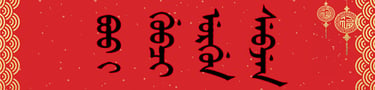
Does Incorrect Manchu Writing Mean a Qing Dynasty Artifact Is Fake?
Can spelling mistakes in Manchu inscriptions reveal fake Qing artifacts? Learn how to distinguish historical variations, engraving errors, anachronisms, and forgery clues.
MING YE
10/16/202614 min read


Does Incorrect Manchu Writing Mean a Qing Dynasty Artifact Is Fake?
How to Evaluate Spelling Errors, Historical Orthography, Engraving Mistakes, and Suspicious Inscriptions on Qing Antiques
By MING YE
Imagine examining a Qing dynasty artifact that bears an inscription in Manchu.
The object may be an official seal, a bronze vessel, a palace plaque, a coin, a porcelain object, or a ceremonial artifact.
At first glance, the inscription appears consistent with traditional Manchu writing. It contains vertical, connected letters and the distinctive dots and circles associated with the script.
But closer examination reveals a problem.
One letter appears incorrect. A dot is missing. The spelling does not match a modern dictionary. Perhaps the inscription contains a word that seems grammatically impossible.
Does this mean the artifact is a forgery?
Not necessarily. An error in a Manchu inscription can raise legitimate questions about an artifact's authenticity, but it is not sufficient by itself to prove that the object is fake.
Historical Manchu writing changed over time. Genuine Qing objects could contain copying or engraving mistakes, while some inscriptions followed conventions that differ from modern standardized spelling.
Conversely, certain linguistic errors can provide strong evidence against a claimed historical attribution—especially when they reveal anachronistic vocabulary, impossible orthography, or a misunderstanding of the language that is inconsistent with the object's supposed origin.
The key is to distinguish an ordinary historical variation from a meaningful contradiction.
This article explains how Manchu inscription errors should be evaluated and why linguistic analysis can be a valuable part of Qing artifact authentication.
1. What Counts as an Error in Manchu Writing?
Before deciding whether an inscription is incorrect, we must define what kind of error has occurred.
Not all apparent errors have the same significance.
A Manchu inscription may contain:
A missing dot or circle.
An incorrectly formed letter.
An unusual historical spelling.
A grammatical inconsistency.
A wrongly copied personal name.
An incorrect official title.
An inappropriate historical term.
A word copied from another language without proper adaptation.
A reversed or misplaced character.
An inscription that does not match the object's claimed date.
Some of these may reflect ordinary scribal or manufacturing mistakes.
Others may result from historical spelling conventions.
Still others may reveal that the inscription was created by someone unfamiliar with Manchu.
Therefore, the first task is not to label the artifact genuine or fake.
It is to identify the exact nature of the apparent error.
2. Did Manchu Spelling Change During the Qing Period?
Yes.
Manchu writing developed before the Qing dynasty entered Beijing in 1644.
According to Qing historical accounts, Nurhaci commissioned the creation of an early Manchu writing system in 1599, traditionally associated with Erdeni and Gagai.
Important reforms associated with Dahai around 1632 helped establish the distinguishing dots and circles characteristic of later standard Manchu orthography.
Early Manchu writing did not always follow the same conventions as later standardized texts.
Consequently, an inscription that differs from modern textbook spelling is not automatically incorrect.
Its historical date must be considered.
For example, an early seventeenth-century inscription should not be evaluated exclusively according to the orthographic conventions of an eighteenth-century printed dictionary.
Researchers must distinguish historical spelling variation from genuine error.
An apparent mistake may be a legitimate feature of an earlier writing tradition.
3. Can Genuine Qing Artifacts Contain Spelling Mistakes?
Yes, this is possible.
Historical objects were produced by human beings.
Even within highly organized imperial institutions, documents and inscriptions could pass through multiple stages of production.
A text might be drafted by an official, copied by a scribe, transferred to a craftsman, and finally carved or engraved onto an object.
Mistakes could occur during any of these stages.
A small dot might be omitted.
A letter might be copied incorrectly.
A craftsman might misunderstand the written model.
A damaged inscription might later appear to contain an error.
However, the possibility of mistakes does not mean that every unusual inscription should be accepted as authentic.
The nature, number, and historical context of the errors matter.
An isolated minor mistake is different from a long inscription containing systematic grammatical problems.
4. Why Are Dots and Circles Particularly Important?
Standard Manchu writing uses dots and circles to distinguish certain letters.
These marks are essential parts of the orthographic system.
Their omission or incorrect placement can change the intended reading.
However, small marks are also vulnerable to damage.
On a coin, a dot may become indistinct because of casting quality or wear.
On a stone monument, weathering may obscure a small carved feature.
On a seal, the engraved surface may be difficult to interpret without examining a proper impression.
On a painted object, pigment loss may remove a small part of a letter.
Therefore, a missing dot should not immediately be classified as an original spelling mistake.
Researchers should first determine whether the mark was never present or has become invisible because of the object's condition.
This distinction can be difficult without high-resolution photographs or direct examination.
5. Could an Engraver Make a Mistake Even If the Original Text Was Correct?
Yes.
The production of an inscription often involved more than one person.
An official or calligrapher might prepare the written text.
A craftsman could then transfer it onto wood, stone, metal, or another material.
During this process, individual strokes or letters might be altered.
This possibility is especially relevant when the engraver was reproducing a script that required specialized knowledge.
However, it would be misleading to assume that Qing craftsmen were generally unfamiliar with Manchu.
Imperial workshops and official institutions could employ experienced specialists.
The important question is whether the observed mistake is consistent with the known production process.
For example, an isolated reversed letter might be compatible with a copying or engraving error.
An entire inscription composed of meaningless pseudo-Manchu shapes would require a different explanation.
6. Are Errors on Official Seals More Suspicious?
Potentially.
Official seals were instruments of government authority.
Their inscriptions identified offices, institutions, and titles.
Because seals served formal administrative functions, researchers would normally expect their inscriptions to follow established conventions.
A significant error in the name of an institution may therefore be more concerning than a minor irregularity on an ordinary decorative object.
However, the conclusion depends on the specific seal.
The researcher must consider its date, institutional context, script style, and whether the inscription is being examined on the seal face or in its impression.
Some Qing seals used specialized Manchu seal-script forms.
These forms may look unfamiliar to readers trained only in ordinary Manchu handwriting.
A decorative or formal letterform should not be mistaken for a spelling error.
A suspected official seal should also be compared with documented examples and relevant administrative records.
7. Why Is the Seal Face Different from the Seal Impression?
A seal presents a special problem because its engraved surface may contain reversed writing.
The characters are arranged so that the stamped impression reads correctly.
Consequently, a photograph of the engraved seal face may appear unusual to someone accustomed to reading ordinary text.
A letter that looks reversed may be correct in the context of seal production.
This is particularly important when evaluating Manchu inscriptions.
Before declaring that a seal contains incorrectly written Manchu, researchers should establish whether they are examining the engraved surface or the stamped impression.
A properly oriented impression may resolve an apparent error.
Without this distinction, even a genuine seal could be incorrectly classified as suspicious.
8. Are Errors on Qing Coins Evidence of Forgery?
They can be evidence, but not conclusive proof.
Many Qing cash coins contain Manchu mint designations.
For example:
Boo Ciowan — ᠪᠣᠣ ᠴᡳᠣᠸᠠᠨ
This identifies the Board of Revenue mint in Beijing.
Boo Yuwan — ᠪᠣᠣ ᠶᡠᠸᠠᠨ
This identifies the Board of Works mint in Beijing.
A coin with an unusual Manchu mint inscription should be compared with documented coin types.
However, historical cash coins were produced in large quantities, and their inscriptions could vary in execution.
Wear, casting defects, and variations between coin issues may affect the appearance of letters.
A malformed inscription might indicate poor production, damage, a contemporary imitation, or a modern reproduction.
It could also reflect a variety that requires specialist examination.
Therefore, linguistic analysis should be combined with numismatic evidence such as casting characteristics, weight, dimensions, and known mint varieties.
9. What If the Manchu Inscription Contains a Completely Wrong Word?
A clearly incorrect word can be more significant than a missing dot.
For example, suppose an object is claimed to be an official Qing seal.
Its inscription should identify a particular government institution.
However, the Manchu text contains an unrelated word that cannot plausibly function as the institution's name.
This discrepancy would require explanation.
Possible explanations include a transcription mistake, damage, a later alteration, or an incorrect attribution of the object.
It might also indicate that the inscription was produced by someone who copied Manchu letters without understanding the language.
The significance depends on how confidently the text can be read and whether the expected institutional terminology is historically documented.
A suspicious word is stronger evidence when it directly contradicts the object's claimed identity.
10. Can Incorrect Grammar Reveal a Forgery?
Sometimes.
Manchu has its own grammatical system.
It is not simply Chinese written with different letters.
Manchu is generally described as an agglutinative language with subject–object–verb word order.
Its grammar uses suffixes and particles to express relationships between words.
A long inscription that ignores these structures may be linguistically suspicious.
For example, a supposed eighteenth-century Manchu commemorative text containing repeated grammatical combinations that cannot be reconciled with historical Manchu usage would deserve careful investigation.
However, short inscriptions often lack enough grammatical structure for this kind of analysis.
A two-word mint designation cannot be evaluated in the same way as a long historical narrative.
Official titles and formulaic expressions may also follow specialized conventions.
Therefore, grammatical analysis is most useful when the inscription contains enough text to support a meaningful comparison.
11. What If the Manchu Looks Like a Direct Copy of Chinese Word Order?
This can raise questions, but it is not automatically proof of forgery.
Manchu and Chinese have different grammatical structures.
A text created by someone unfamiliar with Manchu might reproduce Chinese word order or vocabulary in an unnatural way.
However, historical translation practices were complex.
Qing government institutions sometimes produced corresponding texts in Manchu and Chinese.
Official translations could use established terminology and formulaic constructions.
Certain translated texts may also reflect the influence of their source language.
Therefore, a close resemblance to Chinese phrasing is not sufficient evidence of modern fabrication.
Researchers must determine whether the construction is attested in historical Manchu documents.
The distinction is between an unusual but historically documented translation convention and an impossible or unsupported grammatical construction.
12. Can a Modern Manchu Spelling Reveal That an Object Is Not from the Qing Period?
Potentially, if the spelling or terminology can be shown to be historically anachronistic.
A modern transcription convention, newly coined expression, or spelling practice that demonstrably postdates the claimed period may contradict an object's proposed date.
However, this requires strong evidence.
Many features of modern standardized Manchu are derived from historical Qing writing.
Their appearance on an old object is not inherently suspicious.
Likewise, a modern researcher may transcribe an authentic Qing inscription using contemporary Romanization.
The Romanization is not part of the original artifact.
Therefore, researchers must distinguish the original inscription from later cataloging or transcription.
An anachronism is meaningful only when it is actually present on the object and demonstrably inconsistent with the claimed period.
13. Could a Forgery Contain Perfectly Correct Manchu?
Yes.
Correct Manchu writing does not prove that an artifact is authentic.
A modern maker can copy an inscription from a genuine historical object.
A reproduction may contain accurate Manchu spelling, grammar, and official terminology.
Some forgeries may closely imitate documented Qing seals, coins, or plaques.
Therefore, linguistic correctness is only one aspect of authentication.
An object can have a historically accurate inscription but incorrect materials, manufacturing techniques, or provenance.
Conversely, a genuine historical object may contain a minor inscriptional irregularity.
This is why authenticity cannot be determined through spelling alone.
14. What Is the Difference Between a Historical Copy and a Modern Forgery?
Not every later copy is a forgery.
A historical inscription may have been copied for preservation, teaching, or artistic purposes.
A museum may display a modern reproduction of a damaged plaque.
A calligrapher may reproduce a Qing inscription as a study.
A collector may own a later object modeled on an earlier design.
These objects are not necessarily deceptive.
The problem arises when a later reproduction is falsely represented as an original Qing artifact.
Therefore, researchers should distinguish:
Original artifact: An object produced during the claimed historical period.
Historical reproduction: A later copy made in a historical context.
Modern reproduction: A contemporary object reproducing an earlier design.
Forgery: An object intentionally presented through deceptive attribution or fabrication.
The same Manchu inscription might appear on an original object and a later reproduction.
Its wording alone cannot determine which category applies.
15. How Important Is the Number of Errors?
The number of errors can matter, but their significance is not purely numerical.
One major anachronism may be more important than several minor letter irregularities.
For example, an inscription using a title that did not exist during the claimed period could present a serious chronological problem.
By contrast, several indistinct dots on a worn coin might reflect manufacturing conditions or damage.
The pattern of errors is also important.
Repeated mistakes involving the same letter distinction may suggest that the writer did not understand standard Manchu orthography.
However, such a pattern could also reflect a particular scribal tradition or production problem.
The errors must be interpreted historically rather than simply counted.
16. What Makes an Error Especially Suspicious?
Certain types of inconsistency deserve closer examination.
Type of problemWhy it mattersNecessary verificationMissing dot or circleMay alter a letterDetermine whether it is damage or original executionUnusual spellingMay reflect historical variationCompare texts from the relevant periodIncorrect official titleMay contradict the object's claimed functionCheck Qing institutional terminologyAnachronistic vocabularyMay conflict with the proposed dateEstablish when the term was usedImpossible grammatical structureMay indicate misunderstanding of ManchuCompare historical grammar and parallel textsIncorrect mint designationMay conflict with a known coin typeConsult numismatic referencesReversed lettersMay be an error or normal seal engravingExamine the properly oriented impressionRepeated meaningless formsMay indicate pseudo-writingAttempt a complete transcriptionInconsistent script styleMay suggest later alteration or copyingCompare documented examplesConflict between Manchu and ChineseMay reveal an error or different textual functionsRead both inscriptions independently
These factors should be considered together with physical and documentary evidence.
17. What If the Chinese Inscription Is Correct but the Manchu Is Wrong?
This situation can be significant.
A bilingual Qing artifact may contain a Chinese inscription that appears historically appropriate while the Manchu text contains unusual or incorrect forms.
However, the two languages do not always convey identical information.
For example, the Chinese side of a Qing coin may identify the reign while the Manchu side identifies the mint.
A mismatch in subject matter would therefore be normal.
On an official seal or palace plaque, the two inscriptions may identify the same institution or building.
A substantial disagreement between the two could require investigation.
Possible explanations include a copying error, a historical translation convention, a later replacement, or a modern reproduction.
The correct approach is to read both inscriptions independently and establish their intended relationship.
A Chinese inscription should not automatically be treated as the definitive original.
18. Can an Incorrect Manchu Inscription Help Date an Artifact?
Sometimes.
Historical spelling conventions, institutional titles, and script styles can provide chronological clues.
For example, an inscription using terminology associated with a later administrative institution would be difficult to reconcile with an earlier claimed date.
Likewise, a securely identified early orthographic feature may support investigation of an object's historical context.
However, such evidence is rarely sufficient by itself.
Historical forms could be copied in later periods.
Modern reproductions can imitate early spelling.
Certain titles and expressions remained in use for long periods.
Therefore, linguistic dating should be combined with material analysis and documented provenance.
A precise date should not be assigned solely from a spelling variation.
19. What Evidence Is Needed Before Calling an Artifact Fake?
A responsible authentication assessment should examine several independent categories of evidence.
1. Linguistic evidence
Does the Manchu inscription contain valid words, grammar, and historically appropriate terminology?
2. Paleographic evidence
Are the letterforms and script style consistent with the claimed period and object type?
3. Material evidence
Are the material and manufacturing techniques historically plausible?
4. Historical evidence
Does the inscription refer to institutions, titles, or events that existed at the claimed time?
5. Comparative evidence
Are there documented examples of similar objects?
6. Provenance
Is the object's ownership, discovery, or collection history known?
7. Condition and alteration
Could damage, restoration, or later modification explain the apparent errors?
8. Specialist review
Have qualified researchers examined the inscription and object?
The strongest conclusions arise when several independent lines of evidence agree.
A single suspicious letter should normally lead to further investigation, not an immediate declaration of forgery.
20. A Practical Method for Evaluating Incorrect Manchu
When an inscription appears wrong, the following procedure can help establish the problem.
Step 1: Obtain clear images.
Photograph the entire object and the inscription from several angles.
Step 2: Confirm the script.
Make sure the writing is actually Manchu rather than Mongolian or another script.
Step 3: Establish the correct orientation.
This is particularly important for seals.
Step 4: Produce a complete transcription.
Identify each visible letter without silently correcting apparent mistakes.
Step 5: Record uncertain readings.
Mark damaged or unclear sections.
Step 6: Compare historical spelling.
Use references appropriate to the proposed date.
Step 7: Identify the exact inconsistency.
Is the problem orthographic, grammatical, institutional, or chronological?
Step 8: Compare documented artifacts.
Look for examples from museums and reliable catalogs.
Step 9: Examine the object's physical history.
Consider materials, wear, restoration, and provenance.
Step 10: State a proportionate conclusion.
Describe the inscription as consistent, unusual, suspicious, or incompatible with a particular attribution only when the evidence supports that judgment.
This method prevents a preliminary observation from becoming an unsupported authenticity claim.
21. What Should a Museum or Collector Say When an Inscription Is Incorrect?
Careful wording is important.
If an inscription contains a possible error, the description should identify the observed problem.
For example:
“The Manchu inscription contains an unusual letterform that requires comparison with documented Qing examples.”
If the reading is secure:
“The inscription appears to contain a spelling error in the institutional name.”
If the discrepancy is historically significant:
“The Manchu terminology is inconsistent with the object's proposed eighteenth-century attribution and warrants further authentication.”
If the evidence remains incomplete:
“The inscription has not been fully deciphered, and its authenticity cannot be assessed from the available images.”
These statements are more informative than simply declaring that the object is fake.
They also allow later research to refine the conclusion.
22. Why Is Manchu Expertise Important in Qing Artifact Authentication?
Many Qing artifacts contain Manchu inscriptions that are not immediately understandable to modern viewers.
This creates a risk of incorrect identification.
A collector might mistake Mongolian for Manchu.
A catalog might reproduce an incorrect transcription.
A modern imitation might contain plausible-looking but meaningless Manchu-like forms.
Conversely, an authentic inscription might be rejected because its historical spelling differs from a modern reference.
Specialist knowledge helps distinguish these situations.
Manchu linguistic analysis can identify words, grammatical structures, and official terminology.
Paleographic analysis can examine historical letterforms.
Institutional history can establish whether the inscription matches the claimed administrative context.
However, even expert linguistic analysis cannot replace material and provenance research.
The most reliable authentication is interdisciplinary.
23. Does Incorrect Manchu Writing Prove a Qing Artifact Is Fake?
Returning to the original question:
An incorrect Manchu inscription can be evidence that a Qing artifact has a problem, but it does not automatically prove that the artifact is fake.
A minor spelling irregularity may reflect historical variation, copying mistakes, engraving errors, wear, or later restoration.
A more serious problem—such as demonstrably anachronistic terminology, an impossible institutional title, or a long inscription containing systematic linguistic inconsistencies—may strongly challenge the object's claimed attribution.
The significance depends on the kind of error, the type of artifact, and the historical context.
A genuine object can contain mistakes.
A forged object can contain perfectly correct Manchu.
Therefore, the absence or presence of linguistic errors is not a complete test of authenticity.
For historians, Manchu inscriptions provide evidence of language use and institutional practice.
For collectors, they can reveal discrepancies that deserve further investigation.
For museums, accurate transcription helps prevent misleading catalog descriptions.
For researchers of Qing material culture, the combination of linguistic and physical evidence is essential.
The correct principle is not “wrong Manchu means fake,” but “an unexplained Manchu error is evidence that must be investigated.”
When linguistic inconsistencies directly contradict an object's claimed date, institution, or historical function, they may become powerful evidence against its authenticity.
But the final judgment must rest on the complete historical and material record.
— MING YE
References and Research Materials
Manwen Laodang (满文老档, Old Manchu Archives). Important early Manchu records relevant to historical orthography and documentary conventions.
Qinding Qingwen Zhuanti (钦定清文篆体, Imperially Commissioned Manchu Seal-Script Forms). A Qing imperial work concerning specialized Manchu seal-script styles.
Da Qing Huidian (大清会典, Collected Statutes of the Great Qing). A major primary source for Qing institutions, official titles, and administrative regulations.
Qing Shilu (清实录, Veritable Records of the Qing Dynasty). Historical records relevant to Qing government institutions and chronology.
The Palace Museum, Beijing. Collection records and research materials concerning Qing official seals, imperial inscriptions, and historical artifacts.
National Palace Museum, Taipei. Qing historical objects, imperial seals, documents, and multilingual inscriptions.
First Historical Archives of China. Manchu- and Chinese-language Qing administrative records.
Gertraude Roth Li, Manchu: A Textbook for Reading Documents (2000). A reference for Manchu orthography, grammar, and historical document reading.
Jerry Norman, A Comprehensive Manchu-English Dictionary (2013). A major reference for Manchu vocabulary and historical terminology.
David Hartill, Cast Chinese Coins (2005). A numismatic reference for Qing cash coins and mint inscriptions.
Mark C. Elliott, The Manchu Way: The Eight Banners and Ethnic Identity in Late Imperial China (2001). A study of Manchu identity and Qing institutional history.
Evelyn S. Rawski, The Last Emperors: A Social History of Qing Imperial Institutions (1998). A study of Qing imperial institutions and material culture.