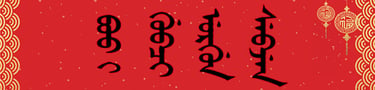
Can Manchu Script Write Modern Words? Technology and New Vocabulary
Can Manchu express computer, internet, AI, and modern names? Explore loanwords, new vocabulary, phonetic transcription, Unicode, and the challenges of modern Manchu.
MING YE
11/13/202611 min read
Can the Manchu Script Be Used to Write Modern Words?
How Manchu Can Express Contemporary Concepts, Foreign Names, Technology, and New Vocabulary
By MING YE
Can the Manchu script be used to write modern words such as “computer,” “internet,” “smartphone,” “artificial intelligence,” or “social media”?
Yes. The Manchu script can be used to write modern vocabulary, but creating an appropriate Manchu expression requires more than simply converting English or Chinese letters into Manchu characters.
Like other writing systems, Manchu is capable of representing new vocabulary. Its alphabetic structure allows speakers, translators, and language learners to express unfamiliar concepts through several methods, including borrowing foreign words, creating new compounds, extending the meanings of existing words, and translating concepts using established vocabulary.
However, an important distinction must be made between the Manchu language and the Manchu script.
The Manchu language is a linguistic system with its own vocabulary, pronunciation, and grammar.
The Manchu script is the writing system traditionally used to record that language.
A modern English word can sometimes be approximated phonetically using Manchu letters. That does not automatically make it an established Manchu word.
Similarly, a new technical concept can be translated into Manchu, but the resulting expression may be a modern proposal rather than historically documented vocabulary.
This distinction is particularly important because Manchu has a relatively small contemporary speaker community and lacks a universally adopted terminology authority for many modern subjects.
Understanding how modern vocabulary can be written therefore requires examining the script's capabilities, the history of language borrowing, and the challenges of contemporary terminology development.
1. Is the Manchu Script Limited to Historical Vocabulary?
No. The Manchu script is not inherently restricted to words used during the Qing dynasty.
A writing system and the vocabulary of a language are different things.
The traditional Manchu script was developed in 1599 through adaptation of Mongolian writing and underwent an important reform in 1632.
It became a major written language of the Qing state, appearing in administrative documents, dictionaries, historical records, literature, and inscriptions.
Much of the surviving written material therefore reflects the political, social, and cultural conditions of earlier centuries.
However, the historical age of a writing system does not determine whether it can express modern ideas.
English uses an alphabet with ancient origins but continually develops new vocabulary.
Chinese characters are likewise used to write contemporary technological and scientific terms.
The same general principle applies to Manchu.
New concepts can be represented through linguistic adaptation.
The central question is not whether the alphabet is old.
It is whether an appropriate word can be created, borrowed, or translated using the language's existing resources.
For example, a modern Manchu text might need to discuss computers, digital communication, or international organizations.
These subjects were absent from the earliest Manchu documents.
Nevertheless, they can be addressed through newly formed terminology.
The historical origins of the Manchu script do not prevent it from being used to express contemporary concepts.
2. How Can New Words Be Created in Manchu?
There are several possible methods for developing modern Manchu vocabulary.
These methods are not unique to Manchu. They are common processes in the evolution of languages.
MethodHow it worksPossible applicationSemantic extensionGiving an existing word an additional meaningExtending an older term to a related modern conceptCompoundingCombining existing Manchu wordsCreating a descriptive technical expressionLoanword adaptationBorrowing a foreign word and adapting its pronunciationInternational technology or cultural terminologyCalqueTranslating the meaningful parts of a foreign expressionConcepts such as “social network”Descriptive translationExplaining a concept using several wordsSpecialized terms without established equivalentsDirect transcriptionRepresenting a foreign name or term phoneticallyPersonal names, brands, and place names
Each method has advantages and limitations.
Semantic extension may produce a concise expression, but it can also introduce ambiguity.
Compounding can make a new term easier to understand, provided that the component words and grammatical structure are appropriate.
Borrowing may preserve international recognition but introduce unfamiliar sounds.
Descriptive translation can convey meaning accurately, although the resulting expression may be relatively long.
The most appropriate method depends on the concept being translated.
A personal name may require phonetic transcription.
A scientific concept may benefit from a carefully constructed technical term.
A cultural expression may be better conveyed through descriptive translation.
Modern Manchu terminology can be developed through several linguistic processes, but each proposed expression must be evaluated for accuracy, clarity, and actual usage.
3. Can Manchu Write Words Such as “Computer” and “Internet”?
Yes, modern concepts such as computers and the internet can be discussed in Manchu.
However, their written representation requires a terminology decision.
Consider several common modern concepts.
English conceptPossible translation strategyComputerEstablished modern term, if documented, or a newly constructed technical expressionInternetA borrowed term or a descriptive compound referring to interconnected networksSmartphoneA compound or descriptive expression distinguishing the device from an ordinary telephoneArtificial intelligenceA technical translation based on intelligence and artificial creationSocial mediaA descriptive expression involving social communication and mediaEmailA borrowed or descriptive term referring to electronic correspondence
These are translation strategies, not verified Manchu equivalents.
It would be misleading to present an invented Romanized expression as an established Manchu word without supporting evidence.
For historical languages with limited modern standardization, this distinction is particularly important.
A researcher may propose a term that is grammatically plausible.
Another translator may prefer a loanword.
A third may use a descriptive expression.
All three approaches may be understandable, but they do not necessarily have equal historical or contemporary acceptance.
When preparing educational materials, the source of a modern term should be identified whenever possible.
A useful distinction is between historically attested vocabulary, documented contemporary usage, and newly proposed terminology.
Manchu can express modern technological concepts, but the existence of a possible translation should not be confused with the existence of a universally accepted modern term.
4. Can English Words Be Written Directly in Manchu Letters?
Foreign words can often be represented phonetically using the Manchu script.
However, direct transcription is not always straightforward.
English and Manchu have different sound systems.
Some English consonants, vowels, and consonant clusters do not correspond neatly to the sounds traditionally represented in Manchu.
Consequently, a transcription may require approximation.
This is similar to the way foreign names are adapted into Chinese, Japanese, or other languages.
The written form reflects an interpretation of the foreign pronunciation rather than a perfect reproduction of the original spelling.
For example, the English word “computer” could be approached as a phonetic borrowing.
However, an accurate transcription would require decisions about pronunciation, syllable structure, and the Manchu letters used to represent the sounds.
Simply converting the English spelling letter by letter would be unreliable.
The letters of the English alphabet and the letters of the Manchu alphabet do not have identical sound values.
English spelling is also not consistently phonetic.
A letter-based substitution could therefore produce a form that neither resembles the English pronunciation nor follows Manchu spelling conventions.
The distinction between transliteration and transcription is important here.
Transliteration generally converts written symbols between scripts according to a defined system.
Phonetic transcription attempts to represent pronunciation.
For foreign names and modern loanwords, pronunciation-based adaptation is often more relevant than mechanical letter substitution.
Writing English words in Manchu requires attention to pronunciation and Manchu orthography, not merely a visual conversion between alphabets.
5. How Did Historical Manchu Handle Foreign Words?
Manchu has a long history of linguistic contact and vocabulary borrowing.
During the Qing dynasty, Manchu interacted extensively with Mongolian, Chinese, Tibetan, and other languages.
These interactions influenced its vocabulary and written practices.
Mongolian was especially important because of longstanding political, cultural, and linguistic connections.
Chinese also became a major source of vocabulary through administration, daily life, literature, and cultural exchange.
Buddhist and other religious terminology circulated through multilingual networks.
Historical Manchu dictionaries and translated documents provide valuable evidence of these processes.
Foreign words could be adapted to Manchu pronunciation and spelling.
Other concepts were expressed through translation or descriptive terminology.
This historical experience is relevant to modern vocabulary development.
It demonstrates that Manchu was never an entirely isolated linguistic system.
Its speakers and writers encountered unfamiliar concepts and developed ways to express them.
However, historical borrowing practices do not automatically establish a single method for translating modern technological vocabulary.
The nature of contemporary terminology differs from many Qing-period administrative and cultural terms.
Modern translators must also consider international usage, digital communication, and consistency across educational resources.
The historical record shows that Manchu could absorb and adapt foreign vocabulary, providing a linguistic precedent for expressing new concepts today.
6. Can Modern Personal Names and Brand Names Be Written in Manchu?
Yes. Modern personal names, place names, and brand names can be represented using Manchu writing.
However, different categories of names may require different approaches.
A personal name is generally treated differently from an ordinary vocabulary word.
Its purpose is to identify a particular person rather than describe a concept.
For this reason, phonetic transcription is often appropriate.
A contemporary English name such as “Michael” or “Jennifer” could be adapted into a Manchu-script representation based on pronunciation.
However, there may be several possible approximations.
The appropriate form depends on the pronunciation being represented and the transcription conventions selected.
Chinese personal names introduce another consideration.
A Chinese name can be represented according to its Mandarin pronunciation or another historically relevant pronunciation.
The resulting Manchu spelling should not be confused with a traditional Manchu personal name.
Brand names present similar challenges.
Names such as Apple, Microsoft, or Google can be treated as proper nouns.
Their original spelling may be retained in multilingual digital contexts, or a phonetic Manchu representation may be developed.
However, a phonetic transcription of a brand name is not necessarily an officially authorized translation.
The same applies to geographical names.
A modern place name may have an established historical Manchu form, a contemporary transcription, or both.
These forms should be distinguished carefully.
Modern names can be written in Manchu, but their transcription should be based on a clear pronunciation standard and should not be presented as historically established without evidence.
7. Does Manchu Have Enough Letters to Represent Modern Vocabulary?
The traditional Manchu alphabet was designed to represent the sound system of Manchu, not every sound found in the world's languages.
This creates challenges when writing foreign vocabulary.
Some foreign sounds have close Manchu equivalents.
Others require approximation.
Consonant clusters may also be difficult to reproduce directly using traditional spelling conventions.
However, this does not make modern vocabulary impossible to write.
Many languages routinely adapt foreign words to their existing phonological systems.
For example, borrowed words may undergo changes in pronunciation when entering a language.
The resulting form becomes compatible with the receiving language.
Manchu can be approached in a similar way.
A translator may choose an established approximation, adapt the pronunciation, or use a descriptive translation instead.
The appropriate method depends on whether the goal is linguistic integration, faithful representation of a foreign name, or technical communication.
There is also a distinction between historical Manchu orthography and broader multilingual transcription practices.
Specialized historical materials may employ conventions for representing sounds from other languages.
Such conventions should be studied in their original contexts rather than assumed to apply universally to every modern foreign word.
The Manchu alphabet has phonological limitations, but these can be addressed through established transcription principles and careful terminology development.
8. Can Unicode and Modern Computers Display Newly Created Manchu Words?
Yes. Modern digital technology can represent newly created Manchu words using the existing Unicode encoding framework.
Manchu is supported within the Unicode Mongolian block, principally U+1800–U+18AF.
The script does not require a new Unicode character every time a new word is invented.
Unicode encodes characters and related writing-system elements, not complete vocabulary lists.
This distinction is important.
For example, English does not need new Unicode characters whenever a new technical word enters the language.
Existing letters are combined to write the new word.
The same principle applies to Manchu.
New vocabulary can generally be written using existing Manchu letters.
However, correct digital display requires suitable software.
Manchu is a complex script.
Its letters change shape according to context, and traditional writing is vertical.
Rendering engines must therefore support contextual shaping and appropriate glyph selection.
Variation selectors may also be needed in particular orthographic situations.
A font that merely contains visually recognizable Manchu letters is not necessarily sufficient for correct rendering.
The application must interpret the text appropriately.
This is especially important when producing digital dictionaries, websites, electronic books, and educational materials.
A newly created word may be linguistically valid but appear incorrectly if the software lacks adequate shaping support.
Modern Manchu vocabulary can be encoded using existing Unicode characters, although correct display depends on appropriate fonts and text-rendering technology.
9. Should Modern Manchu Vocabulary Be Standardized?
Terminology standardization is one of the most important challenges in the contemporary use of Manchu.
A language can express new concepts through multiple possible translations.
However, inconsistent terminology can make communication and education more difficult.
Imagine that several independent translators develop different Manchu expressions for “artificial intelligence.”
One may prefer a descriptive compound.
Another may use a phonetic borrowing.
A third may adapt a term from a related language.
Without documentation, readers may not know whether these expressions refer to the same concept.
This creates problems for dictionaries, textbooks, websites, and digital search systems.
A practical terminology resource should record several types of information.
InformationWhy it mattersEnglish or Chinese source termIdentifies the concept being translatedProposed Manchu expressionProvides the target-language formManchu script spellingPreserves the actual written representationRomanizationSupports pronunciation and searchingDefinitionClarifies the intended meaningSource or creatorEstablishes provenanceFirst documented useHelps distinguish historical and modern terminologyUsage statusIdentifies established, attested, or proposed expressions
Such documentation would help prevent newly invented terms from being mistaken for historical vocabulary.
It would also allow competing proposals to be compared transparently.
However, standardization should not be confused with the authority of a single individual.
A proposed term becomes more useful when it is understandable, consistently documented, and adopted by actual users.
Scholars, educators, translators, and language communities may all contribute to this process.
The development of modern Manchu vocabulary would benefit from transparent documentation, consistent spelling, and careful distinction between attested terms and new proposals.
10. What Role Can Modern Manchu Vocabulary Play in Cultural Preservation?
The ability to express modern concepts is relevant to the future cultural use of Manchu.
A language associated primarily with historical documents may appear distant from contemporary life.
Modern vocabulary provides opportunities to discuss present-day experiences.
These include technology, education, science, social relationships, and cultural activities.
For example, a Manchu-language educational project might introduce terminology related to computers, smartphones, or digital communication.
A cultural organization might develop bilingual materials explaining modern exhibitions or artistic practices.
A digital dictionary could record both historical vocabulary and carefully documented contemporary expressions.
Such projects can make the language more accessible to modern audiences.
However, creating vocabulary is only one part of language revitalization.
A living language also requires opportunities for learning, communication, and transmission.
The existence of a Manchu translation for “internet” does not by itself establish a community of active speakers.
Nevertheless, terminology development can support educational and cultural initiatives.
It can also encourage collaboration among researchers, teachers, and enthusiasts.
The relationship between modern vocabulary and historical preservation is therefore complementary.
Historical dictionaries and manuscripts provide the linguistic foundation.
Contemporary terminology allows that foundation to be applied to new subjects.
Modern vocabulary development can help extend the cultural and educational uses of Manchu while preserving a clear connection to its historical linguistic tradition.
Conclusion: Can Manchu Be Used to Write Modern Words?
Yes. The Manchu script can be used to write modern words, foreign names, technological concepts, and newly created expressions.
Its alphabetic structure allows existing letters to represent new vocabulary.
The language also possesses grammatical and lexical resources that can support semantic extension, compounding, borrowing, and descriptive translation.
Historical Manchu already incorporated vocabulary from other languages, demonstrating that linguistic adaptation is not a new phenomenon.
However, modern terminology requires careful treatment.
A phonetic transcription of an English word is not automatically an established Manchu word.
A newly constructed technical expression should not be presented as historical vocabulary without evidence.
Likewise, a grammatically plausible translation may not have achieved general acceptance.
These distinctions are particularly important for dictionaries, educational resources, and cultural publications.
Digital technology provides additional possibilities.
Unicode supports the Manchu writing system, allowing new words to be represented without inventing new characters.
Appropriate fonts and rendering software remain necessary for accurate display.
The larger issue is therefore not whether Manchu can write modern vocabulary.
It is how that vocabulary should be developed, documented, and used.
The Manchu script is historically rooted but not linguistically confined to the past. Its ability to express contemporary ideas depends on responsible translation, accurate spelling, and the thoughtful development of modern terminology.
By combining historical linguistic knowledge with contemporary educational and digital practices, Manchu can continue to serve as a meaningful written medium for cultural expression.
— MING YE
References and Research Materials
Linguistic and Historical Studies
Gertraude Roth Li, Manchu: A Textbook for Reading Documents (2000).
Jerry Norman, A Comprehensive Manchu-English Dictionary (2013).
Liliya M. Gorelova, Manchu Grammar (2002).
Erich Hauer, Handwörterbuch der Mandschusprache (1952–1955).
Juha Janhunen, Manchuria: An Ethnic History (1996).
Mark C. Elliott, The Manchu Way: The Eight Banners and Ethnic Identity in Late Imperial China (2001).
Laurie Bauer, English Word-Formation (1983), for general linguistic principles of word formation.
Primary Historical Sources
Yuzhi Qingwen Jian (御制清文鉴, Imperially Commissioned Mirror of the Manchu Language).
Yuzhi Zengding Qingwen Jian (御制增订清文鉴, Imperially Commissioned Expanded and Revised Mirror of the Manchu Language).
Manwen Laodang (满文老档, Old Manchu Archives).
Qing-period Manchu-Chinese and Manchu-Mongolian multilingual dictionaries and translated documents.
Digital and Terminology Resources
Unicode Consortium. The Unicode Standard, Mongolian script documentation, including Manchu encoding and contextual shaping.
Unicode Consortium. Unicode Standard Annex #29: Unicode Text Segmentation, for general principles of text segmentation.
First Historical Archives of China. Qing Manchu-language documentary collections.
National Palace Museum, Taipei. Qing multilingual manuscripts and historical materials.
Research note: The modern concepts discussed in this article are illustrative examples. No unverified Romanized Manchu neologisms are presented as established dictionary entries. Contemporary terminology should be checked against documented usage and clearly identified when newly proposed.