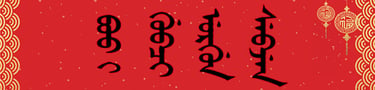
Can English Names Be Written in Manchu Script? A Complete Guide
Can names like John, Michael, or Elizabeth be written in Manchu? Learn how phonetic transcription works, why pronunciation matters, and how names become Manchu calligraphy.
11/14/202610 min read
Can English Names Be Written in the Manchu Script?
A Guide to Transliteration, Pronunciation, Historical Naming Practices, and Writing Foreign Personal Names in Manchu
By MING YE
Can an English name such as John, Michael, William, Elizabeth, or Jennifer be written in the Manchu script?
Yes. English names can be represented in the Manchu script through phonetic transcription, but the process requires careful attention to pronunciation, Manchu spelling conventions, and the differences between the two languages.
The Manchu script is an alphabetic writing system historically developed to represent the Manchu language. Like other alphabetic scripts, it can also be used to approximate foreign names.
However, converting an English name into Manchu is not as simple as replacing each English letter with a corresponding Manchu letter.
English and Manchu have different sound systems. Their spelling conventions are also different.
An English name may contain sounds or consonant combinations that cannot be reproduced exactly using traditional Manchu orthography.
For this reason, the most appropriate Manchu representation is generally based on how the name is pronounced rather than how it is spelled in English.
There is also an important distinction between writing an English name in Manchu letters and translating that name into a traditional Manchu name.
These are two different processes.
Understanding this distinction is especially useful for people interested in Manchu calligraphy, personalized artwork, historical linguistics, and cultural exchange.
1. What Does It Mean to Convert an English Name into Manchu?
Converting an English name into Manchu usually means representing its pronunciation using the letters of the Manchu writing system.
This process is more accurately described as phonetic transcription.
In everyday conversation, people often use the word transliteration for any conversion between writing systems.
However, linguistics distinguishes between two related processes.
Transliteration converts written symbols from one script into another according to a defined system.
Phonetic transcription represents the sounds of a word using the writing conventions of another language or script.
This distinction matters because English spelling does not consistently correspond to pronunciation.
Consider the following names:
English nameApproximate pronunciation in common English varietiesJohn/dʒɑn/ or /dʒɒn/Michael/ˈmaɪkəl/William/ˈwɪljəm/Elizabeth/ɪˈlɪzəbəθ/Jennifer/ˈdʒɛnɪfər/
The pronunciations shown are illustrative and vary by accent.
Several English letters may represent a single sound.
Conversely, one English letter may represent different sounds in different words.
Therefore, converting a name letter by letter may produce a result that does not resemble its actual pronunciation.
A careful Manchu transcription begins with the spoken name.
The translator then determines how its sounds can be approximated using the Manchu writing system.
The goal is to represent the name's pronunciation as accurately and consistently as the receiving script allows.
2. Why Can't English Names Be Converted Letter by Letter?
The English alphabet and the Manchu alphabet represent different linguistic systems.
Although both are alphabetic, their letters do not have identical sound values or spelling rules.
For example, the English letter c may represent /k/ in one word and /s/ in another.
The combination ch may represent different sounds depending on the word's linguistic origin.
English also contains many silent letters.
The name Michael illustrates the problem.
Its spelling contains the sequence ch, but the usual English pronunciation has a /k/ sound in that position.
A mechanical letter-by-letter conversion could therefore misrepresent the name.
Similarly, the name George contains spelling conventions that cannot be understood by treating each letter independently.
The same difficulty occurs with vowels.
English vowel letters may represent several different sounds, including diphthongs.
Manchu has its own vowel system and orthographic conventions.
Consequently, the written representation of an English name requires interpretation.
The translator must decide which Manchu sounds most closely approximate the intended English pronunciation.
This is especially important for names with multiple accepted pronunciations.
A name used in American English may sound different from the same name pronounced in British English or another regional variety.
Accurate Manchu transcription requires pronunciation analysis rather than a simple alphabet-substitution chart.
3. Does the Manchu Alphabet Have All the Sounds Found in English?
No. Traditional Manchu and English have different phonological systems.
Some English sounds have relatively close counterparts in Manchu.
Others do not.
This creates challenges when transcribing foreign names.
English contains sounds such as /θ/ and /ð/, commonly represented by the letters th in words such as think and this.
These sounds are not ordinary phonemes of traditional Manchu.
English also has several vowel distinctions that do not correspond directly to Manchu vowels.
The pronunciation of the English letter r presents another challenge.
Its realization varies across English accents and does not necessarily correspond to the historical pronunciation of Manchu r.
Consonant clusters can also be difficult.
Some English names contain sequences of consonants that may not fit comfortably within traditional Manchu phonological patterns.
When a foreign name contains an unfamiliar sound, a translator may use the closest available approximation.
In some cases, a vowel may be introduced to make a consonant sequence easier to represent.
However, such adjustments should follow a consistent transcription method rather than arbitrary personal preference.
The objective is not to reproduce every English sound perfectly.
It is to produce a recognizable written approximation within the conventions of Manchu.
Phonetic differences mean that a Manchu transcription may resemble the original English pronunciation without reproducing it exactly.
4. How Were Foreign Personal Names Written in Historical Manchu?
The use of Manchu writing for foreign names has historical precedents.
During the Qing dynasty, Manchu was used in diplomacy, administration, translation, and multilingual documentation.
The Qing state maintained contact with Mongolian, Tibetan, Chinese, Russian, and other linguistic communities.
Official documents frequently required the representation of personal names, titles, and geographical names originating in other languages.
Manchu scribes and translators therefore encountered the practical problem of recording foreign sounds.
Different historical contexts could involve different transcription conventions.
Some names were adapted through established linguistic practices.
Others appeared in multilingual documents where the relationship between the original form and the Manchu spelling can be studied directly.
Historical Manchu dictionaries and archival records provide evidence of these practices.
However, it would be inaccurate to assume that Qing translators used one universal system identical to a modern English-to-Manchu transcription method.
The pronunciation of a name could be influenced by the language through which it entered Manchu.
For example, a foreign name transmitted through Chinese might reflect a Chinese pronunciation rather than the pronunciation of the original language.
Historical spellings may also preserve conventions that differ from those a modern translator would choose.
Historical Manchu demonstrates that foreign names could be represented in the script, but individual spellings must be understood within their linguistic and documentary contexts.
5. How Would Common English Names Be Approached?
A practical transcription process begins with the pronunciation of the name.
The translator then identifies the sounds that can be represented directly and those requiring approximation.
Consider several familiar English names.
NameMain transcription considerationJohnThe initial /dʒ/ sound and the vowel used in the speaker's accentMichaelThe /aɪ/ diphthong and unstressed final syllableWilliamThe sequence involving /l/ and /j/, and reduced vowelsElizabethThe /z/ sound, unstressed vowels, and final /θ/JenniferThe initial /dʒ/, vowel distinctions, and final /r/ChristopherConsonant clusters, reduced vowels, and the final syllableCharlotteThe initial consonant sound and accent-dependent final vowelJamesThe initial /dʒ/ and final consonant sequence
These examples identify transcription challenges rather than prescribe definitive Manchu spellings.
A reliable transcription must account for the actual pronunciation intended by the name's owner.
For example, the name Michael may have different pronunciations in English, German, French, and other languages.
A person named Michael who uses the English pronunciation should not automatically receive the same transcription as someone using a German pronunciation.
The same principle applies to names with regional or family-specific pronunciations.
Before preparing a final Manchu spelling, it is therefore useful to confirm how the person pronounces the name.
The resulting transcription can then be checked against Manchu orthographic conventions.
There is no reason to assume that every English name has one universally accepted Manchu spelling.
6. Is Writing an English Name in Manchu the Same as Giving Someone a Manchu Name?
No. This is one of the most important distinctions.
An English name written phonetically in Manchu remains an English name.
Its pronunciation has simply been represented using another writing system.
A traditional Manchu name, by contrast, belongs to a historical and cultural naming tradition.
Manchu personal names have their own linguistic forms, meanings, and historical conventions.
Some traditional names were associated with qualities, objects, animals, wishes, or other cultural references.
Other naming practices reflected particular historical periods and social environments.
A person named William could have the pronunciation of that name represented in Manchu letters.
That would be a phonetic transcription.
Alternatively, the person might choose a separate Manchu-language name.
That would involve selecting a name from Manchu vocabulary or naming traditions.
The two results could be entirely different.
The distinction can be summarized as follows:
ApproachPurposeResultPhonetic transcriptionRepresent the sound of an English nameEnglish name written in Manchu lettersSemantic translationTranslate a meaningful name element, where appropriateA Manchu expression reflecting the selected meaningTraditional Manchu namingChoose a name within Manchu naming traditionsA Manchu personal nameArtistic adaptationCreate a visual interpretation for calligraphyA designed work that should still preserve linguistic accuracy
Semantic translation requires particular caution.
The historical meaning of an English name is not always the same as its contemporary use.
A name may have originated in Hebrew, Greek, Germanic, or another language.
Translating its etymological meaning into Manchu would create a new expression rather than a straightforward phonetic transcription.
An English name written in Manchu letters and a traditional Manchu personal name are not interchangeable concepts.
7. Can English Names Be Used in Manchu Calligraphy?
Yes. English names transcribed into Manchu can be used in calligraphic artwork.
This is one of the most accessible contemporary applications of the script.
A personalized Manchu calligraphy work may feature a person's name as its central subject.
The vertical structure of Manchu writing can produce a distinctive visual composition.
Connected letters create flowing forms, while variations in word length influence the overall balance.
However, personalized calligraphy introduces an important responsibility.
The transcription should be linguistically accurate before the artistic design begins.
A visually attractive inscription is of limited value if the name has been transcribed incorrectly.
The recommended sequence is to establish the intended pronunciation, select a consistent transcription method, verify the Manchu spelling, and then develop the calligraphic composition.
The calligrapher should also preserve essential letter details.
Dots, circles, and positional forms may distinguish different letters.
Changing these features merely for decoration can alter the written result.
In addition, the artist should explain the nature of the inscription accurately.
A suitable description might identify the work as an English personal name rendered phonetically in the traditional Manchu script.
This is more precise than claiming that the person has received an ancient or traditional Manchu name.
Manchu calligraphy can provide a distinctive artistic presentation of English names, provided that the underlying transcription is accurate and clearly described.
8. Can Computers Automatically Convert English Names into Manchu?
In principle, software can assist with English-to-Manchu name transcription.
However, a reliable system requires more than a simple character-conversion table.
The process involves several separate tasks.
First, the software must identify the pronunciation of the English name.
This may require a pronunciation dictionary or a language model capable of handling names.
Second, it must map the relevant sounds to an appropriate Manchu transcription system.
Third, it must produce a correctly spelled sequence of Manchu characters.
Finally, the resulting text must be rendered using software that supports the script's contextual letterforms and vertical layout.
Unicode provides a technical foundation for this process.
Manchu is represented within the Unicode Mongolian block, principally U+1800–U+18AF.
However, Unicode encoding alone does not determine how an English name should be transcribed.
That is a linguistic problem rather than merely a character-encoding problem.
A program that substitutes one Manchu character for each English letter may generate text that looks superficially plausible but is linguistically incorrect.
Artificial intelligence systems can also make mistakes.
They may invent unsupported spellings, confuse Manchu with Mongolian, or produce Romanized forms that do not correspond to valid Manchu orthography.
For this reason, automated output should be reviewed before being used in permanent artwork, educational publications, or formal inscriptions.
Software can assist with Manchu name transcription, but reliable results require phonological rules, correct script rendering, and linguistic verification.
9. What Should Be Checked Before Using a Manchu Name Transcription?
A Manchu transcription intended for public display, artwork, or personal use should be reviewed carefully.
Several questions are particularly important.
Is the original pronunciation correct?
The translator should know how the person actually pronounces the name.
Was the name transcribed phonetically rather than converted letter by letter?
English spelling can be misleading.
Are the selected Manchu sounds appropriate?
Some English sounds require approximation.
Does the spelling follow a consistent convention?
Different transcription decisions should not be combined arbitrarily.
Are the Manchu letterforms rendered correctly?
Digital fonts and applications may produce incorrect connections or positional forms.
Is the result identified accurately?
A modern transcription should not be described as a historically documented Manchu name without supporting evidence.
Has the final artwork been checked independently?
For permanent or high-value applications, an additional review can help identify mistakes.
These considerations are especially important for tattoos, engraved objects, personalized gifts, official publications, and calligraphic works.
A mistake in a temporary digital design may be easy to correct.
An error in a permanent inscription may be considerably more difficult to remedy.
Accurate transcription should always come before artistic presentation or permanent reproduction.
Conclusion: Can English Names Be Converted into Manchu?
Yes. English personal names can be represented in the Manchu script through phonetic transcription.
The Manchu alphabet is capable of recording foreign names through appropriate sound approximations.
Historical Manchu documents also demonstrate that the script was used to represent names and terms from other languages.
However, converting an English name requires more than replacing individual letters.
English and Manchu have different sound systems, and English spelling does not consistently reflect pronunciation.
A reliable transcription should therefore begin with the spoken name.
The translator must then select appropriate Manchu sounds, follow consistent spelling conventions, and verify the final written form.
It is equally important to distinguish phonetic transcription from traditional Manchu naming.
An English name written in Manchu remains a representation of that English name.
A traditional Manchu name belongs to a separate linguistic and cultural naming practice.
For contemporary calligraphy, this distinction is especially valuable.
Manchu writing offers a visually distinctive way to present personal names, but artistic beauty should be supported by linguistic accuracy.
Digital tools and artificial intelligence may assist with the process, although their results require verification.
The most accurate approach is to preserve the pronunciation and identity of the original name while expressing it through the structural conventions of the Manchu script.
This allows English names to be incorporated into Manchu calligraphy and modern cultural projects without confusing transcription, translation, and historical naming traditions.
— MING YE
References and Research Materials
Manchu Linguistics and Historical Studies
Gertraude Roth Li, Manchu: A Textbook for Reading Documents (2000).
Jerry Norman, A Comprehensive Manchu-English Dictionary (2013).
Liliya M. Gorelova, Manchu Grammar (2002).
Paul Georg von Möllendorff, A Manchu Grammar (1892).
Erich Hauer, Handwörterbuch der Mandschusprache (1952–1955).
Juha Janhunen, Manchuria: An Ethnic History (1996).
Mark C. Elliott, The Manchu Way: The Eight Banners and Ethnic Identity in Late Imperial China (2001).
General Linguistic References
International Phonetic Association, Handbook of the International Phonetic Association (1999).
David Crystal, A Dictionary of Linguistics and Phonetics, 6th edition (2008).
Geoffrey K. Pullum and William A. Ladusaw, Phonetic Symbol Guide, 2nd edition (1996).
Primary Historical Sources
Yuzhi Qingwen Jian (御制清文鉴, Imperially Commissioned Mirror of the Manchu Language).
Yuzhi Zengding Qingwen Jian (御制增订清文鉴, Imperially Commissioned Expanded and Revised Mirror of the Manchu Language).
Manwen Laodang (满文老档, Old Manchu Archives).
Qing-period Manchu multilingual dictionaries, diplomatic records, and historical documents containing foreign personal names.
Digital and Archival Resources
Unicode Consortium. The Unicode Standard, Mongolian script documentation relevant to Manchu character encoding and contextual shaping.
First Historical Archives of China. Qing Manchu-language documentary collections.
National Palace Museum, Taipei. Qing multilingual manuscripts and historical materials.
Research note: The English names discussed here are examples for explaining transcription principles. No speculative Manchu spellings are presented as established historical forms. A final transcription should be verified against the intended pronunciation and a consistent Manchu orthographic method.