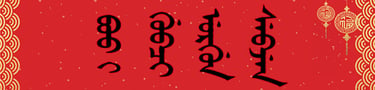
Are There Special Fonts for Manchu Script? Unicode and Calligraphy Guide
Are there special fonts for Manchu? Explore Unicode Manchu fonts, Mongolian Baiti, Noto Sans Mongolian, traditional calligraphy, and digital font compatibility.
MING YE
10/27/20268 min read
Are There Special Fonts for the Manchu Script?
Manchu Unicode Fonts, Traditional Calligraphy, Digital Typography, and the Challenges of Font Design
By MING YE
Are there fonts specifically designed for the Manchu writing system? Can Manchu be displayed in different typefaces, and are modern digital fonts capable of reproducing traditional Manchu calligraphy?
Yes. Fonts designed specifically for Manchu exist, and some fonts developed for the broader Mongolian writing system also support Manchu characters.
However, Manchu typography is more complicated than ordinary English typography.
The Manchu script is traditionally written vertically. Its letters connect to one another, and many characters change shape according to their position within a word.
These characteristics mean that a Manchu font must do more than provide individual letter shapes.
It must also work with a text-rendering system capable of selecting the correct contextual forms.
Furthermore, not every font that supports traditional Mongolian writing necessarily provides complete or accurate support for Manchu.
Different fonts may vary in their character coverage, shaping behavior, proportions, stroke design, and compatibility with modern software.
For researchers, language learners, educators, and designers, understanding these differences is essential.
A suitable Manchu font must balance three requirements: linguistic accuracy, visual readability, and technical compatibility.
1. What Is a Manchu Font?
A Manchu font is a digital typeface capable of displaying the characters and letter forms used in the Manchu writing system.
Like fonts for other languages, it determines how written characters appear on a screen or printed page.
However, Manchu fonts must accommodate the distinctive structure of the script.
Manchu developed from the traditional Mongolian writing system during the late sixteenth and early seventeenth centuries.
The early script was subsequently modified during the reign of Hong Taiji, particularly through reforms associated with Dahai in 1632.
These developments helped establish the distinctive orthographic conventions of written Manchu.
The script uses connected letters arranged in vertical columns.
Many letters have different initial, medial, and final forms.
Some also require particular graphical distinctions involving dots, circles, and other structural features.
A Manchu font must provide appropriate glyphs for these forms.
It must also cooperate with software that determines which glyphs should appear in a particular sequence.
This is why a Manchu font cannot be evaluated solely by examining its isolated alphabet characters.
The accuracy of complete words is equally important.
2. Are Manchu Fonts Different from Mongolian Fonts?
Manchu and traditional Mongolian use closely related writing systems.
Both are represented within the Mongolian script framework of Unicode.
Consequently, some digital fonts support characters used by both languages.
However, support for Mongolian does not automatically guarantee complete support for Manchu.
The two languages have different phonological systems and orthographic conventions.
Manchu also uses characters and letter forms that are not required for ordinary modern Mongolian text.
A font designed primarily for Mongolian may lack some Manchu-specific glyphs.
It may also implement contextual shaping rules that work for Mongolian but produce incorrect results for certain Manchu sequences.
Conversely, a font designed specifically for Manchu may prioritize the shapes and combinations used in historical Manchu texts.
This distinction is particularly important for educational and scholarly publications.
A font may look visually similar to traditional Manchu while still producing orthographic errors.
Therefore, font selection should be based on actual language support rather than appearance alone.
3. What Manchu Fonts Are Available?
Several digital font projects are relevant to Manchu typography.
Their capabilities differ, and users should verify current versions, licensing terms, and compatibility before selecting a font for a particular project.
Noto Sans Mongolian
Noto Sans Mongolian is part of the Noto font family.
The Noto project aims to provide broad support for the world's writing systems.
Noto Sans Mongolian is designed for the traditional Mongolian script and includes support for characters used in related writing traditions.
It can be useful for displaying Unicode Mongolian-script text, including Manchu characters where the required forms are supported.
However, the presence of Manchu characters in a font does not establish that every historical Manchu spelling or variation sequence will render correctly.
For scholarly work, representative Manchu words should be tested carefully.
Mongolian Baiti
Mongolian Baiti is a font associated with Microsoft Windows.
It supports traditional Mongolian-script characters and is relevant to Manchu text display.
Its availability and behavior depend on the operating system and application.
Because Manchu shares Unicode encoding infrastructure with Mongolian, Mongolian Baiti may be useful for some Manchu documents.
Nevertheless, users should verify the accuracy of Manchu-specific letter forms and contextual shaping.
Manchu-Specific Font Projects
Specialized Manchu fonts have also been developed for educational, scholarly, and cultural purposes.
Some prioritize historical manuscript forms.
Others focus on modern Unicode text entry and digital publishing.
However, not all such fonts use the same encoding model.
Certain older projects rely on custom character mappings rather than standardized Unicode.
These may produce visually recognizable Manchu but are less suitable for searchable, interoperable digital text.
A font's name alone does not establish whether it supports modern Unicode correctly.
The most important questions are whether it uses standard character encoding, supports the necessary Manchu forms, and works reliably with contemporary applications.
4. What Is the Difference Between a Unicode Font and a Traditional Custom Font?
This distinction is fundamental to digital Manchu typography.
A Unicode font displays characters that have standardized code points.
The underlying text remains identifiable independently of the font.
For example, a Manchu character retains its Unicode identity when copied between compatible applications.
A traditional custom-font system may work differently.
Some older Manchu fonts were designed by replacing the visual appearance of ordinary Latin characters with Manchu-looking glyphs.
In such systems, the computer may internally store Latin letters even though the document appears to contain Manchu.
This creates several problems.
The text may become unreadable when the original font is unavailable.
Search engines may fail to recognize it as Manchu.
Copying the text into another application may reveal Latin characters or unrelated symbols.
Converting such documents into Unicode requires more than changing the font.
The original character mapping must be identified and translated into standardized Unicode sequences.
For modern educational websites, dictionaries, and archival projects, Unicode-based fonts are generally preferable.
They provide a more reliable foundation for long-term digital preservation.
5. Can Manchu Fonts Reproduce Traditional Calligraphy?
Digital fonts can imitate certain visual characteristics of traditional Manchu calligraphy.
However, a font and an original handwritten work are fundamentally different.
A digital font contains a predefined collection of glyphs.
Its shapes are repeated according to the rules of the font and rendering system.
Traditional calligraphy, by contrast, involves individual decisions concerning brush movement, stroke pressure, rhythm, spacing, and composition.
Even when two handwritten characters represent the same letter, their appearance may differ.
These variations are part of the artistic character of calligraphy.
A font can reproduce selected stylistic features, but it does not automatically reproduce the full expressive range of handwriting.
This distinction is particularly important when discussing Manchu calligraphic traditions.
Historical Manchu writing includes formal documentary styles, manuscript handwriting, and decorative artistic forms.
A font intended for ordinary reading may prioritize clarity and consistency.
A calligraphic typeface may emphasize historical or artistic appearance.
Neither approach is inherently superior.
Their suitability depends on the intended purpose.
For language instruction, accurate and easily distinguishable letter forms are especially important.
For artistic design, visual expression may receive greater emphasis.
However, decorative appearance should not come at the expense of recognizable and linguistically correct characters.
6. Are There Fonts for Manchu Seal Script?
Manchu seal script presents additional challenges for digital typography.
Decorative and seal-script traditions may transform the proportions and structure of conventional Manchu letters.
These transformations can involve geometric arrangements, ornamental strokes, and stylized compositions.
Such designs are not necessarily equivalent to the standard forms used in ordinary Manchu writing.
A conventional Unicode Manchu font is primarily intended to represent the established writing system.
It does not automatically provide every historical or artistic variant.
A Manchu seal-script font would therefore require a carefully designed set of glyphs and rules for representing the intended style.
Some decorative forms may be implemented as alternative glyphs within a font.
Others may be better treated as individual artistic compositions.
This distinction matters because Unicode encodes characters rather than every possible calligraphic design.
A stylized letter does not automatically require a new Unicode code point.
If it represents an existing character, its appearance may be handled through typography.
However, creating a fully functional font for a decorative Manchu style can be difficult when the design does not follow ordinary contextual joining conventions.
A digital Manchu seal-script typeface is therefore both a typographic project and a problem of accurately interpreting historical letter structures.
7. Why Do Some Manchu Fonts Display Letters Incorrectly?
Several technical problems can affect Manchu fonts.
The first is incomplete character coverage.
A font may contain the most common Mongolian-script letters but omit characters required for Manchu.
The second is incorrect contextual shaping.
Manchu letters change form depending on their position and surrounding characters.
A font must provide suitable glyphs and layout rules.
The third involves Unicode variation selectors.
Certain letter forms are represented using defined character sequences involving Mongolian Free Variation Selectors.
If the font or rendering engine does not support these sequences correctly, the displayed result may be wrong.
The fourth problem is software compatibility.
A font may function correctly in one application but fail in another because the programs use different rendering technologies.
Finally, vertical layout introduces additional complications.
A font that works in horizontal text does not necessarily guarantee correct traditional vertical presentation.
These problems demonstrate why visual inspection of isolated characters is insufficient.
A reliable Manchu font should be tested using complete words, varied letter combinations, and representative passages.
8. How Should a Manchu Font Be Evaluated?
The best font depends on its intended use.
For an educational website, readability and reliable Unicode support are particularly important.
For a historical transcription, accurate letter forms and consistency with the source material may be more significant.
For a digital dictionary, character coverage and search compatibility are essential.
For artistic design, visual style becomes an additional consideration.
A useful evaluation framework includes the following criteria:
CriterionWhy It MattersUnicode compatibilityEnsures standardized character representationManchu character coverageSupports letters and forms required by the languageContextual shapingProduces correct initial, medial, and final formsVariation selector supportHandles defined alternative glyph formsVertical writing compatibilitySupports traditional Manchu text layoutCross-platform renderingImproves consistency between devicesReadabilityHelps learners distinguish similar lettersLicensingDetermines whether the font can be embedded or distributedHistorical accuracyMatters for scholarly and calligraphic applications
No single font should be assumed to satisfy every requirement without testing.
In particular, a font suitable for decorative artwork may not be the best choice for a searchable dictionary.
Likewise, a font that works well in a desktop publishing application may require additional testing before being used on a website.
Conclusion: Are There Special Fonts for the Manchu Script?
Yes. Manchu-specific fonts exist, and some fonts developed for traditional Mongolian writing also support Manchu characters.
Modern Unicode technology makes it possible to display Manchu as genuine digital text rather than relying entirely on images or proprietary character mappings.
However, Manchu typography remains technically demanding.
Its connected letters, contextual forms, variation sequences, and vertical writing direction require appropriate font design and text-rendering support.
Not every Mongolian font provides complete Manchu compatibility.
Similarly, not every visually attractive Manchu typeface is suitable for scholarly or educational use.
Traditional Manchu calligraphy introduces further distinctions between standardized digital typography and individual artistic expression.
The essential question is not simply whether a font contains Manchu-looking letters, but whether it represents the language accurately and works reliably in modern digital environments.
The continued development of high-quality Manchu fonts is therefore important for language education, historical research, digital archives, and cultural preservation.
Reliable typography allows Manchu to remain accessible not only as a historical writing system but also as a language that can be studied, published, and used through modern technology.
— MING YE
References and Research Materials
Technical Standards and Font Resources
Unicode Consortium, The Unicode Standard, Chapter 13, Section 13.5: Mongolian. Documentation of the Unicode encoding framework used for Manchu.
Unicode Consortium, Mongolian Code Chart, U+1800–U+18AF. Official character names and code points.
Unicode Consortium, Unicode Technical Note #57: Encoding and Shaping of the Mongolian Script (2024).
Unicode Consortium, Unicode Technical Report #54: Unicode Mongolian 12.1 Snapshot (2019).
Google Fonts, Noto Sans Mongolian. Font project and distribution information.
Microsoft, Mongolian Baiti Font Family. Font information and platform support.
Microsoft, OpenType Specification. Technical documentation concerning font shaping and glyph substitution.
HarfBuzz Project, HarfBuzz Documentation. Text-rendering and complex-script shaping.
World Wide Web Consortium (W3C), CSS Writing Modes Level 3. Vertical text-layout specifications.
Historical and Linguistic References
Gertraude Roth Li, Manchu: A Textbook for Reading Documents (2000).
Jerry Norman, A Comprehensive Manchu-English Dictionary (2013).
Liliya M. Gorelova, Manchu Grammar (2002).
Mark C. Elliott, The Manchu Way: The Eight Banners and Ethnic Identity in Late Imperial China (2001).
First Historical Archives of China. Qing Manchu-language manuscripts and historical documents.
National Palace Museum, Taipei. Manchu-language archival materials and historical writing examples.