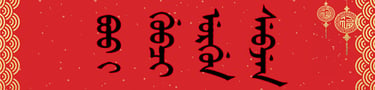
A Longtime U.S. Collector Commissions Large-Scale Manchu–Chinese Calligraphy by Ming Ye
From handwritten Manchu Spring Festival couplets in 2021 to a new large-scale bilingual commission, a cultural connection that has continued for years
MING YE
10/7/20263 min read
In the fall of 2026, calligraphy artist Ming Ye (pen name: Yehenara Yulin) completed a new private commission for a longtime collector in the United States. The project included a large-scale Manchu–Chinese bilingual calligraphy work, together with a pair of vertical couplets and a horizontal inscription combining Manchu and Chinese writing.
This commission did not begin with a recent introduction.
Ming Ye first became acquainted with the collector around 2021. At the time, the collector was still a student living in the United States, while Ming Ye was working in China.
Over the following years, Ming Ye sent handwritten Manchu Spring Festival couplets, calligraphy works, and other cultural items featuring Manchu script from China to the United States.
As time passed, their connection gradually developed beyond a simple relationship between artist and buyer.
The collector has maintained a long-term interest in Manchu history, language, and traditional culture. He has also introduced Manchu culture to American friends and colleagues, showing them examples of Ming Ye’s handwritten Manchu calligraphy and explaining some of the history behind the script.
For many people encountering Manchu writing for the first time, the script itself immediately creates curiosity.
Even without being able to read the words, viewers often notice its vertical structure, distinctive letterforms, and the rhythm created by brush and ink.
That moment — seeing the writing first and then asking about the culture behind it — is something Ming Ye has increasingly observed while presenting Manchu calligraphy in the United States.
A Connection That Continued from China to the United States
In 2021, the artist and collector were living on opposite sides of the Pacific.
Several years later, Ming Ye had moved to the United States and continued his calligraphy practice, cultural activities, and research there. The collector, once a student, had also entered professional life.
Their locations and circumstances changed, but the connection formed through Manchu calligraphy continued.
For Ming Ye, this new large-scale commission therefore represents more than another completed artwork. It also records a cultural relationship that has developed across several years and across both China and the United States.
Manchu and Chinese Writing in the Same Artwork
The new works continue one of Ming Ye’s long-standing creative approaches: Manchu–Chinese bilingual calligraphy.
Manchu and Chinese writing have very different visual structures.
Chinese calligraphy emphasizes the internal structure and balance of individual characters, while traditional Manchu writing is vertically connected and develops through continuous flowing forms.
When the two writing systems appear together within the same artwork, they can communicate related meanings while creating distinctly different visual rhythms.
This combination reflects one of Ming Ye’s continuing artistic interests:
not only preserving Manchu script, but allowing it to enter contemporary visual spaces again.
In the United States, this approach also creates another kind of cultural encounter.
Viewers do not need to speak Manchu or Chinese before responding to the artwork. They can first experience the forms, ink, brush movement, and visual contrast, and then gradually learn more about the history and culture represented by the writing.
An Artwork as a Record of Cultural Exchange
For Ming Ye, private commissions like this also carry another kind of meaning.
A calligraphy work may eventually hang in a home, an office, or another everyday space where people who have never encountered Manchu writing before may see it for the first time.
Cultural exchange does not always begin inside a museum or classroom.
Sometimes it begins with a friend showing another friend a piece of calligraphy, an artwork hanging on an office wall, or a simple question:
“What language is this?”
That question can become the beginning of a much larger conversation.
This private commission was completed in 2026.
Private Commission — Not for Sale


